Department of Molecular Physiology and Biological Physics, University of Virginia, Charlottesville, Virginia, United States of America.
PLoS One. 2013;8(3):e58703. doi: 10.1371/journal.pone.0058703. Epub 2013 Mar 13.
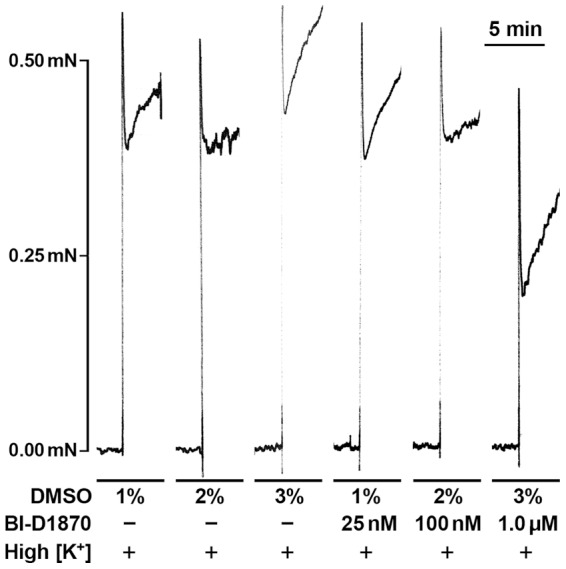
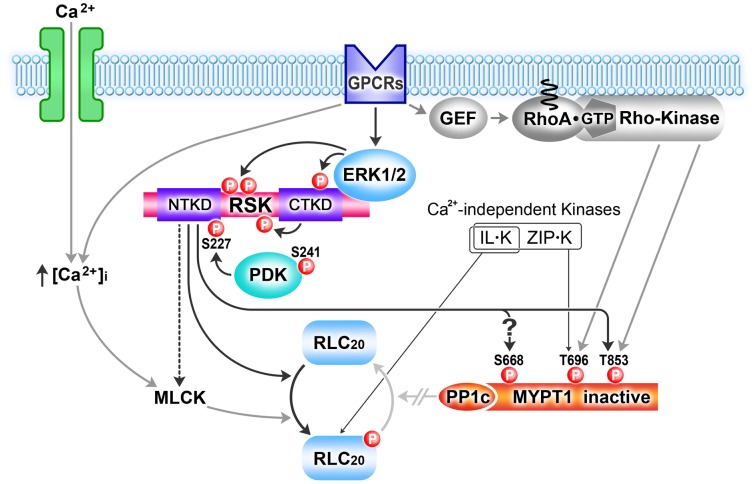
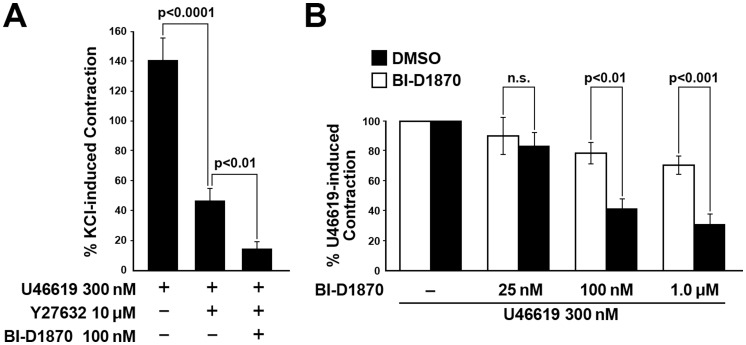
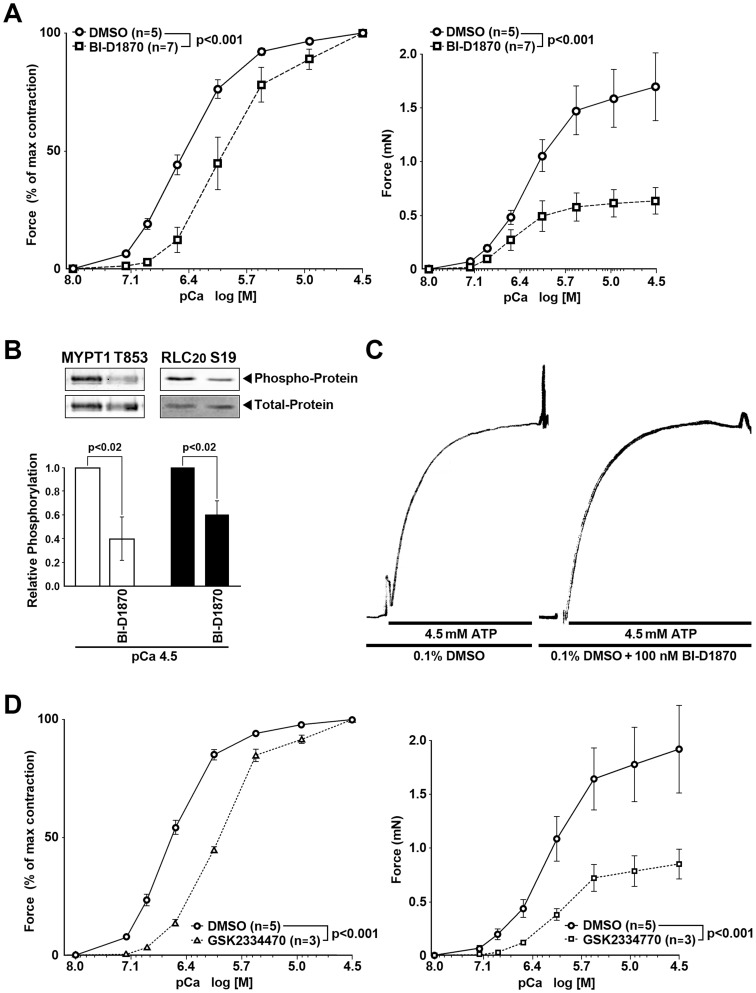
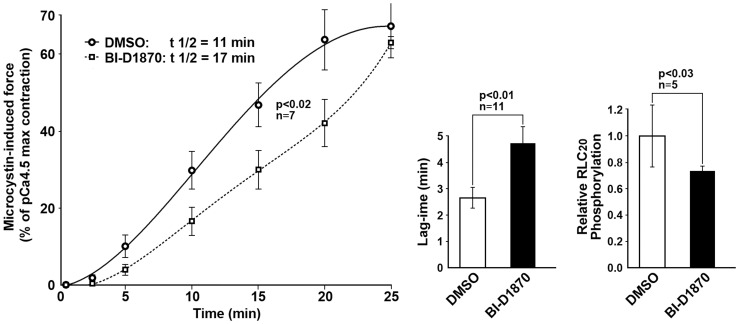
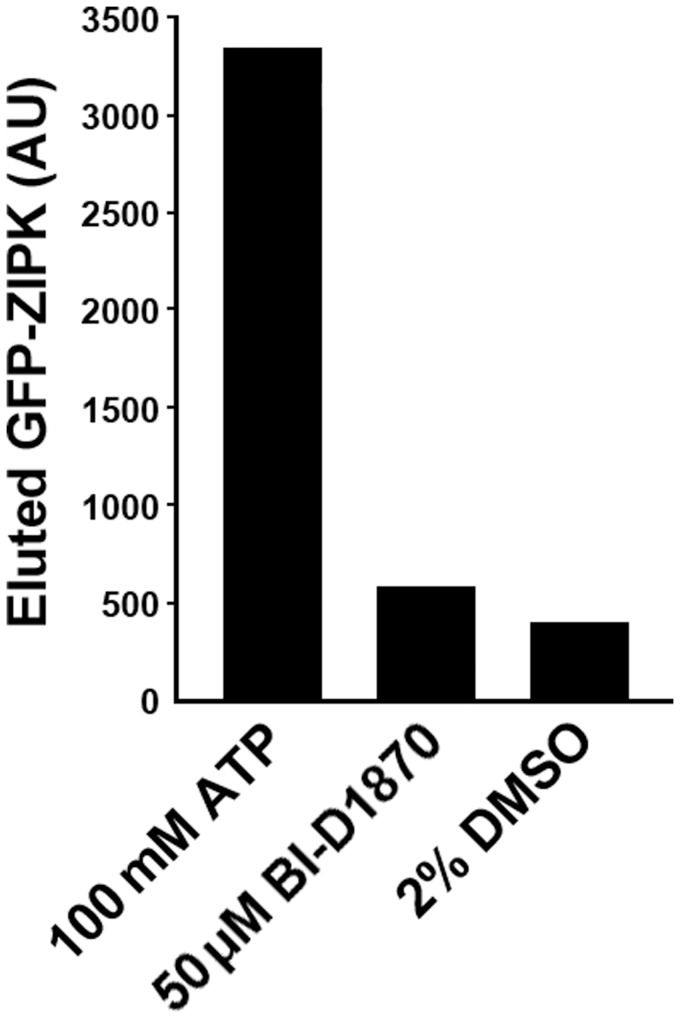
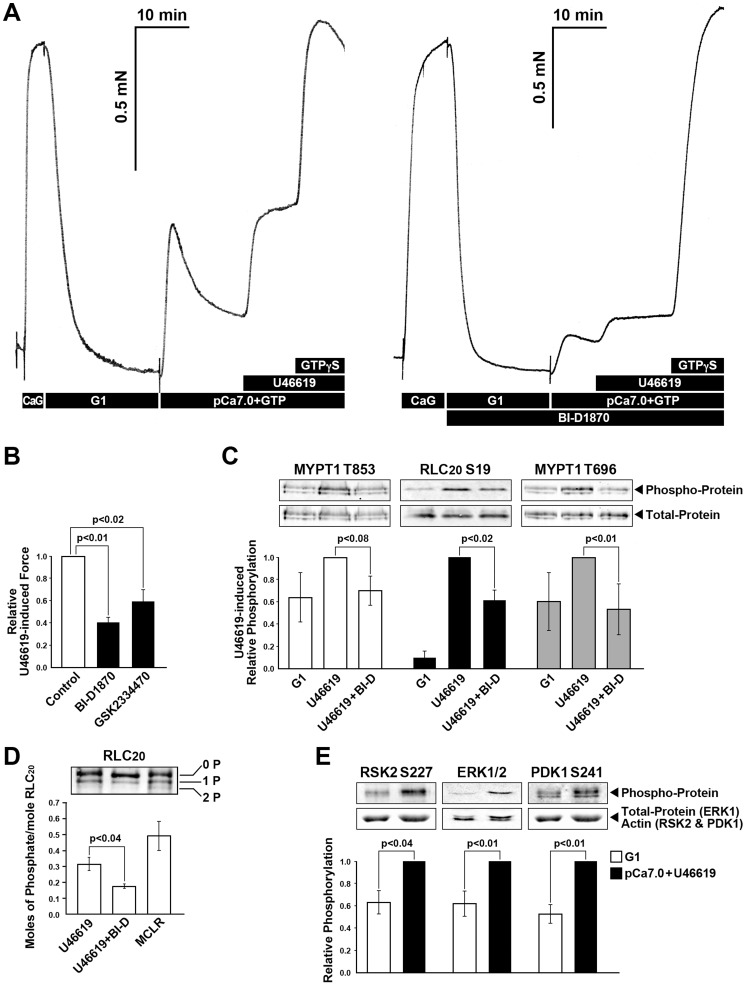
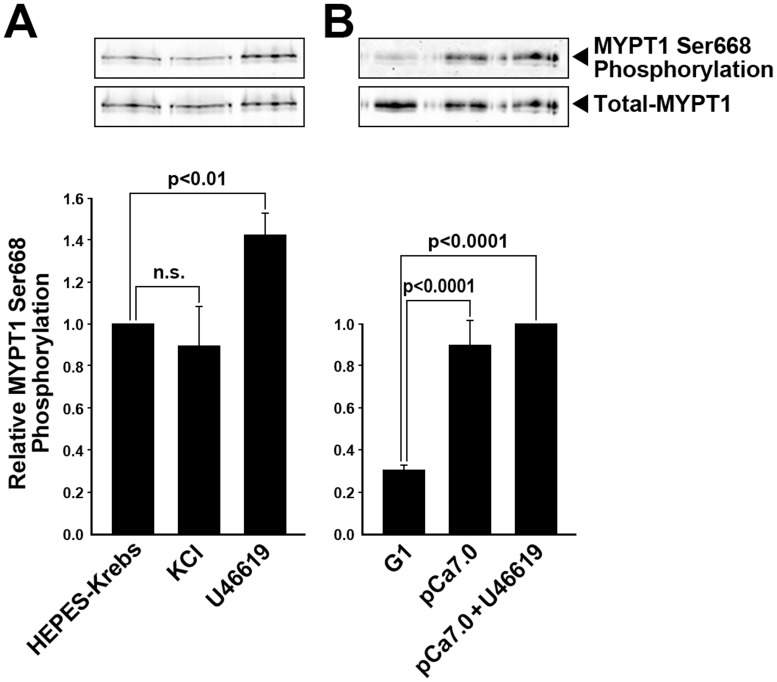
In the canonical model of smooth muscle (SM) contraction, the contractile force is generated by phosphorylation of the myosin regulatory light chain (RLC20) by the myosin light chain kinase (MLCK). Moreover, phosphorylation of the myosin targeting subunit (MYPT1) of the RLC20 phosphatase (MLCP) by the RhoA-dependent ROCK kinase, inhibits the phosphatase activity and consequently inhibits dephosphorylation of RLC20 with concomitant increase in contractile force, at constant intracellular [Ca(2+)]. This pathway is referred to as Ca(2+)-sensitization. There is, however, emerging evidence suggesting that additional Ser/Thr kinases may contribute to the regulatory pathways in SM. Here, we report data implicating the p90 ribosomal S6 kinase (RSK) in SM contractility. During both Ca(2+)- and agonist (U46619) induced SM contraction, RSK inhibition by the highly selective compound BI-D1870 (which has no effect on MLCK or ROCK) resulted in significant suppression of contractile force. Furthermore, phosphorylation levels of RLC20 and MYPT1 were both significantly decreased. Experiments involving the irreversible MLCP inhibitor microcystin-LR, in the absence of Ca(2+), revealed that the decrease in phosphorylation levels of RLC20 upon RSK inhibition are not due solely to the increase in the phosphatase activity, but reflect direct or indirect phosphorylation of RLC20 by RSK. Finally, we show that agonist (U46619) stimulation of SM leads to activation of extracellular signal-regulated kinases ERK1/2 and PDK1, consistent with a canonical activation cascade for RSK. Thus, we demonstrate a novel and important physiological function of the p90 ribosomal S6 kinase, which to date has been typically associated with the regulation of gene expression.
在经典的平滑肌(SM)收缩模型中,肌球蛋白轻链激酶(MLCK)使肌球蛋白调节轻链(RLC20)磷酸化,从而产生收缩力。此外,RhoA 依赖性 ROCK 激酶使 RLC20 磷酸酶(MLCP)的肌球蛋白靶向亚基(MYPT1)磷酸化,抑制磷酸酶活性,从而抑制 RLC20 的去磷酸化,同时伴随着收缩力的增加,细胞内 [Ca(2+)]保持不变。该途径称为 Ca(2+)敏化。然而,越来越多的证据表明,其他丝氨酸/苏氨酸激酶可能有助于 SM 中的调节途径。在这里,我们报告的数据表明 p90 核糖体 S6 激酶(RSK)参与 SM 收缩性。在 Ca(2+)和激动剂(U46619)诱导的 SM 收缩过程中,高选择性化合物 BI-D1870(对 MLCK 或 ROCK 没有作用)抑制 RSK,导致收缩力显著抑制。此外,RLC20 和 MYPT1 的磷酸化水平均显著降低。在没有 Ca(2+)的情况下,涉及不可逆的 MLCP 抑制剂微囊藻素-LR 的实验表明,RSK 抑制时 RLC20 磷酸化水平的降低不仅是由于磷酸酶活性的增加,还反映了 RSK 对 RLC20 的直接或间接磷酸化。最后,我们表明激动剂(U46619)刺激 SM 导致细胞外信号调节激酶 ERK1/2 和 PDK1 的激活,与 RSK 的经典激活级联一致。因此,我们证明了 p90 核糖体 S6 激酶的一种新的重要生理功能,迄今为止,它通常与基因表达的调节有关。