Department of Sciences for Health Promotion and Mother-Child Care "G, D'Alessandro", University of Palermo, Via del Vespro 133, I-90127, Palermo, Italy.
Antimicrob Resist Infect Control. 2013 Mar 21;2(1):8. doi: 10.1186/2047-2994-2-8.
Extended spectrum β-lactamases (ESBLs) often associated with resistance to aminoglycosides and fluoroquinolones have recently emerged in community-associated Escherichia coli. The worldwide clonal dissemination of E. coli sequence type (ST)131 is playing a prominent role.We describe an outbreak of colonizations by ESBL-producing E. coli (ESBL-E. coli) in the neonatal intensive care unit (NICU) of the University Hospital, Palermo, Italy.
An epidemiological investigation was conducted with the support of molecular typing. All children admitted to the NICU and colonized by ESBL-E. coli between January and June 2012, were included in the study. Cases were defined as infants colonized by E. coli resistant to third generation cephalosporins and fluoroquinolones. A case-control study was also performed to identify possible risk factors.
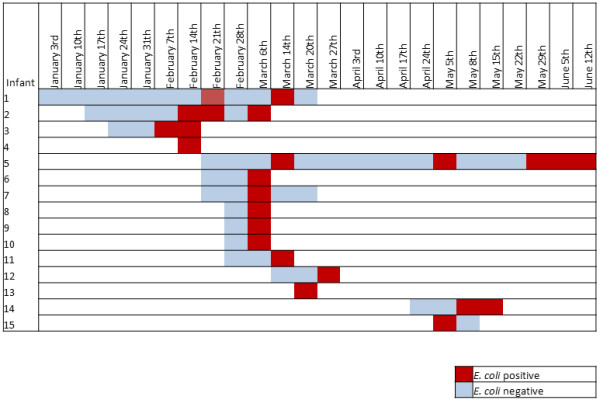
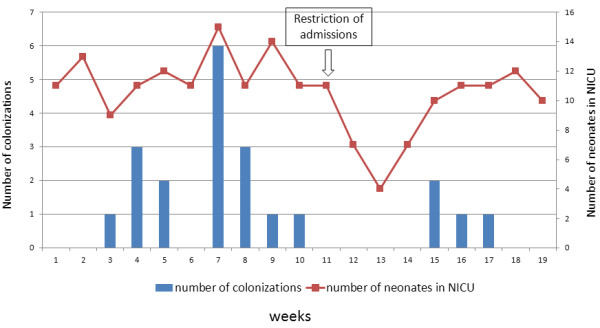
During the outbreak period, 15 infants were found to be colonized by ESBL-E. coli. The epidemic strain demonstrated continuous transmission throughout the outbreak period. Case-control study identified a lower birth weight as the only risk factor for colonization. The strain belonged to the sequence-type 131 community-associated clone. Transmission control interventions, including contact precautions and cohorting, restriction of the new admissions, sanitization of surfaces and equipment and targeted training sessions of the NICU staff, were successful in interrupting the outbreak.
Although invasive infections did not develop in any of the 15 colonized neonates, our report highlights the need to strictly monitor the spill in the NICU setting of multidrug resistant community-associated organisms. Our findings confirm also the role of active surveillance in detecting the silent spread of ESBL-producing Gram negatives in a critical healthcare setting and trigging the implementation of infection control measures. As β-lactam and fluoroquinolone resistant E. coli strains are increasingly spreading in the community, this event could become a more serious challenge.
最近,社区获得性大肠埃希菌中出现了与氨基糖苷类和氟喹诺酮类药物耐药相关的扩展谱β-内酰胺酶(ESBL)。 全球克隆传播的大肠埃希菌序列型(ST)131 发挥着突出的作用。我们描述了意大利巴勒莫大学医院新生儿重症监护病房(NICU)中 ESBL 产大肠埃希菌(ESBL-E. coli)的暴发情况。
在分子分型的支持下进行了流行病学调查。 所有 2012 年 1 月至 6 月期间入住 NICU 并被 ESBL-E. coli 定植的儿童均被纳入研究。病例定义为对第三代头孢菌素和氟喹诺酮类药物耐药的大肠埃希菌定植的婴儿。还进行了病例对照研究以确定可能的危险因素。
在暴发期间,发现 15 名婴儿被 ESBL-E. coli 定植。流行菌株在整个暴发期间持续传播。病例对照研究确定低出生体重是定植的唯一危险因素。该菌株属于序列型 131 社区相关克隆。包括接触预防和分组、限制新入院、表面和设备的消毒以及对 NICU 工作人员的有针对性的培训课程在内的传播控制干预措施成功地中断了暴发。
尽管 15 名定植的新生儿中没有发生侵袭性感染,但我们的报告强调了在 NICU 环境中严格监测耐多药社区获得性生物体溢出的必要性。我们的研究结果还证实了主动监测在检测 ESBL 产革兰氏阴性菌在关键医疗保健环境中沉默传播并触发感染控制措施实施方面的作用。由于β-内酰胺类和氟喹诺酮类耐药的大肠埃希菌菌株在社区中越来越多地传播,这一事件可能成为更严重的挑战。