Henry Ford Hospital, Sleep Disorders and Research Center, Detroit, Michigan, United States of America.
PLoS One. 2013;8(3):e59007. doi: 10.1371/journal.pone.0059007. Epub 2013 Mar 8.
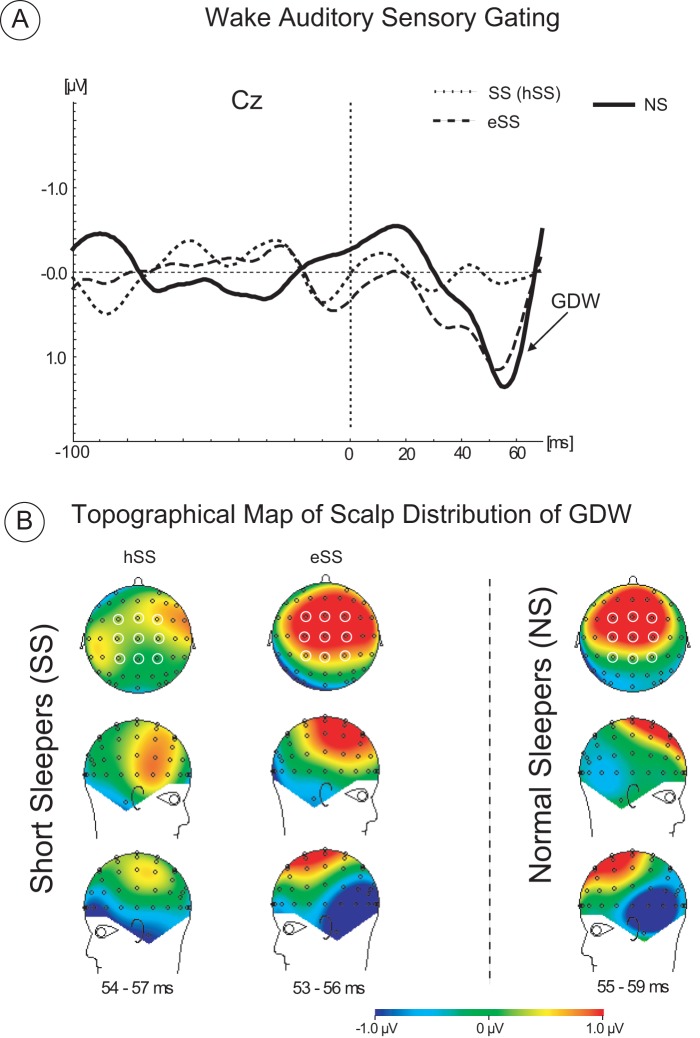
Chronic sleep loss has been associated with increased daytime sleepiness, as well as impairments in memory and attentional processes. In the present study, we evaluated the neuronal changes of a pre-attentive process of wake auditory sensory gating, measured by brain event-related potential (ERP)--P50 in eight normal sleepers (NS) (habitual total sleep time (TST) 7 h 32 m) vs. eight chronic short sleeping individuals (SS) (habitual TST ≤6 h). To evaluate the effect of sleep extension on sensory gating, the extended sleep condition was performed in chronic short sleeping individuals. Thus, one week of time in bed (6 h 11 m) corresponding to habitual short sleep (hSS), and one week of extended time (∼ 8 h 25 m) in bed corresponding to extended sleep (eSS), were counterbalanced in the SS group. The gating ERP assessment was performed on the last day after each sleep condition week (normal sleep and habitual short and extended sleep), and was separated by one week with habitual total sleep time and monitored by a sleep diary. We found that amplitude of gating was lower in SS group compared to that in NS group (0.3 µV vs. 1.2 µV, at Cz electrode respectively). The results of the group × laterality interaction showed that the reduction of gating amplitude in the SS group was due to lower amplitude over the left hemisphere and central-midline sites relative to that in the NS group. After sleep extension the amplitude of gating increased in chronic short sleeping individuals relative to their habitual short sleep condition. The sleep condition × frontality interaction analysis confirmed that sleep extension significantly increased the amplitude of gating over frontal and central brain areas compared to parietal brain areas.
慢性睡眠缺失与日间嗜睡增加以及记忆和注意力过程受损有关。在本研究中,我们评估了一种非注意过程的神经元变化,即通过脑事件相关电位(ERP)测量的觉醒听觉感觉门控,P50 在 8 名正常睡眠者(NS)(习惯性总睡眠时间(TST)为 7 小时 32 分钟)与 8 名慢性短睡眠者(SS)(习惯性 TST≤6 小时)之间。为了评估睡眠延长对感觉门控的影响,对慢性短睡眠者进行了睡眠延长实验。因此,在 SS 组中,将一周的卧床时间(6 小时 11 分钟)对应于习惯性短睡眠(hSS),一周的延长时间(约 8 小时 25 分钟)对应于延长睡眠(eSS),这两种情况是相互平衡的。在每个睡眠条件周(正常睡眠和习惯性短睡眠及延长睡眠)的最后一天进行门控 ERP 评估,并在一周后用习惯性总睡眠时间进行分离,同时通过睡眠日记进行监测。我们发现,与 NS 组相比,SS 组的门控 ERP 振幅较低(0.3µV 对 1.2µV,在 Cz 电极)。组×侧别交互作用的结果表明,SS 组门控振幅的降低是由于左侧和中央中线部位的振幅低于 NS 组。在睡眠延长后,慢性短睡眠者的门控振幅相对于其习惯性短睡眠条件有所增加。睡眠条件×额区交互作用分析证实,与顶区相比,睡眠延长显著增加了额区和中央脑区的门控振幅。