Agrawal Toshy, Kotasthane Anil S
Department of Plant Molecular Biology and Biotechnology, Indira Gandhi Krishi Vishwavidyalaya, Raipur, 492 006 Chhattisgarh, India.
Springerplus. 2012 Dec;1(1):73. doi: 10.1186/2193-1801-1-73. Epub 2012 Dec 20.
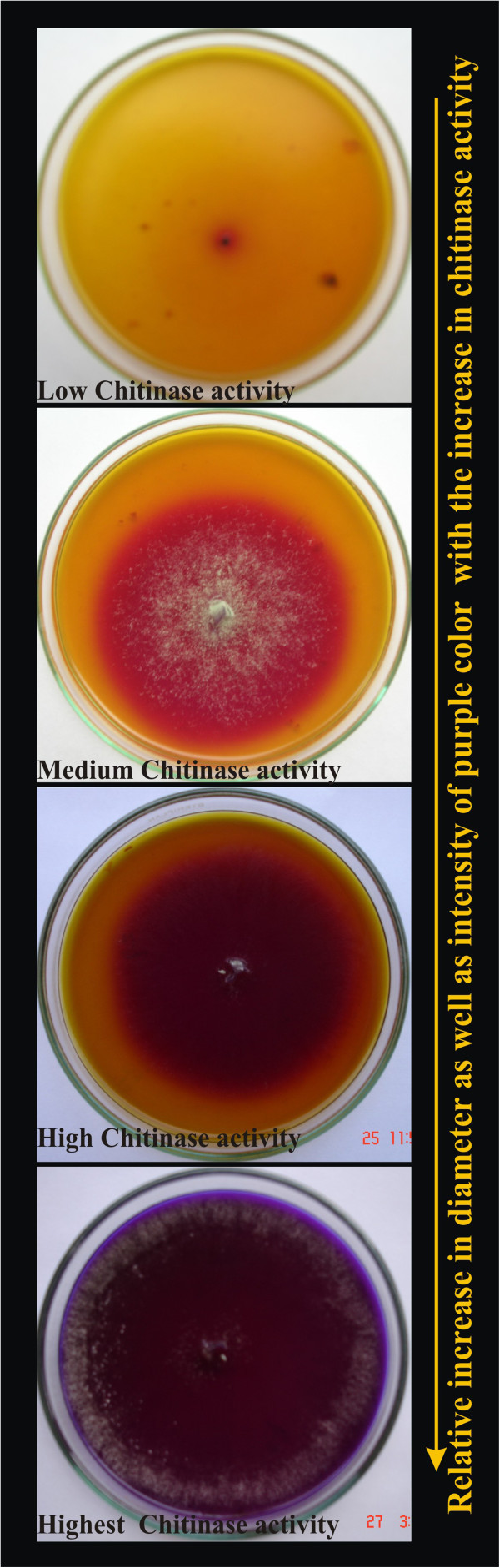
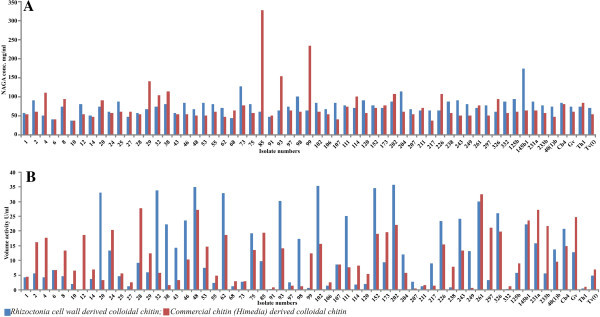
Chitin is the second most abundant polymer in nature after cellulose and plays a major role in fungal cell walls. As a producer of variety of chitinase enzymes Trichoderma has become an important means of biological control of fungal diseases. A simple and sensitive method based on the use of basal medium with colloidal chitin as sole carbon source supplemented with Bromo cresol purple (pH indicator dye) is proposed to evaluate large populations of Trichoderma for chitinase activity. The soluble substrate with pH indicator dye (Bromo cresol purple, BCP) for the assay of chitinase activity on solid media is sensitive, easy, reproducible semi-quantitative enzyme diffusion plate assay and economic option to determine chitinases. Colloidal chitin derived from Rhizoctonia cell wall and commercial chitin included as a carbon source in broth also allowed selection and comparison of chitinolytic and exochitinase activity in Trichoderma spectrophotometrically. Released N-acetyl-β--D-glucosamine (NAGA) ranged from 37.67 to 174.33 mg/ml and 37.67 to 327.67 mg/ml and p-nitrophenol (pNP) ranged from 0.17 to 35.78 X 10(-3) U/ml and 0.62 to 32.6 X 10(-3) U/ml) respectively with Rhizoctonia cell wall and commercial chitin derived colloidal chitin supplemented broth.
几丁质是自然界中仅次于纤维素的第二丰富的聚合物,在真菌细胞壁中起主要作用。作为多种几丁质酶的生产者,木霉已成为真菌病害生物防治的重要手段。本文提出了一种简单灵敏的方法,以含有胶体几丁质作为唯一碳源并添加溴甲酚紫(pH指示染料)的基础培养基来评估大量木霉的几丁质酶活性。用于在固体培养基上测定几丁质酶活性的带有pH指示染料(溴甲酚紫,BCP)的可溶性底物是一种灵敏、简便、可重复的半定量酶扩散平板测定法,也是测定几丁质酶的经济选择。来源于立枯丝核菌细胞壁的胶体几丁质和作为肉汤中碳源的商业几丁质,也能够通过分光光度法选择和比较木霉中的几丁质分解活性和外几丁质酶活性。以立枯丝核菌细胞壁和商业几丁质衍生的胶体几丁质补充肉汤时,释放的N-乙酰-β-D-葡萄糖胺(NAGA)分别为37.67至174.33mg/ml和37.67至327.67mg/ml,对硝基苯酚(pNP)分别为0.17至35.78×10⁻³U/ml和0.62至32.6×10⁻³U/ml。