Department of Otolaryngology, University of California Irvine, Irvine, California, United States of America.
PLoS One. 2013;8(3):e59815. doi: 10.1371/journal.pone.0059815. Epub 2013 Mar 19.
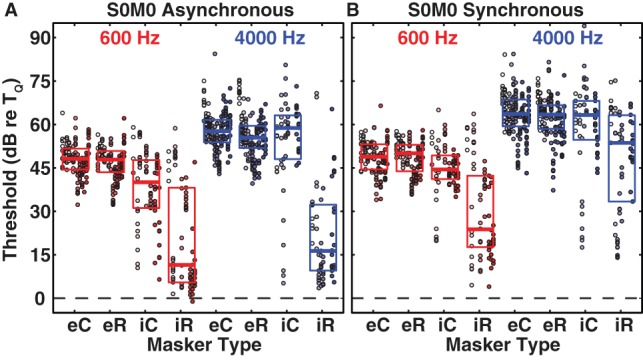
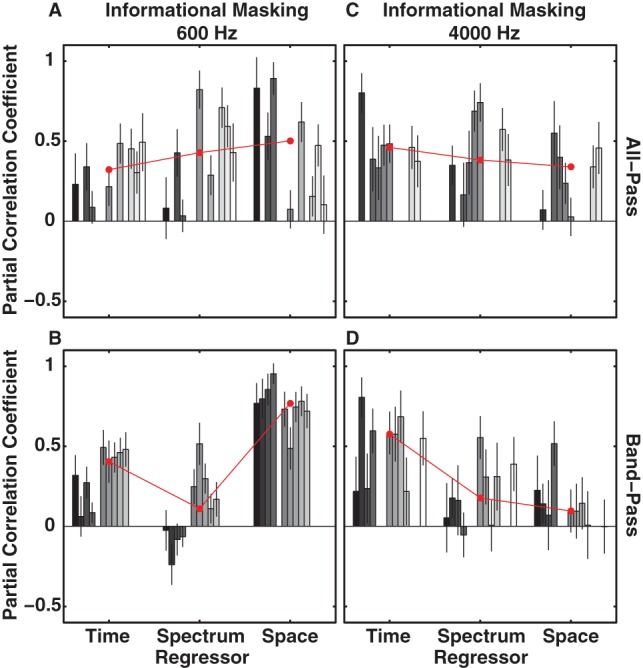
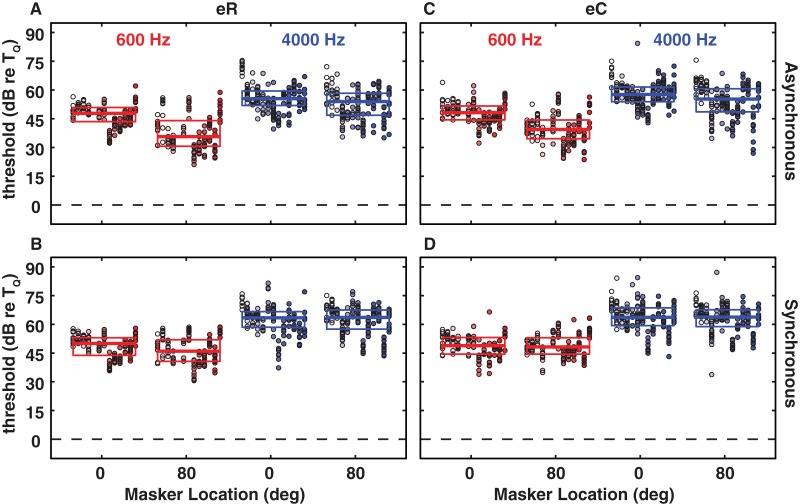
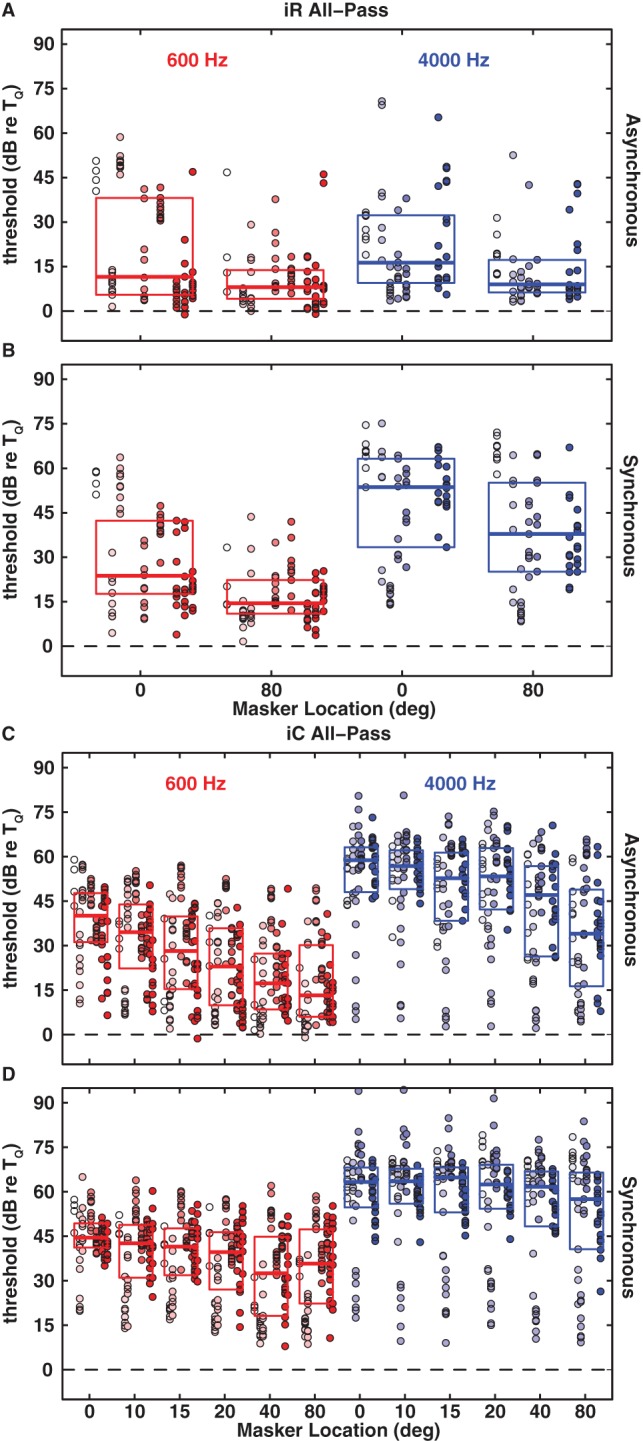
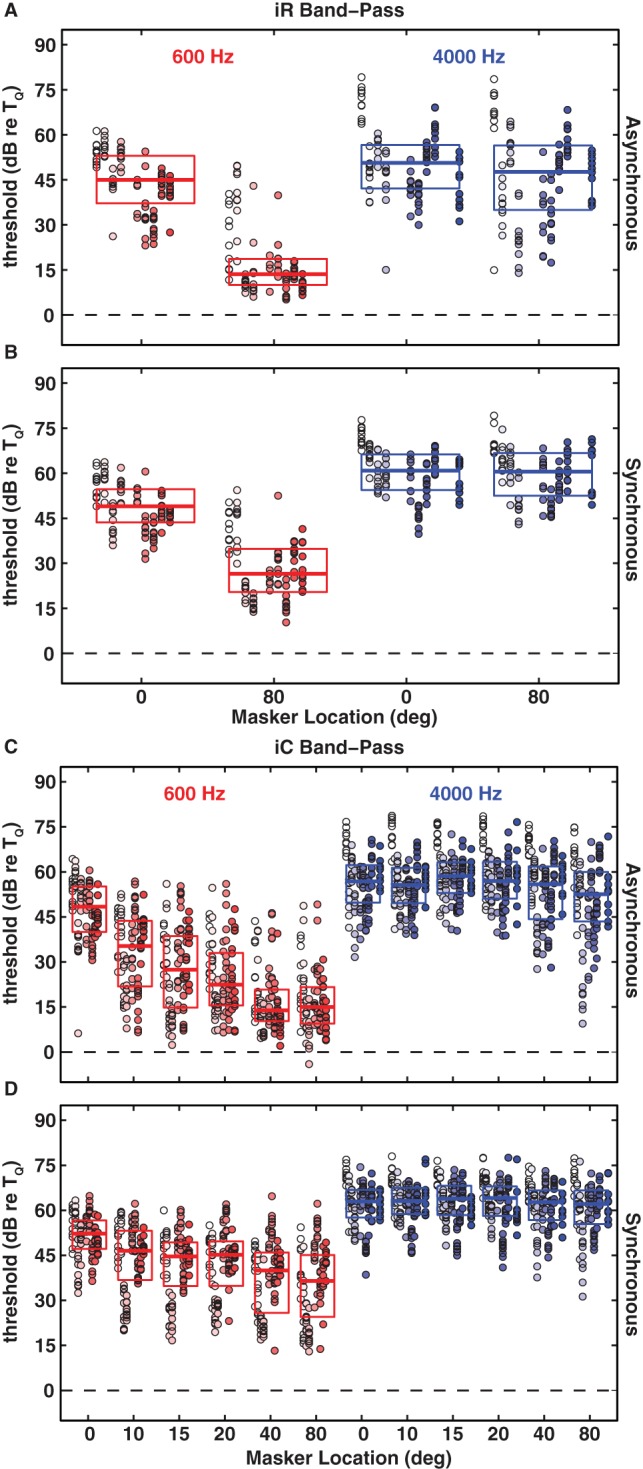
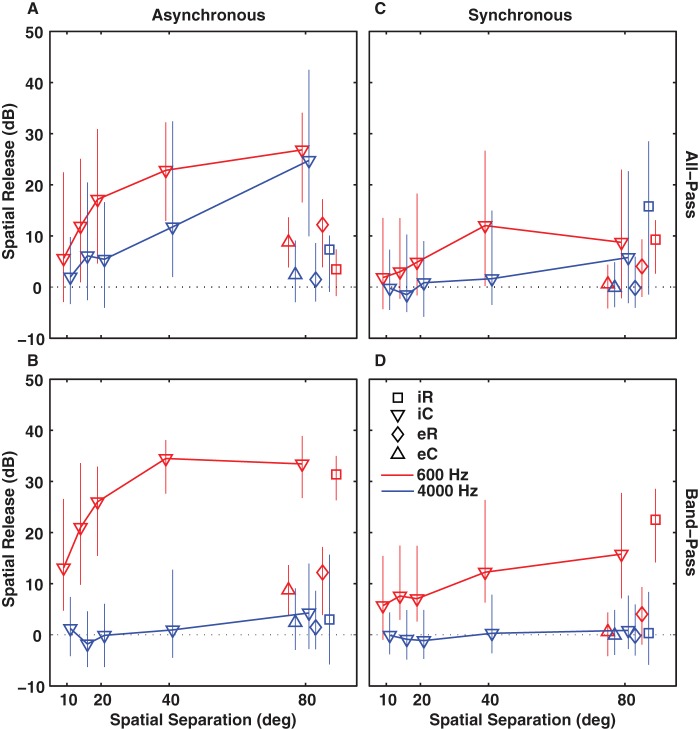
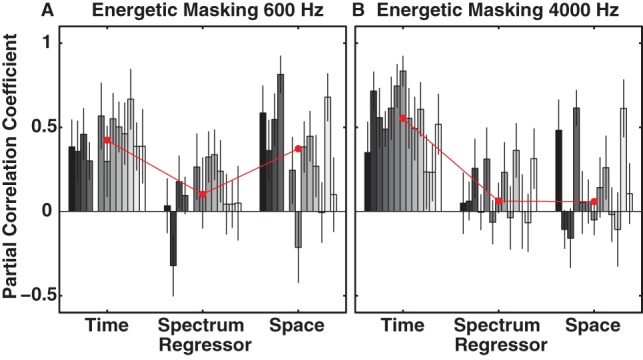
The auditory system creates a neuronal representation of the acoustic world based on spectral and temporal cues present at the listener's ears, including cues that potentially signal the locations of sounds. Discrimination of concurrent sounds from multiple sources is especially challenging. The current study is part of an effort to better understand the neuronal mechanisms governing this process, which has been termed "auditory scene analysis". In particular, we are interested in spatial release from masking by which spatial cues can segregate signals from other competing sounds, thereby overcoming the tendency of overlapping spectra and/or common temporal envelopes to fuse signals with maskers. We studied detection of pulsed tones in free-field conditions in the presence of concurrent multi-tone non-speech maskers. In "energetic" masking conditions, in which the frequencies of maskers fell within the ± 1/3-octave band containing the signal, spatial release from masking at low frequencies (600 Hz) was found to be about 10 dB. In contrast, negligible spatial release from energetic masking was seen at high frequencies (4000 Hz). We observed robust spatial release from masking in broadband "informational" masking conditions, in which listeners could confuse signal with masker even though there was no spectral overlap. Substantial spatial release was observed in conditions in which the onsets of the signal and all masker components were synchronized, and spatial release was even greater under asynchronous conditions. Spatial cues limited to high frequencies (>1500 Hz), which could have included interaural level differences and the better-ear effect, produced only limited improvement in signal detection. Substantially greater improvement was seen for low-frequency sounds, for which interaural time differences are the dominant spatial cue.
听觉系统基于听众耳朵处存在的频谱和时间线索,包括潜在地指示声音位置的线索,创建声学世界的神经元表示。来自多个声源的声音的同时辨别尤其具有挑战性。本研究是努力更好地理解控制这一过程的神经元机制的一部分,该过程被称为“听觉场景分析”。特别是,我们有兴趣研究通过空间线索来解除掩蔽的机制,该机制可以将信号与其他竞争声音分开,从而克服重叠频谱和/或共同时间包络使信号与掩蔽器融合的趋势。我们在自由场条件下研究了在同时存在多音非语音掩蔽器的情况下脉冲音调的检测。在“能量”掩蔽条件下,掩蔽器的频率落在包含信号的±1/3 倍频程带内,低频(约 600Hz)时的掩蔽解除空间释放约为 10dB。相比之下,高频(约 4000Hz)时几乎没有能量掩蔽的空间释放。在宽带“信息”掩蔽条件下,我们观察到了强大的掩蔽解除空间释放,即使信号和掩蔽器之间没有频谱重叠,听众也可以将信号与掩蔽器混淆。在信号和所有掩蔽器分量的起始同步的情况下,观察到了相当大的空间释放,并且在异步情况下空间释放更大。仅包括高频(>1500Hz)的空间线索,包括耳间水平差异和更好耳朵效应,只能对信号检测产生有限的改善。对于低频声音,空间线索主要是耳间时间差,其改善幅度要大得多。