Department of Psychiatry, University of Michigan, Ann Arbor, MI 48109, USA.
JAMA Intern Med. 2013 Apr 22;173(8):657-62; discussion 663. doi: 10.1001/jamainternmed.2013.351.
In 2003, the first phase of duty hour requirements for US residency programs recommended by the Accreditation Council for Graduate Medical Education (ACGME) was implemented. Evidence suggests that this first phase of duty hour requirements resulted in a modest improvement in resident well-being and patient safety. To build on these initial changes, the ACGME recommended a new set of duty hour requirements that took effect in July 2011.
To determine the effects of the 2011 duty hour reforms on first-year residents (interns) and their patients.
As part of the Intern Health Study, we conducted a longitudinal cohort study comparing interns serving before (2009 and 2010) and interns serving after (2011) the implementation of the new duty hour requirements.
Fifty-one residency programs at 14 university and community-based GME institutions.
A total of 2323 medical interns.
Self-reported duty hours, hours of sleep, depressive symptoms, well-being, and medical errors at 3, 6, 9, and 12 months of the internship year.
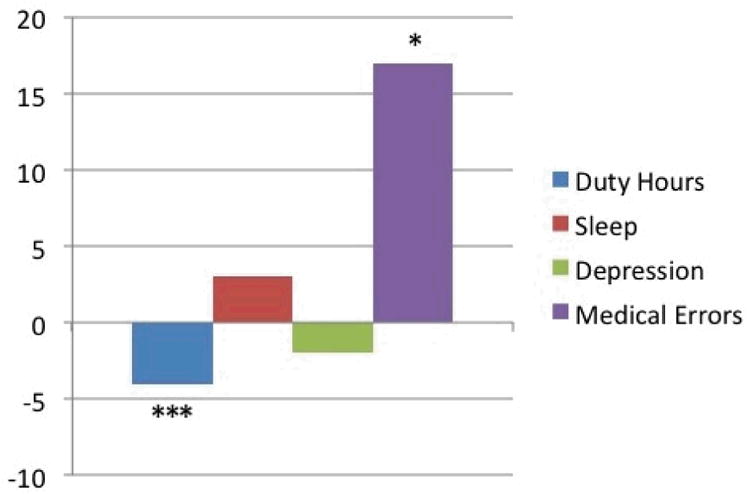
Fifty-eight percent of invited interns chose to participate in the study. Reported duty hours decreased from an average of 67.0 hours per week before the new rules to 64.3 hours per week after the new rules were instituted (P < .001). Despite the decrease in duty hours, there were no significant changes in hours slept (6.8 → 7.0; P = .17), depressive symptoms (5.8 → 5.7; P = .55) or well-being score (48.5 → 48.4; P = .86) reported by interns. With the new duty hour rules, the percentage of interns who reported concern about making a serious medical error increased from 19.9% to 23.3% (P = .007).
Although interns report working fewer hours under the new duty hour restrictions, this decrease has not been accompanied by an increase in hours of sleep or an improvement in depressive symptoms or well-being but has been accompanied by an unanticipated increase in self-reported medical errors.
2003 年,美国住院医师规范化培训认证委员会(ACGME)实施了第一阶段的住院医师工作时间要求。有证据表明,这第一阶段的工作时间要求导致住院医师的幸福感和患者安全有适度的改善。为了在此基础上进一步改进,ACGME 推荐了一套新的工作时间要求,该要求于 2011 年 7 月生效。
确定 2011 年工作时间改革对第一年住院医师(实习生)及其患者的影响。
作为实习医生健康研究的一部分,我们进行了一项纵向队列研究,比较了在新工作时间要求实施之前(2009 年和 2010 年)和实施之后(2011 年)服务的实习生。
14 个大学和社区的住院医师规范化培训机构的 51 个住院医师培训计划。
共有 2323 名医学实习生。
在实习年度的 3、6、9 和 12 个月时,自我报告的工作时间、睡眠时间、抑郁症状、幸福感和医疗错误。
邀请的实习生中有 58%选择参与研究。报告的工作时间从新规定前的每周平均 67.0 小时减少到新规定实施后的每周 64.3 小时(P <.001)。尽管工作时间减少了,但实习生报告的睡眠时间(6.8→7.0;P =.17)、抑郁症状(5.8→5.7;P =.55)或幸福感评分(48.5→48.4;P =.86)没有显著变化。在新的工作时间规定下,报告对犯严重医疗错误感到担忧的实习生比例从 19.9%增加到 23.3%(P =.007)。
尽管根据新的工作时间限制,实习生报告的工作时间减少了,但这一减少并没有伴随着睡眠时间的增加或抑郁症状或幸福感的改善,而是伴随着自我报告的医疗错误的意外增加。