Department of Microbiology and Immunology, South Carolina Clinical and Translational Research Institute (SCTR), Medical University of South Carolina, Charleston, South Carolina, United States of America.
PLoS One. 2013;8(3):e57911. doi: 10.1371/journal.pone.0057911. Epub 2013 Mar 25.
Immune evasion is one of the recognized hallmarks of cancer. Inflammatory responses to cancer can also contribute directly to oncogenesis. Since the immune system is hardwired to protect the host, there is a possibility that cancers, regardless of their histological origins, endow themselves with a common and shared inflammatory cancer-associated molecular pattern (iCAMP) to promote oncoinflammation. However, the definition of iCAMP has not been conceptually and experimentally investigated.
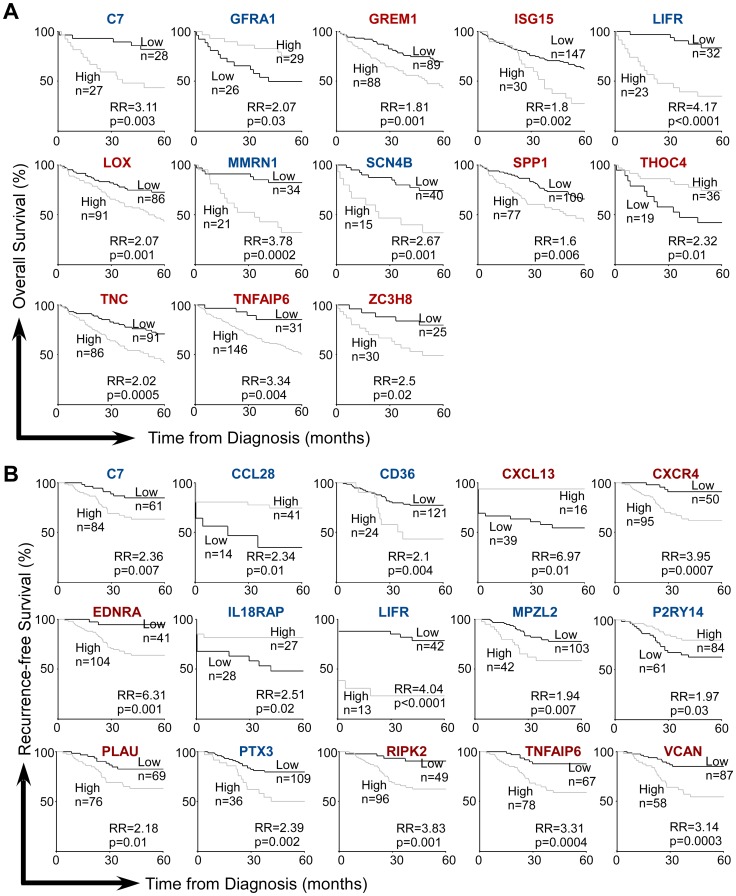
Genome-wide cDNA expression data was analyzed for 221 normal and 324 cancer specimens from 7 cancer types: breast, prostate, lung, colon, gastric, oral and pancreatic. A total of 96 inflammatory genes with consistent dysregulation were identified, including 44 up-regulated and 52 down-regulated genes. Protein expression was confirmed by immunohistochemistry for some of these genes. The iCAMP contains proteins whose roles in cancer have been implicated and others which are yet to be appreciated. The clinical significance of many iCAMP genes was confirmed in multiple independent cohorts of colon and ovarian cancer patients. In both cases, better prognosis correlated strongly with high CXCL13 and low level of GREM1, LOX, TNFAIP6, CD36, and EDNRA. An "Inflammatory Gene Integrated Score" was further developed from the combination of 18 iCAMP genes in ovarian cancer, which predicted overall survival. Noticeably, as a selective nuclear import protein whose immuno-regulatory function just begins to emerge, karyopherin alpha 2 (KPNA2) is uniformly up-regulated across cancer types. For the first time, the cancer-specific up-regulation of KPNA2 and its clinical significance were verified by tissue microarray analysis in colon and head-neck cancers.
This work defines an inflammatory signature shared by seven epithelial cancer types and KPNA2 as a consistently up-regulated protein in cancer. Identification of iCAMP may not only serve as a novel biomarker for prognostication and individualized treatment of cancer, but also have significant biological implications.
免疫逃避是癌症的公认特征之一。对癌症的炎症反应也可以直接促进肿瘤发生。由于免疫系统是为了保护宿主而存在的,因此无论癌症的组织起源如何,都有可能赋予自己一种共同的、共享的炎症相关的肿瘤分子模式(iCAMP),以促进肿瘤炎症。然而,iCAMP 的定义在概念和实验上尚未得到研究。
对来自 7 种癌症类型(乳腺、前列腺、肺、结肠、胃、口腔和胰腺)的 221 个正常和 324 个癌症标本进行了全基因组 cDNA 表达数据分析。共鉴定出 96 个具有一致失调的炎症基因,包括 44 个上调基因和 52 个下调基因。其中一些基因的蛋白表达通过免疫组织化学得到了证实。iCAMP 包含了一些在癌症中作用已被牵连的蛋白质,还有一些尚未被认识到的蛋白质。许多 iCAMP 基因的临床意义在多个独立的结肠癌和卵巢癌患者队列中得到了证实。在这两种情况下,更好的预后与 CXCL13 高和 GREM1、LOX、TNFAIP6、CD36 和 EDNRA 低水平密切相关。进一步从卵巢癌中 18 个 iCAMP 基因的组合中开发了一种“炎症基因综合评分”,该评分可以预测总生存期。值得注意的是,作为一种选择性核输入蛋白,其免疫调节功能才刚刚开始显现,核转运蛋白 α 2(KPNA2)在所有癌症类型中均呈上调表达。首次通过结肠癌和头颈部癌症的组织微阵列分析验证了 KPNA2 在癌症中的特异性上调及其临床意义。
这项工作定义了七种上皮癌类型共有的炎症特征,并将 KPNA2 确定为一种在癌症中持续上调的蛋白质。iCAMP 的鉴定不仅可以作为癌症预后和个体化治疗的新型生物标志物,而且具有重要的生物学意义。