Department of Psychiatry, University of Muenster, Muenster, Germany.
PLoS One. 2013;8(3):e58880. doi: 10.1371/journal.pone.0058880. Epub 2013 Mar 11.
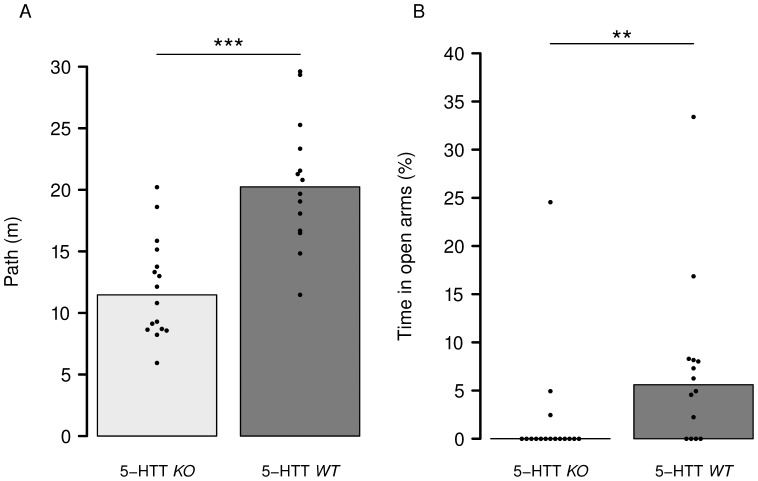
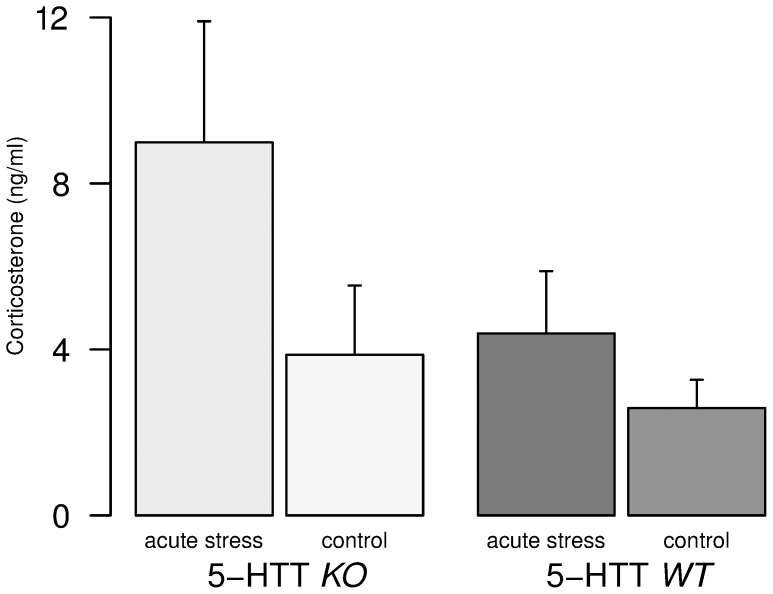
The most prominent brain region evaluating the significance of external stimuli immediately after their onset is the amygdala. Stimuli evaluated as being stressful actuate a number of physiological processes as an immediate stress response. Variation in the serotonin transporter gene has been associated with increased anxiety- and depression-like behavior, altered stress reactivity and adaptation, and pathophysiology of stress-related disorders. In this study the instant reactions to an acute stressor were measured in a serotonin transporter knockout mouse model. Mice lacking the serotonin transporter were verified to be more anxious than their wild-type conspecifics. Genome-wide gene expression changes in the amygdala were measured after the mice were subjected to control condition or to an acute stressor of one minute exposure to water. The dissection of amygdalae and stabilization of RNA was conducted within nine minutes after the onset of the stressor. This extremely short protocol allowed for analysis of first wave primary response genes, typically induced within five to ten minutes of stimulation, and was performed using Affymetrix GeneChip Mouse Gene 1.0 ST Arrays. RNA profiling revealed a largely new set of differentially expressed primary response genes between the conditions acute stress and control that differed distinctly between wild-type and knockout mice. Consequently, functional categorization and pathway analysis indicated genes related to neuroplasticity and adaptation in wild-types whereas knockouts were characterized by impaired plasticity and genes more related to chronic stress and pathophysiology. Our study therefore disclosed different coping styles dependent on serotonin transporter genotype even directly after the onset of stress and accentuates the role of the serotonergic system in processing stressors and threat in the amygdala. Moreover, several of the first wave primary response genes that we found might provide promising targets for future therapeutic interventions of stress-related disorders also in humans.
在外部刺激开始后立即评估其重要性的最突出的大脑区域是杏仁核。被评估为有压力的刺激会引发许多生理过程,作为即时应激反应。5-羟色胺转运体基因的变异与焦虑和抑郁样行为增加、应激反应和适应改变以及应激相关障碍的病理生理学有关。在这项研究中,在 5-羟色胺转运体敲除小鼠模型中测量了对急性应激源的即时反应。缺乏 5-羟色胺转运体的小鼠被证实比它们的野生型同类更焦虑。在将小鼠暴露于对照条件或一分钟暴露于水中的急性应激源后,测量了杏仁核中的全基因组基因表达变化。在应激源开始后九分钟内进行了杏仁核的解剖和 RNA 稳定。这个非常短的方案允许分析第一波主要反应基因,通常在刺激后五到十分钟内诱导,并且使用 Affymetrix GeneChip Mouse Gene 1.0 ST Arrays 进行。RNA 分析揭示了急性应激和对照条件之间差异表达的主要反应基因的一组全新基因,这些基因在野生型和敲除小鼠之间明显不同。因此,功能分类和途径分析表明,与神经可塑性和适应相关的基因在野生型中,而敲除型则表现出可塑性受损,与慢性应激和病理生理学相关的基因更多。因此,我们的研究表明,即使在应激开始后直接依赖 5-羟色胺转运体基因型也存在不同的应对方式,强调了 5-羟色胺能系统在处理应激源和威胁中的作用在杏仁核中。此外,我们发现的一些第一波主要反应基因可能为未来人类应激相关障碍的治疗干预提供有希望的靶点。