Department of Biology, Norwegian University of Science and Technology (NTNU), Trondheim, Norway.
PLoS One. 2013;8(3):e58987. doi: 10.1371/journal.pone.0058987. Epub 2013 Mar 25.
Under the threat of global climatic change and food shortages, it is essential to take the initiative to obtain a comprehensive understanding of common and specific defence mechanisms existing in plant systems for protection against different types of biotic invaders. We have implemented an integrated approach to analyse the overall transcriptomic reprogramming and systems-level defence responses in the model plant species Arabidopsis thaliana (A. thaliana henceforth) during insect Brevicoryne brassicae (B. brassicae henceforth) and bacterial Pseudomonas syringae pv. tomato strain DC3000 (P. syringae henceforth) attacks. The main aim of this study was to identify the attacker-specific and general defence response signatures in A. thaliana when attacked by phloem-feeding aphids or pathogenic bacteria.
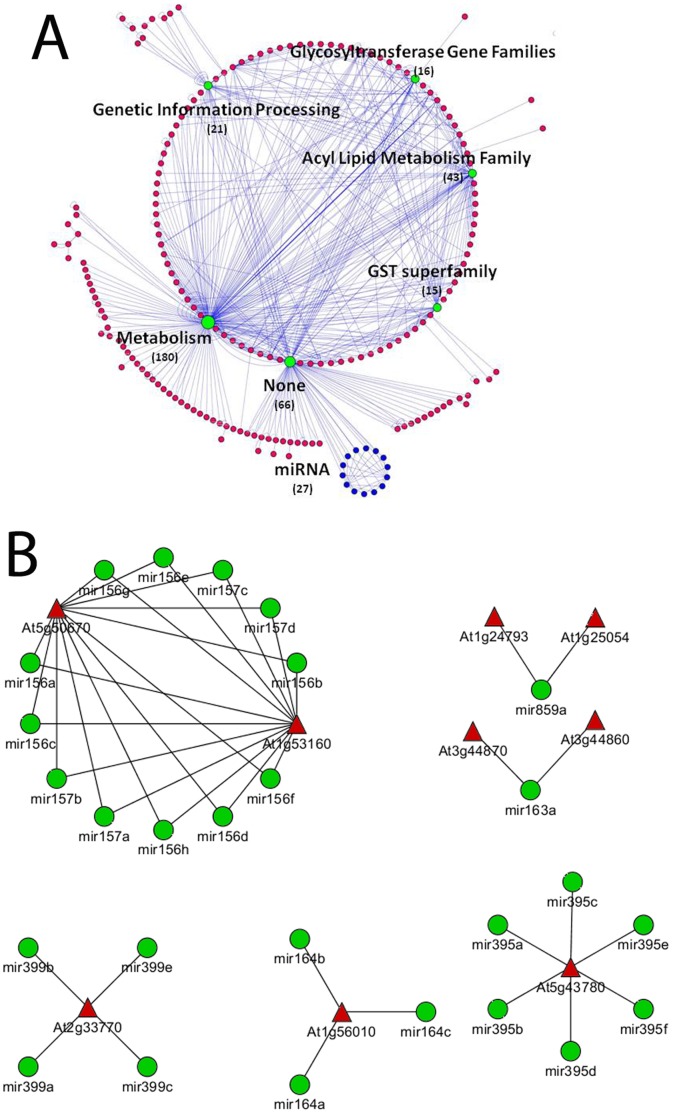
The obtained annotated networks of differentially expressed transcripts indicated that members of transcription factor families, such as WRKY, MYB, ERF, BHLH and bZIP, could be crucial for stress-specific defence regulation in Arabidopsis during aphid and P. syringae attack. The defence response pathways, signalling pathways and metabolic processes associated with aphid attack and P. syringae infection partially overlapped. Components of several important biosynthesis and signalling pathways, such as salicylic acid (SA), jasmonic acid (JA), ethylene (ET) and glucosinolates, were differentially affected during the two the treatments. Several stress-regulated transcription factors were known to be associated with stress-inducible microRNAs. The differentially regulated gene sets included many signature transcription factors, and our co-expression analysis showed that they were also strongly co-expressed during 69 other biotic stress experiments.
Defence responses and functional networks that were unique and specific to aphid or P. syringae stresses were identified. Furthermore, our analysis revealed a probable link between biotic stress and microRNAs in Arabidopsis and, thus gives indicates a new direction for conducting large-scale targeted experiments to explore the detailed regulatory links between them. The presented results provide a comparative understanding of Arabidopsis - B. brassicae and Arabidopsis - P. syringae interactions at the transcriptomic level.
在全球气候变化和粮食短缺的威胁下,主动了解植物系统中存在的针对不同类型生物入侵的共同和特定防御机制至关重要。我们采用综合方法分析了模式植物拟南芥(Arabidopsis thaliana,后文简称 A. thaliana)在遭受棉蚜(Brevicoryne brassicae,后文简称 B. brassicae)和丁香假单胞菌番茄致病变种(Pseudomonas syringae pv. tomato strain DC3000,后文简称 P. syringae)侵害时的整体转录组重编程和系统水平防御反应。本研究的主要目的是鉴定 A. thaliana 在受到韧皮部取食蚜虫或致病细菌侵害时的攻击特异性和一般性防御反应特征。
差异表达转录本的注释网络表明,WRKY、MYB、ERF、BHLH 和 bZIP 等转录因子家族成员可能对拟南芥在蚜虫和 P. syringae 攻击时的应激特异性防御调节至关重要。与蚜虫攻击和 P. syringae 感染相关的防御反应途径、信号转导途径和代谢过程部分重叠。水杨酸(salicylic acid,SA)、茉莉酸(jasmonic acid,JA)、乙烯(ethylene,ET)和硫代葡萄糖苷等几种重要生物合成和信号转导途径的成分在两种处理中均受到不同程度的影响。许多应激调节转录因子与应激诱导的 microRNAs 有关。差异调控的基因集包括许多特征转录因子,我们的共表达分析表明,它们在其他 69 种生物应激实验中也表现出强烈的共表达。
鉴定了对棉蚜或 P. syringae 胁迫具有独特和特异性的防御反应和功能网络。此外,我们的分析还揭示了拟南芥中生物胁迫与 microRNAs 之间可能存在联系,从而为开展大规模靶向实验以探索它们之间的详细调控关系提供了新的方向。所呈现的结果提供了在转录组水平上对拟南芥 - B. brassicae 和拟南芥 - P. syringae 相互作用的比较理解。