Haji Khamis A, Khatib Bakari O, Smith Stephen, Ali Abdullah S, Devine Gregor J, Coetzee Maureen, Majambere Silas
Parasit Vectors. 2013 Mar 28;6:82. doi: 10.1186/1756-3305-6-82.
Long-lasting insecticide treated nets (LLINs) and indoor residual house spraying (IRS) are the main interventions for the control of malaria vectors in Zanzibar. The aim of the present study was to assess the susceptibility status of malaria vectors against the insecticides used for LLINs and IRS and to determine the durability and efficacy of LLINs on the island.
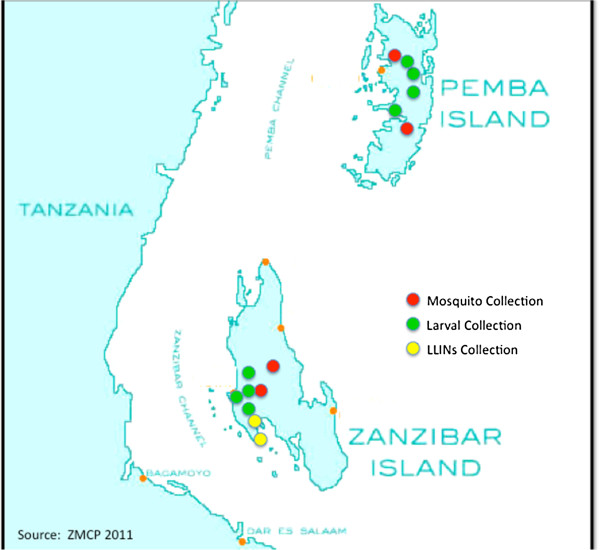
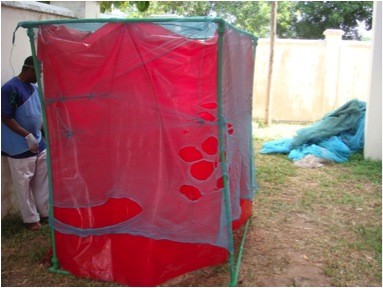
Mosquitoes were sampled from Pemba and Unguja islands in 2010-2011 for use in WHO susceptibility tests. One hundred and fifty LLINs were collected from households on Unguja, their physical state was recorded and then tested for efficacy as well as total insecticide content.
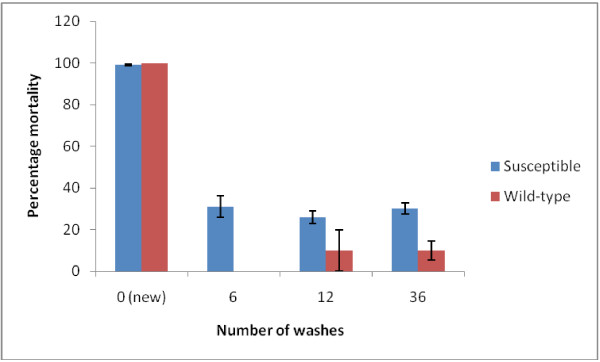
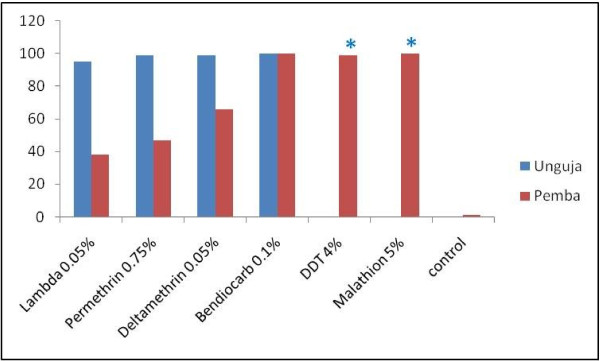
Species identification revealed that over 90% of the Anopheles gambiae complex was An. arabiensis with a small number of An. gambiae s.s. and An. merus being present. Susceptibility tests showed that An. arabiensis on Pemba was resistant to the pyrethroids used for LLINs and IRS. Mosquitoes from Unguja Island, however, were fully susceptible to all pyrethroids tested. A physical examination of 150 LLINs showed that two thirds were damaged after only three years in use. All used nets had a significantly lower (p < 0.001) mean permethrin concentration of 791.6 mg/m2 compared with 944.2 mg/m2 for new ones. Their efficacy decreased significantly against both susceptible An. gambiae s.s. colony mosquitoes and wild-type mosquitoes from Pemba after just six washes (p < 0.001).
The sustainability of the gains achieved in malaria control in Zanzibar is seriously threatened by the resistance of malaria vectors to pyrethroids and the short-lived efficacy of LLINs. This study has revealed that even in relatively well-resourced and logistically manageable places like Zanzibar, malaria elimination is going to be difficult to achieve with the current control measures.
长效杀虫剂处理蚊帐(LLINs)和室内滞留喷洒(IRS)是桑给巴尔控制疟蚊的主要干预措施。本研究的目的是评估疟蚊对用于LLINs和IRS的杀虫剂的易感性状况,并确定该岛上LLINs的耐用性和有效性。
2010 - 2011年从奔巴岛和温古贾岛采集蚊子用于世卫组织易感性测试。从温古贾岛的家庭中收集了150顶LLINs,记录其物理状态,然后测试其有效性以及总杀虫剂含量。
物种鉴定显示,超过90%的冈比亚按蚊复合体为阿拉伯按蚊,还有少量的冈比亚按蚊指名亚种和梅氏按蚊。易感性测试表明,奔巴岛的阿拉伯按蚊对用于LLINs和IRS的拟除虫菊酯具有抗性。然而,温古贾岛的蚊子对所有测试的拟除虫菊酯均完全敏感。对150顶LLINs的物理检查表明,仅使用三年后,三分之二的蚊帐已损坏。所有使用过的蚊帐平均氯菊酯浓度为791.6 mg/m²,显著低于新蚊帐的944.2 mg/m²(p < 0.001)。仅经过六次洗涤后,它们对易感的冈比亚按蚊指名亚种群体蚊子和来自奔巴岛的野生型蚊子的有效性就显著下降(p < 0.001)。
桑给巴尔在疟疾控制方面取得的成果的可持续性受到疟蚊对拟除虫菊酯的抗性以及LLINs短期有效性的严重威胁。本研究表明,即使在像桑给巴尔这样资源相对丰富且后勤管理易于操作的地方,采用当前的控制措施也难以实现疟疾消除。