Laboratory for Cognitive Neuroscience and NeuroImaging, Department of Bio and Brain Engineering, Korea Advanced Institute of Science and Technology Daejeon, South Korea.
Front Hum Neurosci. 2013 Feb 26;7:49. doi: 10.3389/fnhum.2013.00049. eCollection 2013.
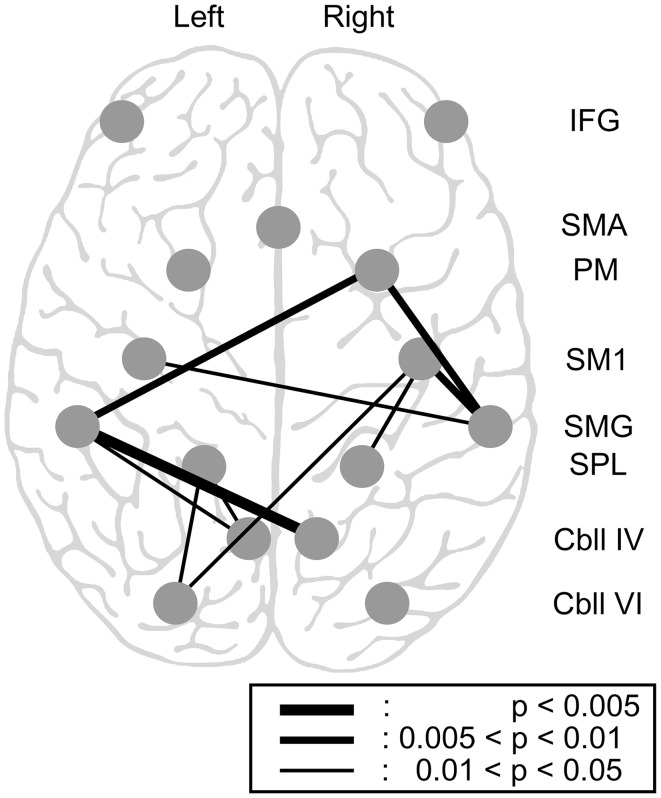
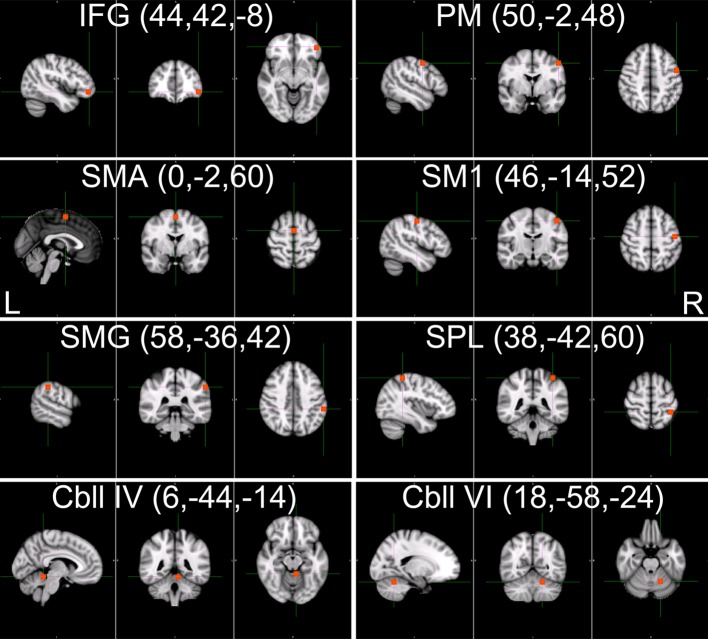
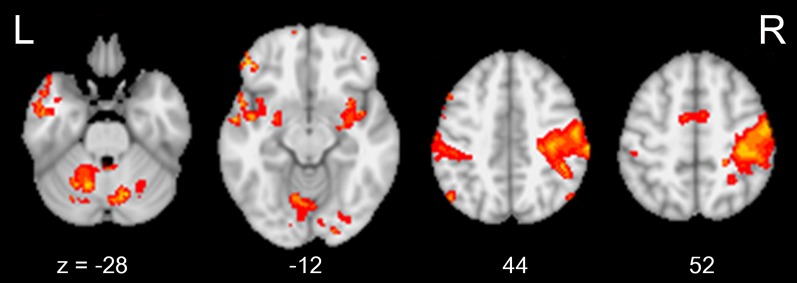
Intrinsic functional connectivity from resting state functional magnetic resonance imaging (rsfMRI) has increasingly received attention as a possible predictor of cognitive function and performance. In this study, we investigated the influence of practicing skillful tool manipulation on intrinsic functional connectivity in the resting brain. Acquisition of tool-use skill has two aspects such as formation of motor representation for skillful manipulation and acquisition of the tool concept. To dissociate these two processes, we chose chopsticks-handling with the non-dominant hand. Because participants were already adept at chopsticks-handling with their dominant hand, practice with the non-dominant hand involved only acquiring the skill for tool manipulation with existing knowledge. Eight young participants practiced chopsticks-handling with their non-dominant hand for 8 weeks. They underwent functional magnetic resonance imaging (fMRI) sessions before and after the practice. As a result, functional connectivity among tool-use-related regions of the brain decreased after practice. We found decreased functional connectivity centered on parietal areas, mainly the supramarginal gyrus (SMG) and superior parietal lobule (SPL) and additionally between the primary sensorimotor area and cerebellum. These results suggest that the parietal lobe and cerebellum purely mediate motor learning for skillful tool-use. This decreased functional connectivity may represent increased efficiency of functional network.
静息态功能磁共振成像(rsfMRI)的内源性功能连接作为认知功能和表现的可能预测指标,越来越受到关注。在这项研究中,我们研究了熟练工具操作对静息大脑内源性功能连接的影响。工具使用技能的获得有两个方面,即熟练操作的运动表现形成和工具概念的获得。为了区分这两个过程,我们选择用非优势手进行筷子操作。由于参与者已经擅长用优势手进行筷子操作,因此用非优势手进行练习仅涉及利用现有知识掌握工具操作的技能。八名年轻参与者用非优势手进行了 8 周的筷子练习。他们在练习前后接受了功能磁共振成像(fMRI)检查。结果表明,练习后与工具使用相关的大脑区域之间的功能连接减少了。我们发现,以顶叶区域为中心的功能连接减少,主要是缘上回(SMG)和顶上小叶(SPL),并且初级感觉运动区和小脑之间的功能连接也减少了。这些结果表明,顶叶和小脑纯粹介导熟练工具使用的运动学习。功能连接的减少可能代表功能网络效率的提高。