Duke University Human Vaccine Institute, Departments of Medicine and Immunology, Duke University School of Medicine, Durham, North Carolina 27710, USA.
Nature. 2013 Apr 25;496(7446):469-76. doi: 10.1038/nature12053. Epub 2013 Apr 3.
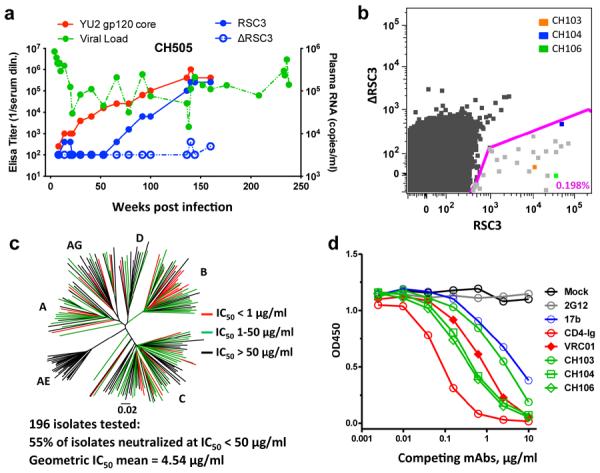
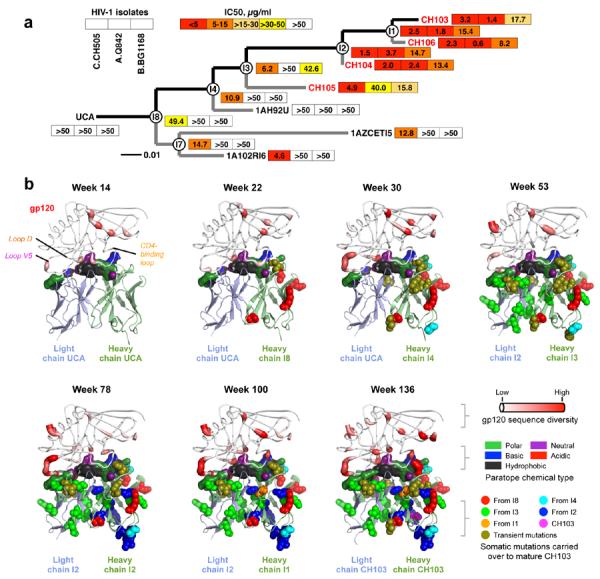
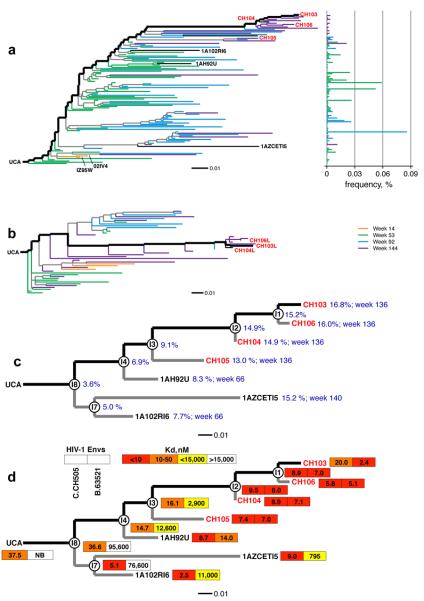
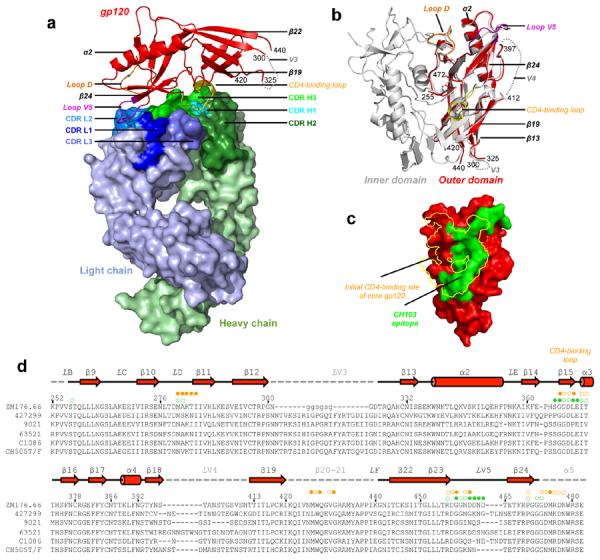
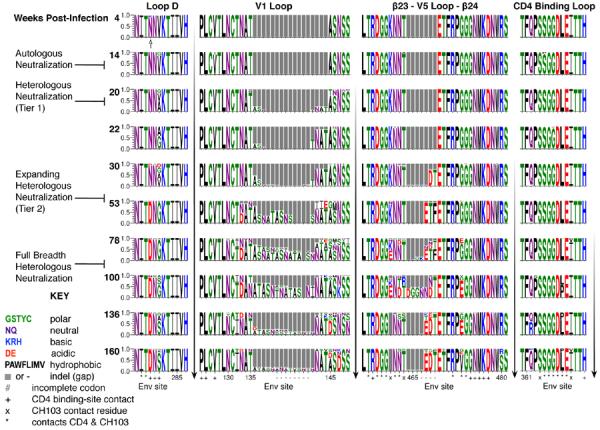
Current human immunodeficiency virus-1 (HIV-1) vaccines elicit strain-specific neutralizing antibodies. However, cross-reactive neutralizing antibodies arise in approximately 20% of HIV-1-infected individuals, and details of their generation could provide a blueprint for effective vaccination. Here we report the isolation, evolution and structure of a broadly neutralizing antibody from an African donor followed from the time of infection. The mature antibody, CH103, neutralized approximately 55% of HIV-1 isolates, and its co-crystal structure with the HIV-1 envelope protein gp120 revealed a new loop-based mechanism of CD4-binding-site recognition. Virus and antibody gene sequencing revealed concomitant virus evolution and antibody maturation. Notably, the unmutated common ancestor of the CH103 lineage avidly bound the transmitted/founder HIV-1 envelope glycoprotein, and evolution of antibody neutralization breadth was preceded by extensive viral diversification in and near the CH103 epitope. These data determine the viral and antibody evolution leading to induction of a lineage of HIV-1 broadly neutralizing antibodies, and provide insights into strategies to elicit similar antibodies by vaccination.
目前的人类免疫缺陷病毒 1 型(HIV-1)疫苗可诱导产生针对特定毒株的中和抗体。然而,约有 20%的 HIV-1 感染者会产生交叉反应性中和抗体,了解其产生机制可为有效的疫苗接种提供蓝图。本研究报告了一名非洲供体感染后时间内,广谱中和抗体的分离、进化和结构。成熟抗体 CH103 可中和约 55%的 HIV-1 分离株,其与 HIV-1 包膜蛋白 gp120 的共结晶结构揭示了一种新的基于环的 CD4 结合位点识别机制。病毒和抗体基因测序显示,病毒和抗体同时进化和成熟。值得注意的是,CH103 谱系的未突变共同祖先可强烈结合传播/原始 HIV-1 包膜糖蛋白,抗体中和广度的进化先于 CH103 表位内及附近的广泛病毒多样化。这些数据确定了导致 HIV-1 广谱中和抗体谱系诱导的病毒和抗体进化,并为通过疫苗接种诱导类似抗体提供了见解。