Department of Radiology and Imaging Sciences, Center for Neuroimaging, Indiana University School of Medicine Indianapolis, IN, USA.
Front Aging Neurosci. 2013 Apr 1;5:11. doi: 10.3389/fnagi.2013.00011. eCollection 2013.
Our goal was to evaluate the association of APOE with amyloid deposition, cerebrospinal fluid levels (CSF) of Aβ, tau, and p-tau, brain atrophy, cognition and cognitive complaints in E-MCI patients and cognitively healthy older adults (HC) in the ADNI-2 cohort.
Two-hundred and nine E-MCI and 123 HC participants from the ADNI-2 cohort were included. We evaluated the impact of diagnostic status (E-MCI vs. HC) and APOE ε4 status (ε4 positive vs. ε4 negative) on cortical amyloid deposition (AV-45/Florbetapir SUVR PET scans), brain atrophy (structural MRI scans processed using voxel-based morphometry and Freesurfer version 5.1), CSF levels of Aβ, tau, and p-tau, and cognitive performance and complaints.
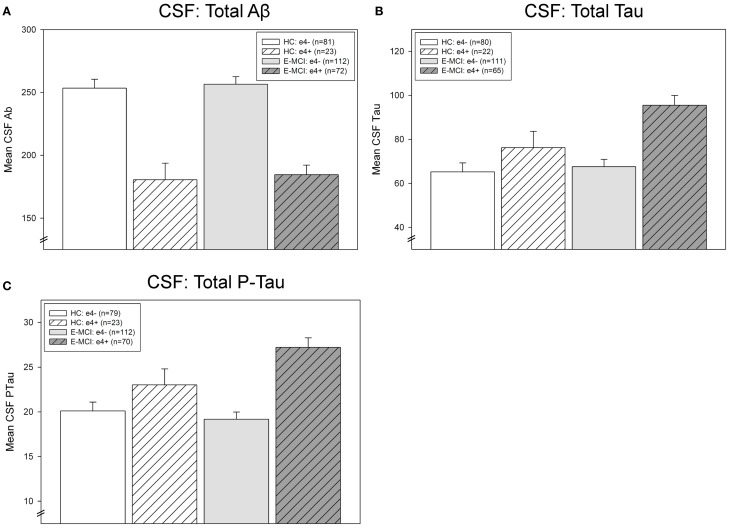
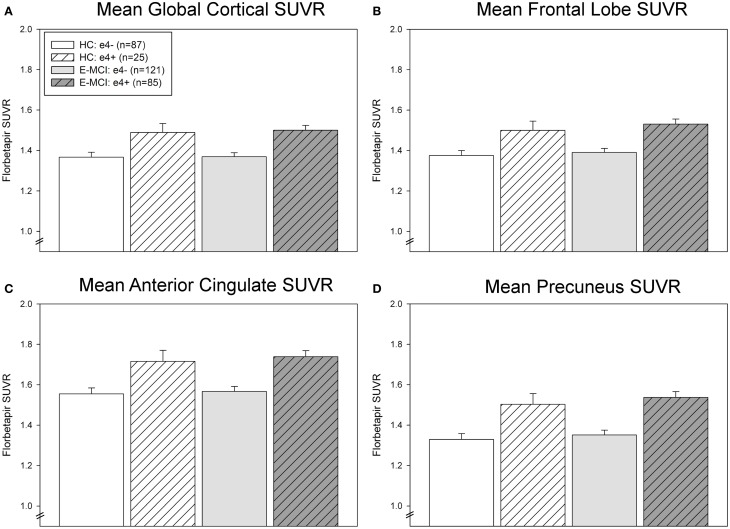
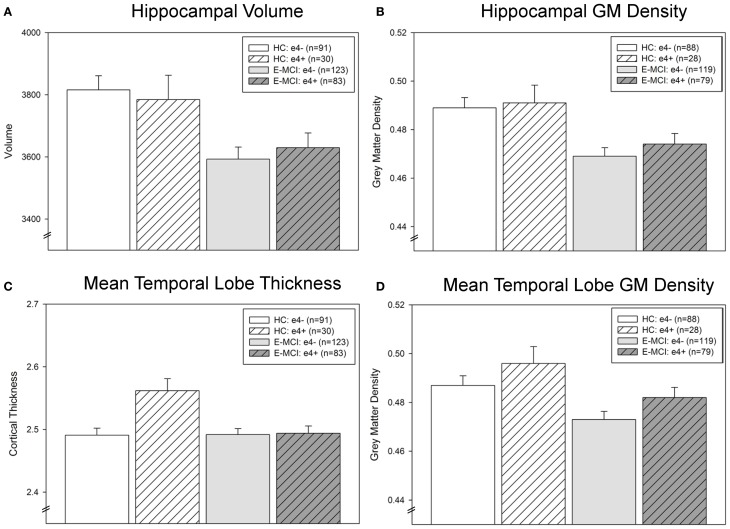
E-MCI participants showed significantly impaired cognition, higher levels of cognitive complaints, greater levels of tau and p-tau, and subcortical and cortical atrophy relative to HC participants (p < 0.05). Cortical amyloid deposition and CSF levels of Aβ were significantly associated with APOE ε4 status but not E-MCI diagnosis, with ε4 positive participants showing more amyloid deposition and lower levels of CSF Aβ than ε4 negative participants. Other effects of APOE ε4 status on cognition and CSF tau levels were also observed.
APOE ε4 status is associated with amyloid accumulation and lower CSF Aβ, as well as increased CSF tau levels in early prodromal stages of AD (E-MCI) and HC. Alternatively, neurodegeneration, cognitive impairment, and increased complaints are primarily associated with a diagnosis of E-MCI. These findings underscore the importance of considering APOE genotype when evaluating biomarkers in early stages of disease.
我们的目的是评估 APOE 与淀粉样蛋白沉积、脑脊液(CSF)中 Aβ、tau 和 p-tau 水平、脑萎缩、认知功能以及 E-MCI 患者和认知健康老年人(HC)的认知主诉之间的相关性,这些患者均来自 ADNI-2 队列。
共纳入 ADNI-2 队列中的 209 名 E-MCI 患者和 123 名 HC 参与者。我们评估了诊断状态(E-MCI 与 HC)和 APOE ε4 状态(ε4 阳性与 ε4 阴性)对皮质淀粉样蛋白沉积(AV-45/氟代苯丙氨酸 SUVR PET 扫描)、脑萎缩(基于体素形态计量学和 Freesurfer 版本 5.1 处理的结构 MRI 扫描)、CSF 中 Aβ、tau 和 p-tau 水平以及认知表现和主诉的影响。
与 HC 参与者相比,E-MCI 参与者的认知功能明显受损,认知主诉水平更高,tau 和 p-tau 水平更高,皮质下和皮质萎缩更严重(p<0.05)。皮质淀粉样蛋白沉积和 CSF 中 Aβ 的水平与 APOE ε4 状态显著相关,但与 E-MCI 诊断无关,ε4 阳性参与者的淀粉样蛋白沉积水平更高,CSF 中 Aβ 水平更低。APOE ε4 状态对认知功能和 CSF tau 水平的其他影响也观察到。
APOE ε4 状态与 AD(E-MCI 和 HC)早期前驱期的淀粉样蛋白积聚和 CSF Aβ 水平降低,以及 CSF tau 水平升高有关。相反,神经退行性变、认知障碍和主诉增加主要与 E-MCI 的诊断有关。这些发现强调了在疾病早期阶段评估生物标志物时考虑 APOE 基因型的重要性。