Machado Dalmo, Oikawa Sérgio, Barbanti Valdir
School of Physical Education and Sport of Ribeirao Preto, University of Sao Paulo, Ribeirão Preto, Brazil.
J Obes. 2013;2013:428135. doi: 10.1155/2013/428135. Epub 2013 Mar 11.
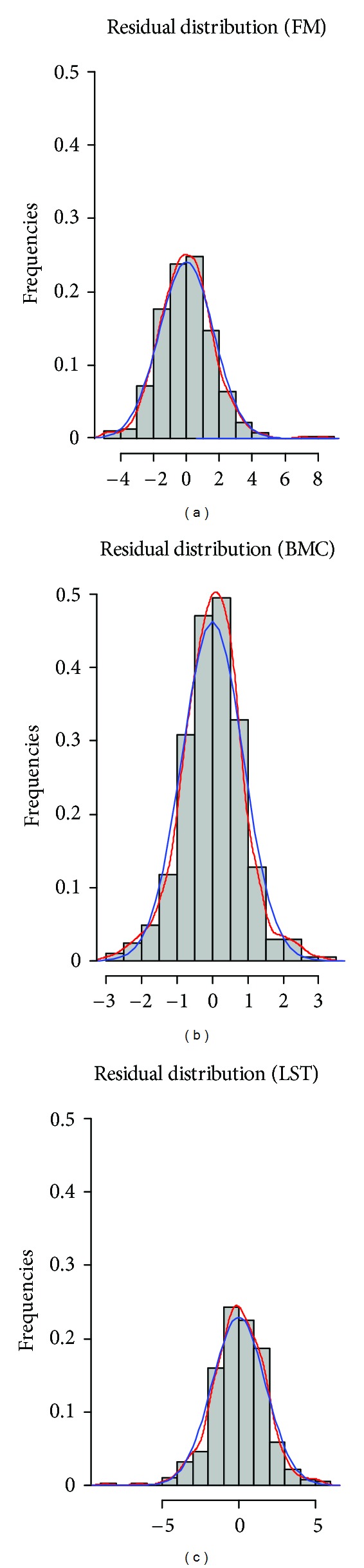
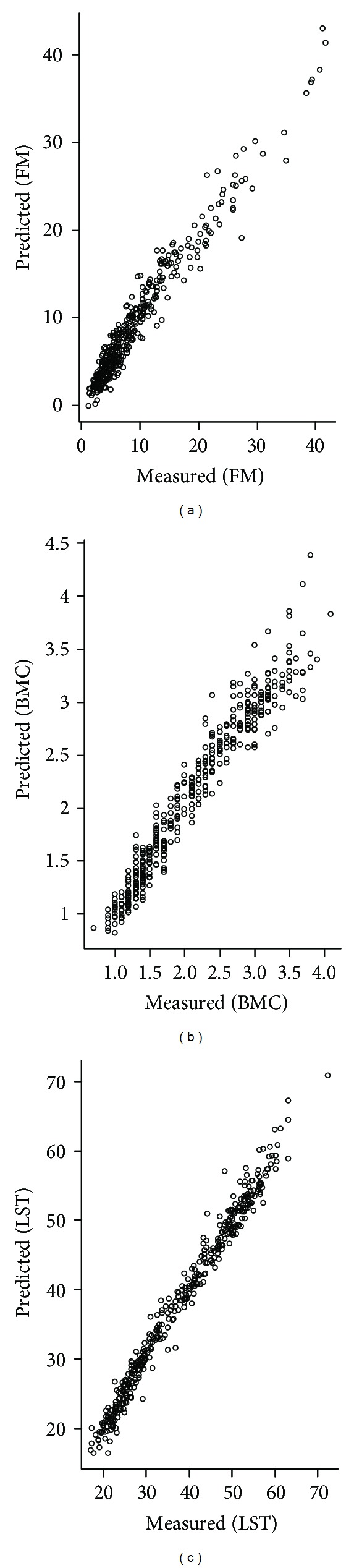
The aim of this study was to propose and cross-validate an anthropometric model for the simultaneous estimation of fat mass (FM), bone mineral content (BMC), and lean soft tissue (LST) using DXA as the reference method. A total of 408 boys (8-18 years) were included in this sample. Whole-body FM, BMC, and LST were measured by DXA and considered as dependent variables. Independent variables included thirty-two anthropometrics measurements and maturity offset determined by the Mirwald equation. From a multivariate regression model ((n)Y(m) = (n)x(r + 1)(r + 1)β(m) + (n)ε(m)), a matrix analysis was performed resulting in a multicomponent anthropometric model. The cross-validation was executed through the sum of squares of residuals (PRESS) method. Five anthropometric variables predicted simultaneously FM, BMC, and LST. Cross-validation parameters indicated that the new model is accurate with high R(PRESS)(2) values ranging from 0.94 to 0.98 and standard error of estimate ranging from 0.01 to 0.09. The newly proposed model represents an alternative to accurately assess the body composition in male pediatric ages.
本研究的目的是提出并交叉验证一种人体测量模型,该模型使用双能X线吸收法(DXA)作为参考方法,同时估计脂肪量(FM)、骨矿物质含量(BMC)和瘦软组织(LST)。本样本共纳入408名男孩(8至18岁)。通过DXA测量全身FM、BMC和LST,并将其视为因变量。自变量包括32项人体测量指标以及通过米尔瓦尔德方程确定的成熟度偏移。从多元回归模型((n)Y(m) = (n)x(r + 1)(r + 1)β(m) + (n)ε(m))进行矩阵分析,得出一个多组分人体测量模型。通过残差平方和(PRESS)方法进行交叉验证。五个人体测量变量可同时预测FM、BMC和LST。交叉验证参数表明,新模型准确,R(PRESS)(2)值较高,范围为0.94至0.98,估计标准误差范围为0.01至0.09。新提出的模型是准确评估男性儿童年龄阶段身体成分的一种替代方法。