Division of Cell Biology, La Jolla Institute for Allergy and Immunology, La Jolla, California, United States of America.
PLoS Pathog. 2013 Mar;9(3):e1003224. doi: 10.1371/journal.ppat.1003224. Epub 2013 Mar 21.
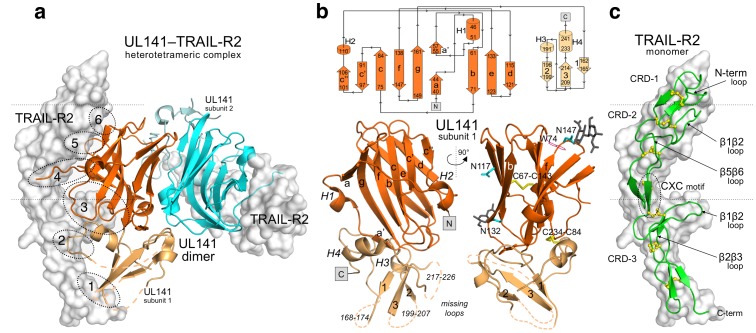
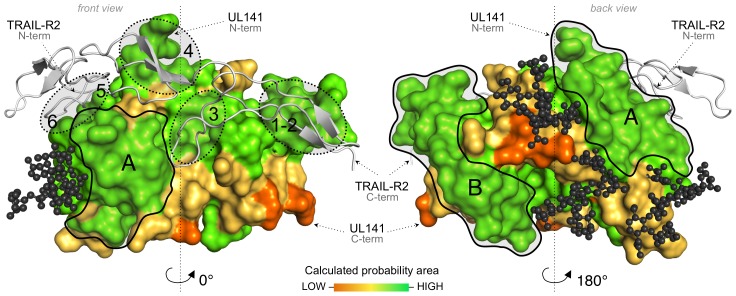
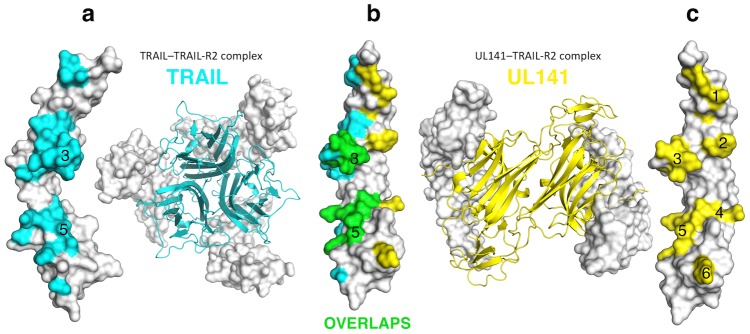
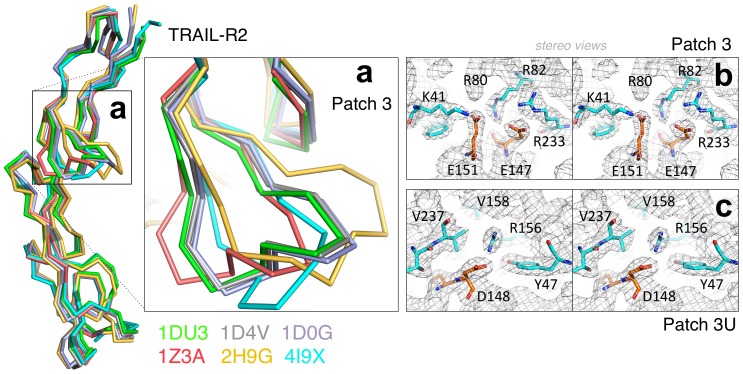
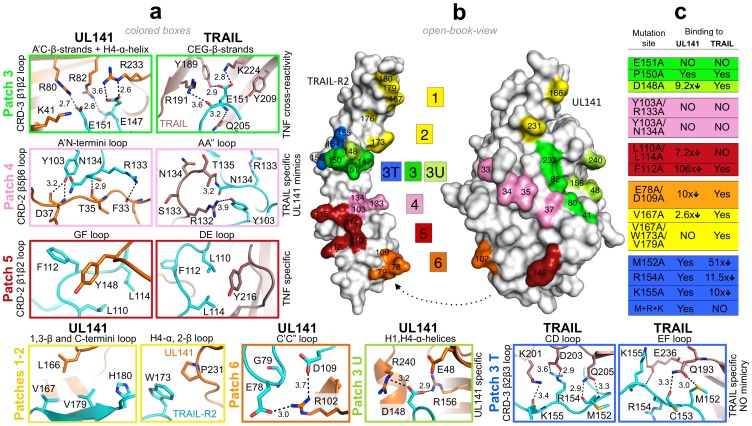
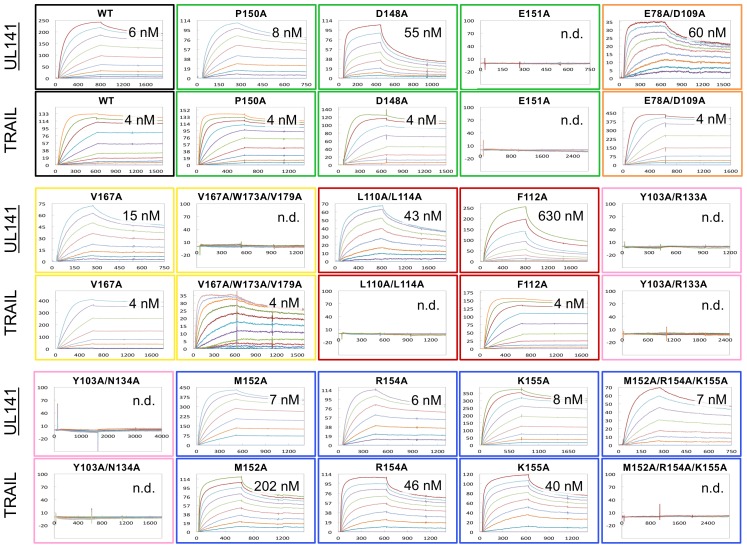
The TRAIL (TNF-related apoptosis inducing ligand) death receptors (DRs) of the tumor necrosis factor receptor superfamily (TNFRSF) can promote apoptosis and regulate antiviral immunity by maintaining immune homeostasis during infection. In turn, human cytomegalovirus (HCMV) expresses immunomodulatory proteins that down-regulate cell surface expression of TNFRSF members as well as poliovirus receptor-related proteins in an effort to inhibit host immune effector pathways that would lead to viral clearance. The UL141 glycoprotein of human cytomegalovirus inhibits host defenses by blocking cell surface expression of TRAIL DRs (by retention in ER) and poliovirus receptor CD155, a nectin-like Ig-fold molecule. Here we show that the immunomodulatory function of HCMV UL141 is associated with its ability to bind diverse proteins, while utilizing at least two distinct binding sites to selectively engage TRAIL DRs or CD155. Binding studies revealed high affinity interaction of UL141 with both TRAIL-R2 and CD155 and low affinity binding to TRAIL-R1. We determined the crystal structure of UL141 bound to TRAIL-R2 at 2.1 Å resolution, which revealed that UL141 forms a homodimer that engages two TRAIL-R2 monomers 90° apart to form a heterotetrameric complex. Our structural and biochemical data reveal that UL141 utilizes its Ig-domain to facilitate non-canonical death receptor interactions while UL141 partially mimics the binding site of TRAIL on TRAIL-R2, which we found to be distinct from that of CD155. Moreover, UL141 also binds to an additional surface patch on TRAIL-R2 that is distinct from the TRAIL binding site. Therefore, the breadth of UL141-mediated effects indicates that HCMV has evolved sophisticated strategies to evade the immune system by modulating multiple effector pathways.
肿瘤坏死因子受体超家族(TNFRSF)的 TRAIL(TNF 相关凋亡诱导配体)死亡受体(DR)可通过在感染过程中维持免疫稳态来促进凋亡并调节抗病毒免疫。反过来,人巨细胞病毒(HCMV)表达免疫调节蛋白,下调 TNFRSF 成员的细胞表面表达以及脊髓灰质炎病毒受体相关蛋白,以抑制导致病毒清除的宿主免疫效应途径。人巨细胞病毒的 UL141 糖蛋白通过阻止 TRAIL DR(通过保留在 ER 中)和脊髓灰质炎病毒受体 CD155 的细胞表面表达来抑制宿主防御,CD155 是一种连接蛋白样 Ig 折叠分子。在这里,我们表明 HCMV UL141 的免疫调节功能与其结合多种蛋白质的能力相关,同时利用至少两个不同的结合位点选择性地结合 TRAIL DR 或 CD155。结合研究表明 UL141 与 TRAIL-R2 和 CD155 具有高亲和力相互作用,与 TRAIL-R1 具有低亲和力结合。我们确定了与 TRAIL-R2 结合的 UL141 的晶体结构,分辨率为 2.1Å,这表明 UL141 形成同源二聚体,与两个 TRAIL-R2 单体 90°相互作用形成异四聚体复合物。我们的结构和生化数据表明,UL141 利用其 Ig 结构域促进非典型死亡受体相互作用,同时 UL141 部分模拟 TRAIL 在 TRAIL-R2 上的结合位点,我们发现该结合位点与 CD155 的不同。此外,UL141 还结合 TRAIL-R2 上的另一个独特表面斑块,该斑块与 TRAIL 结合位点不同。因此,UL141 介导的效应的广度表明 HCMV 通过调节多种效应途径进化出了复杂的逃避免疫系统的策略。