Department of Pediatrics, Zayed Military Hospital, Abu Dhabi, United Arab Emirates.
PLoS One. 2013;8(3):e59923. doi: 10.1371/journal.pone.0059923. Epub 2013 Mar 26.
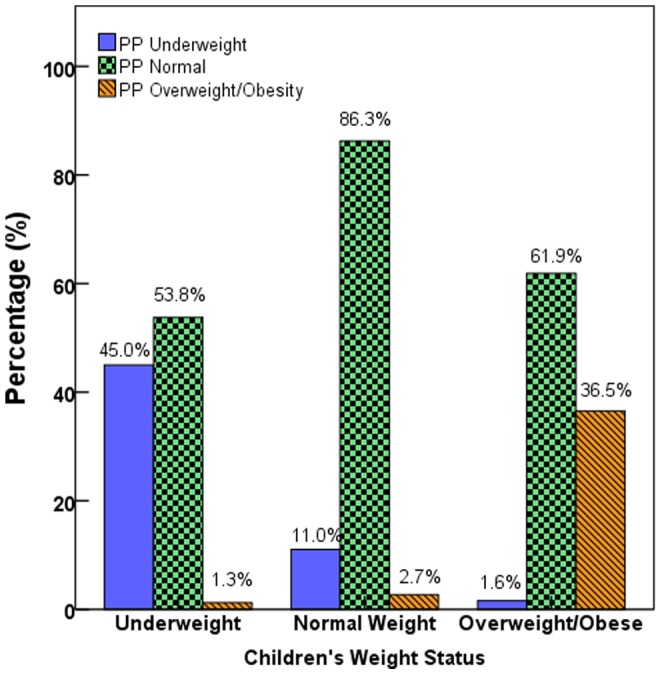
Parental participation is a key factor in the prevention and management of childhood obesity, thus parental recognition of weight problems is essential. We estimated parental perceptions and their determinants in the Emirati population. We invited 1541 students (grade 1-12; 50% boys) and their parents, but only 1440 (6-19 years) and their parents consented. Of these, 945 Emirati nationals provided data for analysis. Anthropometric and demographic variables were measured by standard methods. CDC BMI percentile charts for age and sex were used to classify children's weight. Parental perception of their children's weight status (underweight, normal, and overweight/obese) was recorded. Logistic regression analyses were used to identify independent predictors of parental perceptions of children's weight status. Of all parents, 33.8% misclassified their children's' weight status; underestimating (27.4%) or overestimating (6.3%). Misclassification was highest among parents of overweight/obese children (63.5%) and underweight (55.1%) children. More importantly, parental perceptions of their children being overweight or obese, among truly overweight/obese children, i.e. correct identification of an overweight/obese child as such, were associated with the true child's BMI percentile (CDC) with an OR of 1.313 (95% CI: 1.209-1.425; p<0.001) per percentile point, but not age, parental education, household income, and child's sex. We conclude that the majority of parents of overweight/obese children either overestimated or, more commonly, underestimated children's weight status. Predictors of accurate parental perception, in this population, include the true children's BMI, but not age, household income, and sex. Thus, parents having an incorrect perception of their child's weight status may ignore otherwise appropriate health messages.
父母的参与是预防和管理儿童肥胖的关键因素,因此父母对体重问题的认识是必不可少的。我们估计了阿联酋人口中父母的看法及其决定因素。我们邀请了 1541 名学生(1-12 年级;50%为男生)及其家长,但只有 1440 名(6-19 岁)及其家长同意。其中,945 名阿联酋国民提供了数据分析所需的数据。采用标准方法测量了人体测量学和人口统计学变量。使用 CDC 按年龄和性别划分的 BMI 百分位图表来对儿童的体重进行分类。记录了父母对子女体重状况的认知(体重过轻、正常和超重/肥胖)。采用逻辑回归分析来确定父母对子女体重状况认知的独立预测因素。所有父母中,有 33.8%错误地分类了子女的体重状况;低估(27.4%)或高估(6.3%)。超重/肥胖儿童(63.5%)和体重不足儿童(55.1%)父母的错误分类率最高。更重要的是,在真正超重/肥胖的儿童中,父母对子女超重或肥胖的看法,即正确识别超重/肥胖儿童,与儿童实际的 BMI 百分位(CDC)相关,每增加一个百分位,比值比(OR)为 1.313(95%可信区间:1.209-1.425;p<0.001),而与年龄、父母教育程度、家庭收入和孩子性别无关。我们的结论是,大多数超重/肥胖儿童的父母要么高估,要么更常见的是低估孩子的体重状况。在该人群中,准确的父母认知的预测因素包括儿童的真实 BMI,但不包括年龄、家庭收入和性别。因此,对子女体重状况有错误认知的父母可能会忽略其他适当的健康信息。