National Center for Biotechnology Information, National Library of Medicine, National Institutes of Health, Bethesda, MD 20894, USA.
Virol J. 2013 Apr 4;10:106. doi: 10.1186/1743-422X-10-106.
The family Mimiviridae belongs to the large monophyletic group of Nucleo-Cytoplasmic Large DNA Viruses (NCLDV; proposed order Megavirales) and encompasses giant viruses infecting amoeba and probably other unicellular eukaryotes. The recent discovery of the Cafeteria roenbergensis virus (CroV), a distant relative of the prototype mimiviruses, led to a substantial expansion of the genetic variance within the family Mimiviridae. In the light of these findings, a reassessment of the relationships between the mimiviruses and other NCLDV and reconstruction of the evolution of giant virus genomes emerge as interesting and timely goals.
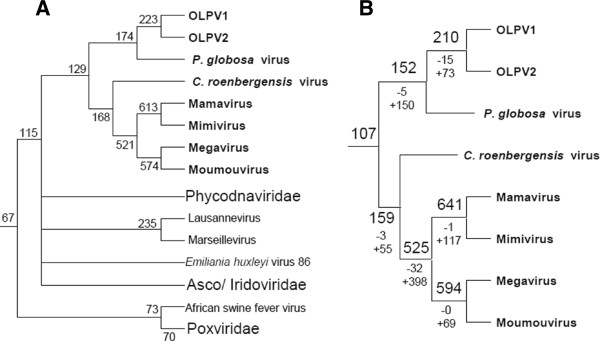
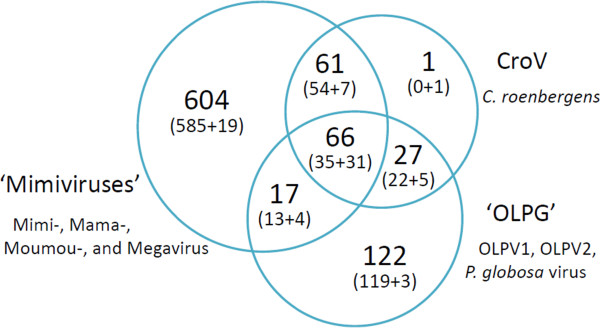
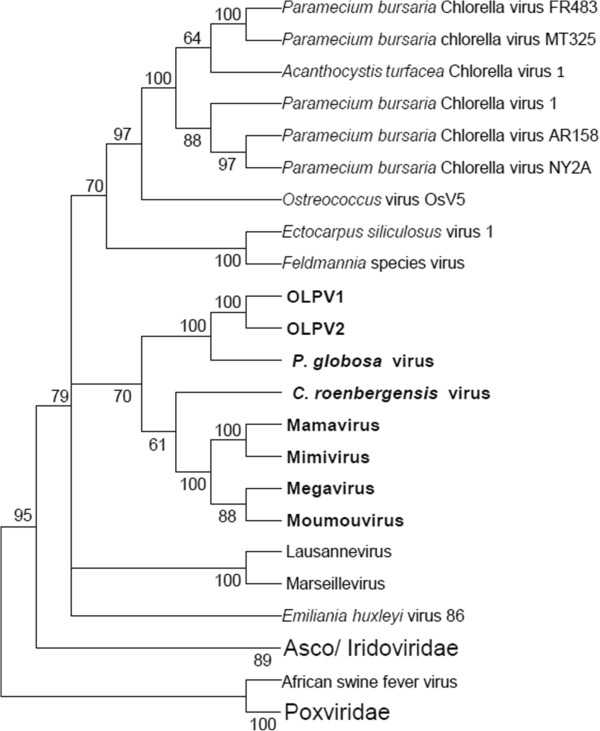
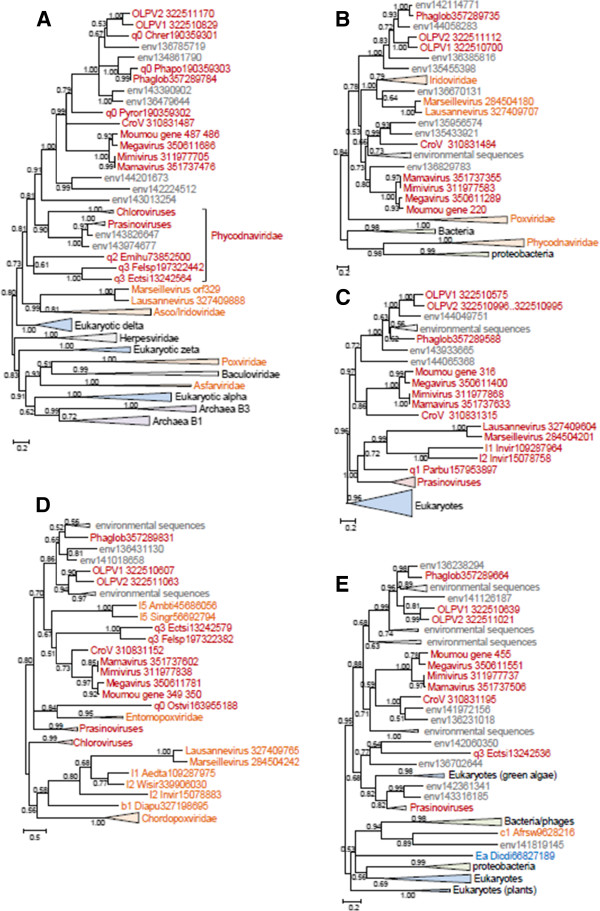
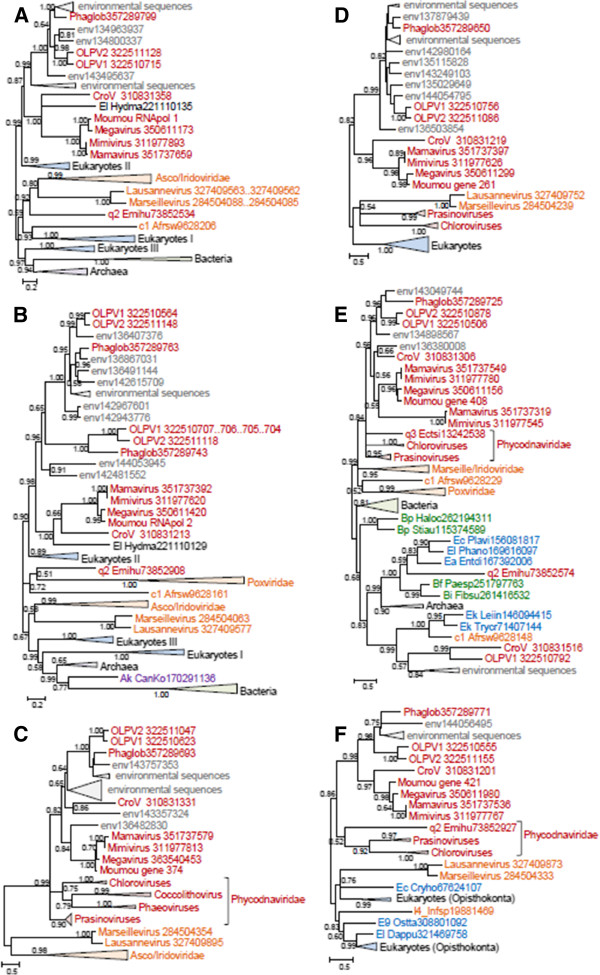
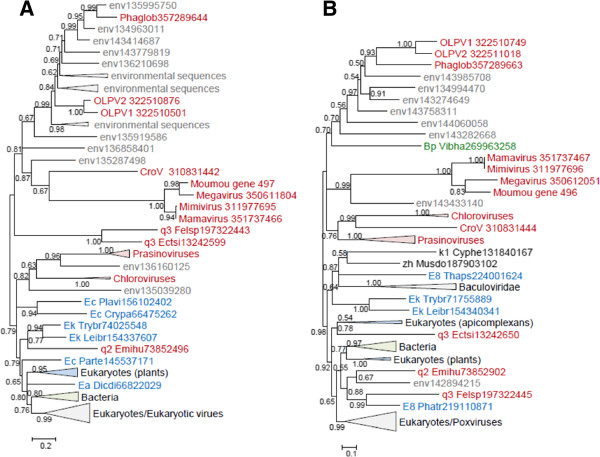
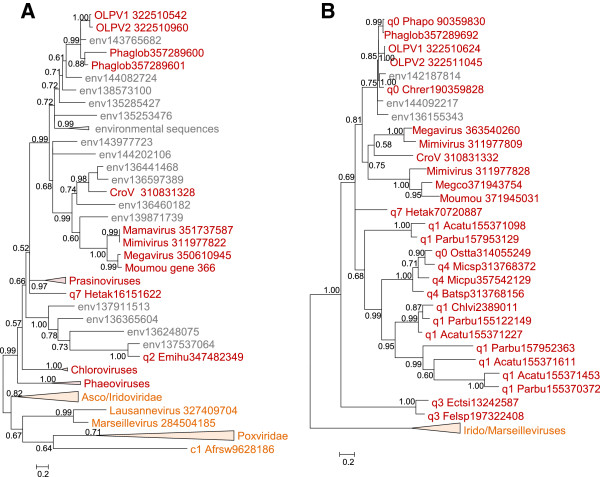
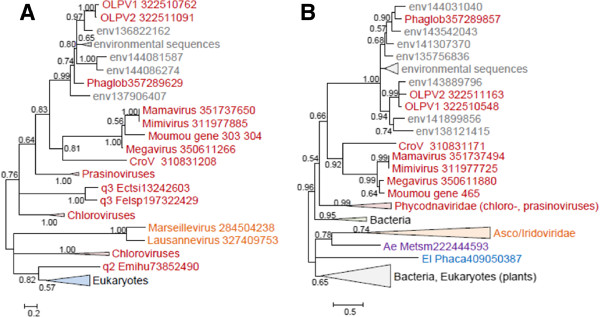
Database searches for the protein sequences encoded in the genomes of several viruses originally classified as members of the family Phycodnaviridae, in particular Organic Lake phycodnaviruses and Phaeocystis globosa viruses (OLPG), revealed a greater number of highly similar homologs in members of the Mimiviridae than in phycodnaviruses. We constructed a collection of 898 Clusters of Orthologous Genes for the putative expanded family Mimiviridae (MimiCOGs) and used these clusters for a comprehensive phylogenetic analysis of the genes that are conserved in most of the NCLDV. The topologies of the phylogenetic trees for these conserved viral genes strongly support the monophyly of the OLPG and the mimiviruses. The same tree topology was obtained by analysis of the phyletic patterns of conserved viral genes. We further employed the mimiCOGs to obtain a maximum likelihood reconstruction of the history of genes losses and gains among the giant viruses. The results reveal massive gene gain in the mimivirus branch and modest gene gain in the OLPG branch.
These phylogenomic results reported here suggest a substantial expansion of the family Mimiviridae. The proposed expanded family encompasses a greater diversity of viruses including a group of viruses with much smaller genomes than those of the original members of the Mimiviridae. If the OLPG group is included in an expanded family Mimiviridae, it becomes the only family of giant viruses currently shown to host virophages. The mimiCOGs are expected to become a key resource for phylogenomics of giant viruses.
Mimiviridae 科属于大型单系核质巨 DNA 病毒(NCLDV;提议的目为 Megavirales),包含感染变形虫且可能感染其他单细胞真核生物的巨型病毒。最近发现的 Cafeteria roenbergensis 病毒(CroV)是原型 mimiviruses 的远亲,导致该科内的遗传变异大幅扩大。鉴于这些发现,对 mimiviruses 与其他 NCLDV 之间的关系进行重新评估以及重建巨型病毒基因组的进化成为一个有趣且及时的目标。
对最初归类为 Phycodnaviridae 科成员的几种病毒基因组中编码的蛋白质序列进行数据库搜索,特别是有机湖 phycodnaviruses 和 Phaeocystis globosa 病毒(OLPG),发现 Mimiviridae 成员中的高度相似同源物数量多于 phycodnaviruses。我们构建了一个包含 898 个同源基因簇的集合,用于对假定扩展的 Mimiviridae 科(MimiCOGs)进行全面的系统发育分析,这些簇用于分析大多数 NCLDV 中保守的基因。这些保守病毒基因的系统发育树拓扑强烈支持 OLPG 和 mimiviruses 的单系性。通过分析保守病毒基因的系统发育模式,也得到了相同的树拓扑。我们进一步利用 mimiCOGs 对巨型病毒之间基因丢失和获得的历史进行最大似然重建。结果表明 mimivirus 分支发生了大规模基因增益,OLPG 分支发生了适度的基因增益。
这里报告的系统基因组学结果表明 Mimiviridae 科的大幅扩张。所提出的扩展科包含更多种类的病毒,包括一组比原始 Mimiviridae 成员的基因组小得多的病毒。如果将 OLPG 组包含在扩展的 Mimiviridae 科中,它将成为目前唯一宿主有噬病毒的巨型病毒科。MimiCOGs 有望成为巨型病毒系统基因组学的关键资源。