Microbes, Evolution, Phylogeny and Infection (MEPHI), UM63, Institut de Recherche pour le Développement (IRD), IHU Méditerranée Infection, Marseille, France, Aix-Marseille Université, Marseille, France.
Faculty of Medicine, Health and Life Sciences, Institute of Life Science, Swansea University, Swansea, United Kingdom.
Elife. 2022 Jul 8;11:e78674. doi: 10.7554/eLife.78674.
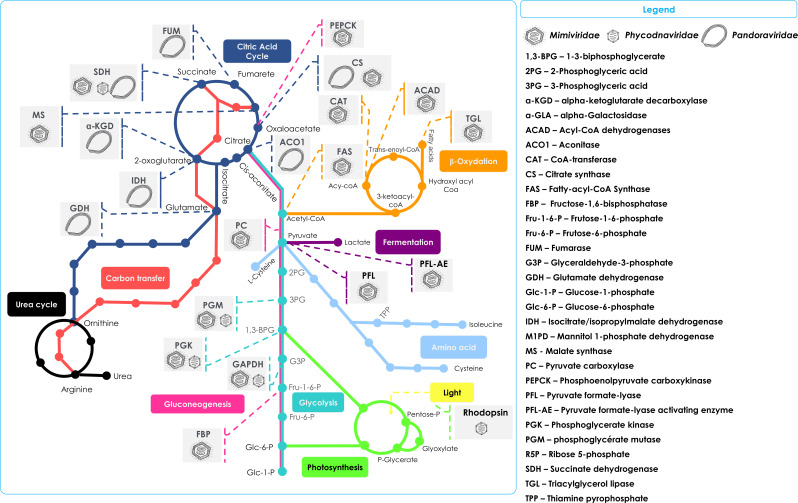
Viruses generally are defined as lacking the fundamental properties of living organisms in that they do not harbor an energy metabolism system or protein synthesis machinery. However, the discovery of giant viruses of amoeba has fundamentally challenged this view because of their exceptional genome properties, particle sizes and encoding of the enzyme machinery for some steps of protein synthesis. Although giant viruses are not able to replicate autonomously and still require a host for their multiplication, numerous metabolic genes involved in energy production have been recently detected in giant virus genomes from many environments. These findings have further blurred the boundaries that separate viruses and living organisms. Herein, we summarize information concerning genes and proteins involved in cellular metabolic pathways and their orthologues that have, surprisingly, been discovered in giant viruses. The remarkable diversity of metabolic genes described in giant viruses include genes encoding enzymes involved in glycolysis, gluconeogenesis, tricarboxylic acid cycle, photosynthesis, and β-oxidation. These viral genes are thought to have been acquired from diverse biological sources through lateral gene transfer early in the evolution of Nucleo-Cytoplasmic Large DNA Viruses, or in some cases more recently. It was assumed that viruses are capable of hijacking host metabolic networks. But the giant virus auxiliary metabolic genes also may represent another form of host metabolism manipulation, by expanding the catalytic capabilities of the host cells especially in harsh environments, providing the infected host cells with a selective evolutionary advantage compared to non-infected cells and hence favoring the viral replication. However, the mechanism of these genes' functionality remains unclear to date.
病毒通常被定义为缺乏生物体的基本属性,因为它们没有能量代谢系统或蛋白质合成机制。然而,变形虫巨型病毒的发现从根本上挑战了这一观点,因为它们具有异常的基因组特性、颗粒大小和编码蛋白质合成某些步骤所需的酶机制。尽管巨型病毒不能自主复制,仍然需要宿主进行繁殖,但最近在来自许多环境的巨型病毒基因组中检测到了许多参与能量产生的代谢基因。这些发现进一步模糊了病毒和生物体之间的界限。在此,我们总结了与细胞代谢途径及其在巨型病毒中发现的同源物有关的基因和蛋白质的信息。在巨型病毒中描述的代谢基因的惊人多样性包括编码参与糖酵解、糖异生、三羧酸循环、光合作用和β-氧化的酶的基因。这些病毒基因被认为是通过横向基因转移从早期核质巨 DNA 病毒的进化过程中的各种生物来源获得的,或者在某些情况下是最近获得的。人们曾假设病毒能够劫持宿主的代谢网络。但是巨型病毒辅助代谢基因也可能代表另一种形式的宿主代谢操纵,通过扩展宿主细胞的催化能力,特别是在恶劣环境中,为感染宿主细胞提供相对于未感染细胞的选择性进化优势,从而有利于病毒复制。然而,这些基因功能的机制迄今为止仍不清楚。