Division of Cardiology, University of North Carolina, Chapel Hill, NC 27599-7075, USA.
J Am Heart Assoc. 2013 Apr 4;2(2):e000004. doi: 10.1161/JAHA.113.000004.
Major advances have been made in the treatment of ST-elevation myocardial infarction (STEMI) in outpatients. In contrast, little is known about outcomes in STEMI that occur in patients hospitalized for a noncardiac condition.
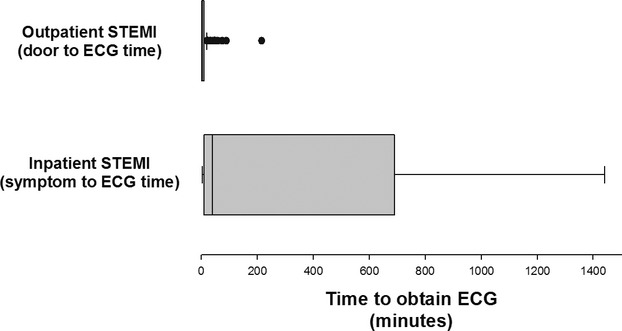
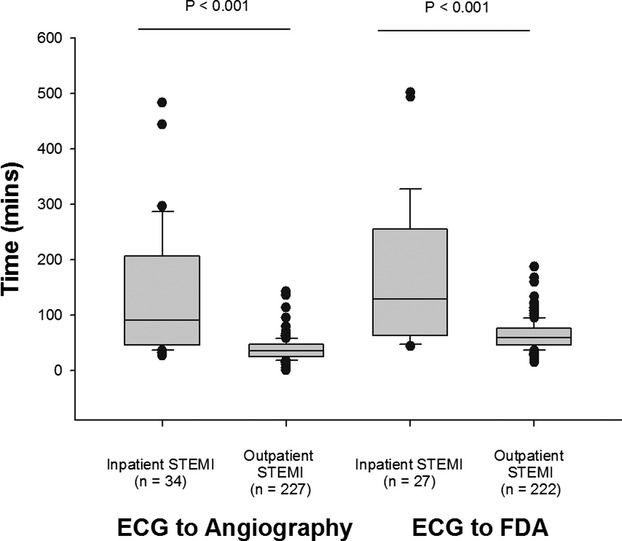
This was a retrospective, single-center study of inpatient STEMIs from January 1, 2007, to July 31, 2011. Forty-eight cases were confirmed to be inpatient STEMIs of a total of 139 410 adult discharges. These patients were older and more often female and had higher rates of chronic kidney disease and prior cerebrovascular events compared with 227 patients with outpatient STEMIs treated during the same period. Onset of inpatient STEMI was heralded most frequently by a change in clinical status (60%) and less commonly by patient complaints (33%) or changes on telemetry. Coronary angiography and percutaneous coronary intervention were performed in 71% and 56% of patients, respectively. The median time to obtain ECG (41 [10, 600] versus 5 [2, 10] minutes; P<0.001), ECG to angiography time (91 [26, 209] versus 35 [25, 46] minutes; P<0.001) and ECG to first device activation (FDA) (129 [65, 25] versus 60 [47, 76] minutes; P<0.001) were longer for inpatient versus outpatient STEMI. Survival to discharge was lower for inpatient STEMI (60% versus 96%; P<0.001), and this difference persisted after adjusting for potential confounders.
Patients who develop a STEMI while hospitalized for a noncardiac condition are older and more often female, have more comorbidities, have longer ECG-to-FDA times, and are less likely to survive than patients with an outpatient STEMI.
ST 段抬高型心肌梗死(STEMI)的门诊治疗已取得重大进展。相比之下,对于因非心脏疾病住院而发生的 STEMI 患者的结局,人们知之甚少。
这是一项回顾性、单中心研究,纳入了 2007 年 1 月 1 日至 2011 年 7 月 31 日期间因非心脏疾病住院的 STEMI 患者。共确认了 48 例住院 STEMI 患者,总计 139410 例成年出院患者。与同期治疗的 227 例门诊 STEMI 患者相比,这些患者年龄更大,女性更多,慢性肾脏病和既往脑血管事件发生率更高。住院 STEMI 最常见的发病先兆是临床状态的改变(60%),较少见的是患者自述(33%)或遥测的变化。分别有 71%和 56%的患者进行了冠状动脉造影和经皮冠状动脉介入治疗。获得心电图的中位数时间(41[10,600]与 5[2,10]分钟;P<0.001)、心电图至冠状动脉造影时间(91[26,209]与 35[25,46]分钟;P<0.001)和心电图至首次设备激活(FDA)时间(129[65,25]与 60[47,76]分钟;P<0.001)在住院 STEMI 患者中均更长。住院 STEMI 患者的出院生存率更低(60%与 96%;P<0.001),这种差异在调整了潜在混杂因素后仍然存在。
因非心脏疾病住院时发生 STEMI 的患者年龄更大,女性更多,合并症更多,心电图至 FDA 时间更长,生存率低于门诊 STEMI 患者。