• 文献检索
  • 文档翻译
  • 深度研究
  • 学术资讯
  • Suppr Zotero 插件Zotero 插件
  • 邀请有礼
  • 套餐&价格
  • 历史记录
应用&插件
Suppr Zotero 插件Zotero 插件浏览器插件Mac 客户端Windows 客户端微信小程序
定价
高级版会员购买积分包购买API积分包
服务
文献检索文档翻译深度研究API 文档MCP 服务
关于我们
关于 Suppr公司介绍联系我们用户协议隐私条款
关注我们

Suppr 超能文献

核心技术专利:CN118964589B侵权必究
粤ICP备2023148730 号-1Suppr @ 2026

文献检索

告别复杂PubMed语法,用中文像聊天一样搜索,搜遍4000万医学文献。AI智能推荐,让科研检索更轻松。

立即免费搜索

文件翻译

保留排版,准确专业,支持PDF/Word/PPT等文件格式,支持 12+语言互译。

免费翻译文档

深度研究

AI帮你快速写综述,25分钟生成高质量综述,智能提取关键信息,辅助科研写作。

立即免费体验

动静脉畸形腔室:它们是否调节经窦压力?一项电网分析。

AVM Compartments: Do they modulate trasnidal pressures? An electrical network analysis.

作者信息

Litao Miguel Lorenzo Silva, Pilar-Arceo Carlene Pc, Legaspi Gerardo Dizon

机构信息

Department of Neurosciences, University of the Philippines -Manila College of Medicine, Quezon City, Philippines.

出版信息

Asian J Neurosurg. 2012 Oct;7(4):174-80. doi: 10.4103/1793-5482.106649.

DOI:10.4103/1793-5482.106649
PMID:23559984
原文链接:https://pmc.ncbi.nlm.nih.gov/articles/PMC3613639/
Abstract

BACKGROUND

Arteriovenous malformation (AVM) compartments are thought as independently fed, hemodynamically independent components of the AVM nidus. Its possible role in modulating transnidal pressures have not been investigated to our knowledge.

OBJECTIVE

To investigate if AVM compartments play a role in modulating transnidal pressures by using electrical models as a method of investigation.

MATERIALS AND METHODS

Monocompartmental and multicompartmental AVM models were constructed using electrical circuits- building on Dr. Guglielmi's previous work. Each compartment was fed by two feeding arteries (resistors) and had a shared draining vein with other compartments in the AVM nidus. Each compartment is composed of a series of resistors which represents the pressure gradient along the AVM (arterial, arteriolar, venular, and venous). Pressure (voltage) readings were obtained within these nidal points.

RESULTS

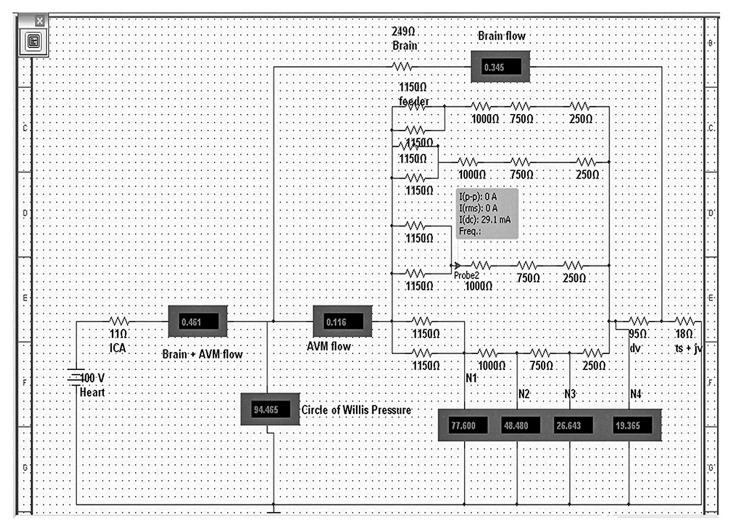
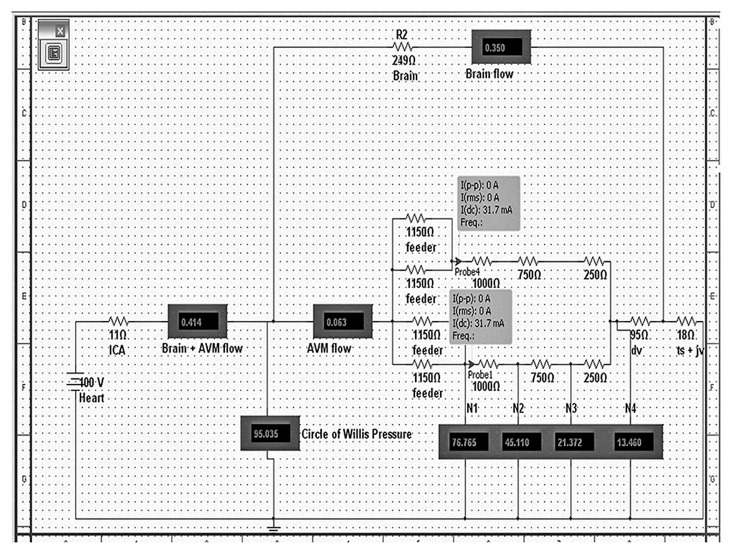
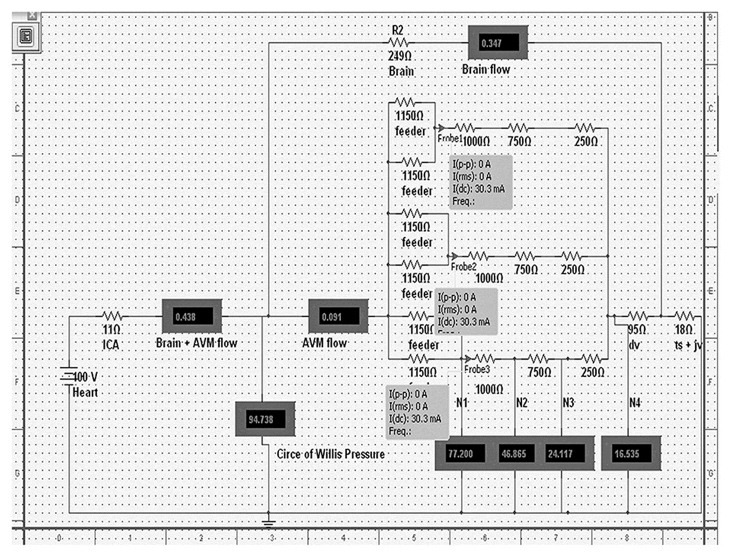
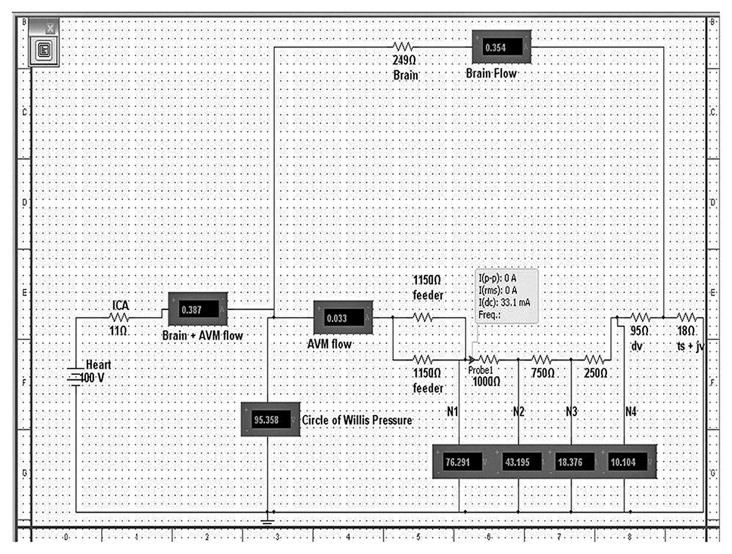
The pressure gradient (venous-arterial) is more as there are less AVM compartments in the nidus model. The monocomparmental model had a pressure gradient of 66mmHg (V); while it was 64, 61, and 59 for the 2-, 3-, and 4-compartment models, respectively. In addition, the more the number of compartments, the greater the flow (mA) is in the whole AVM nidus, 33 ml/min for the monocompartmental AVM and 121ml/min for the 4-compartment AVM; though there was greater flow per compartment as there were less compartments, 33ml/min per compartment for the monocompartmental model versus 29ml/min for the 4-compartment model.

CONCLUSION

Transnidal pressure gradients may be less the more compartments an AVM has. This electrical model represents an approach that can be used in investigating the hemodynamic contributions of AVM compartments.

摘要

背景

动静脉畸形(AVM)腔室被认为是AVM病灶中独立供血、血流动力学独立的组成部分。据我们所知,其在调节经病灶压力方面的可能作用尚未得到研究。

目的

通过使用电模型作为研究方法,探讨AVM腔室在调节经病灶压力方面是否起作用。

材料与方法

基于古列尔米博士之前的工作,使用电路构建单腔室和多腔室AVM模型。每个腔室由两条供血动脉(电阻)供血,并与AVM病灶中的其他腔室共用一条引流静脉。每个腔室由一系列电阻组成,代表沿AVM(动脉、小动脉、小静脉和静脉)的压力梯度。在这些病灶点获取压力(电压)读数。

结果

病灶模型中的AVM腔室越少,压力梯度(静脉-动脉)越大。单腔室模型的压力梯度为66mmHg(V);而双腔室、三腔室和四腔室模型的压力梯度分别为64mmHg、61mmHg和59mmHg。此外,腔室数量越多,整个AVM病灶中的血流量(mA)就越大,单腔室AVM为33ml/min,四腔室AVM为121ml/min;尽管每个腔室的血流量随着腔室数量减少而更大,单腔室模型为每个腔室33ml/min,四腔室模型为每个腔室29ml/min。

结论

AVM的腔室越多,经病灶压力梯度可能越小。这种电模型代表了一种可用于研究AVM腔室血流动力学贡献的方法。
https://cdn.ncbi.nlm.nih.gov/pmc/blobs/aa1a/3613639/57fb0830be38/AJNS-7-174-g004.jpg
https://cdn.ncbi.nlm.nih.gov/pmc/blobs/aa1a/3613639/da33ba2c0eef/AJNS-7-174-g001.jpg
https://cdn.ncbi.nlm.nih.gov/pmc/blobs/aa1a/3613639/c7c81887b854/AJNS-7-174-g002.jpg
https://cdn.ncbi.nlm.nih.gov/pmc/blobs/aa1a/3613639/ecc1ba0642eb/AJNS-7-174-g003.jpg
https://cdn.ncbi.nlm.nih.gov/pmc/blobs/aa1a/3613639/57fb0830be38/AJNS-7-174-g004.jpg
https://cdn.ncbi.nlm.nih.gov/pmc/blobs/aa1a/3613639/da33ba2c0eef/AJNS-7-174-g001.jpg
https://cdn.ncbi.nlm.nih.gov/pmc/blobs/aa1a/3613639/c7c81887b854/AJNS-7-174-g002.jpg
https://cdn.ncbi.nlm.nih.gov/pmc/blobs/aa1a/3613639/ecc1ba0642eb/AJNS-7-174-g003.jpg
https://cdn.ncbi.nlm.nih.gov/pmc/blobs/aa1a/3613639/57fb0830be38/AJNS-7-174-g004.jpg

相似文献

1
AVM Compartments: Do they modulate trasnidal pressures? An electrical network analysis.动静脉畸形腔室:它们是否调节经窦压力?一项电网分析。
Asian J Neurosurg. 2012 Oct;7(4):174-80. doi: 10.4103/1793-5482.106649.
2
A biomathematical model of intracranial arteriovenous malformations based on electrical network analysis: theory and hemodynamics.基于电网分析的颅内动静脉畸形生物数学模型:理论与血流动力学
Neurosurgery. 1996 May;38(5):1005-14; discussion 1014-5. doi: 10.1097/00006123-199605000-00030.
3
An electrical network model of intracranial arteriovenous malformations: analysis of variations in hemodynamic and biophysical parameters.颅内动静脉畸形的电网络模型:血流动力学和生物物理参数变化分析
Neurol Res. 1996 Dec;18(6):575-89. doi: 10.1080/01616412.1996.11740474.
4
Analysis of the hemodynamic characteristics of brain arteriovenous malformations using electrical models: baseline settings, surgical extirpation, endovascular embolization, and surgical bypass.使用电学模型分析脑动静脉畸形的血流动力学特征:基线设置、手术切除、血管内栓塞和手术搭桥。
Neurosurgery. 2008 Jul;63(1):1-10; discussion 11. doi: 10.1227/01.NEU.0000335065.07448.8A.
5
Electrical models in the analysis of hemodynamic characteristics of arteriovenous malformations. Part 1: baseline measurements.动静脉畸形血流动力学特征分析中的电学模型。第1部分:基线测量。
Interv Neuroradiol. 2006 Mar 15;12(1):9-15. doi: 10.1177/159101990601200103. Epub 2006 Jun 15.
6
Direct continuous measurement of draining vein pressure during Onyx embolization in a swine arteriovenous malformation model.在猪动静脉畸形模型中进行Onyx栓塞时对引流静脉压力的直接连续测量。
J Neurointerv Surg. 2015 Jan;7(1):62-6. doi: 10.1136/neurintsurg-2013-011066. Epub 2014 Jan 17.
7
Risk of intracranial arteriovenous malformation rupture due to venous drainage impairment. A theoretical analysis.因静脉引流障碍导致颅内动静脉畸形破裂的风险。一项理论分析。
Stroke. 1996 Jun;27(6):1072-83. doi: 10.1161/01.str.27.6.1072.
8
Transvenous retrograde nidus sclerotherapy under controlled hypotension (TRENSH): hemodynamic analysis and concept validation in a pig arteriovenous malformation model.经静脉逆行瘤内硬化治疗(TRENSH):在猪动静脉畸形模型中进行的控制性降压下的血流动力学分析和概念验证。
Neurosurgery. 2013 Aug;73(2):332-42; discussion 342-3. doi: 10.1227/01.neu.0000430765.80102.77.
9
Computational Network Modeling of Intranidal Hemodynamic Compartmentalization in a Theoretical Three-Dimensional Brain Arteriovenous Malformation.理论三维脑动静脉畸形巢内血流动力学分区的计算网络建模
Front Physiol. 2019 Sep 24;10:1250. doi: 10.3389/fphys.2019.01250. eCollection 2019.
10
Can induction of systemic hypotension help prevent nidus rupture complicating arteriovenous malformation embolization?: analysis of underlying mechanism achieved using a theoretical model.诱导全身低血压有助于预防动静脉畸形栓塞术并发的病灶破裂吗?:使用理论模型对潜在机制的分析
AJNR Am J Neuroradiol. 2000 Aug;21(7):1255-67.

引用本文的文献

1
Optimal control problem arising in mathematical modeling of cerebral vascular pathology embolization.在脑血管病变栓塞的数学建模中出现的最优控制问题。
Sci Rep. 2022 Jan 25;12(1):1302. doi: 10.1038/s41598-022-05231-w.
2
Modelling of the arteriovenous malformation embolization optimal scenario.动静脉畸形栓塞最佳方案的建模
R Soc Open Sci. 2020 Jul 22;7(7):191992. doi: 10.1098/rsos.191992. eCollection 2020 Jul.
3
Update Onyx embolization for plexiform arteriovenous malformation: Ante-grade drifting technique.更新 Onyx 栓塞治疗丛状动静脉畸形:顺行漂移技术。

本文引用的文献

1
Pathophysiology and treatment of brain AVMs.脑动静脉畸形的病理生理学与治疗
Klin Neuroradiol. 2009 Mar;19(1):82-90. doi: 10.1007/s00062-009-8035-y. Epub 2009 May 15.
2
Analysis of the hemodynamic characteristics of brain arteriovenous malformations using electrical models: baseline settings, surgical extirpation, endovascular embolization, and surgical bypass.使用电学模型分析脑动静脉畸形的血流动力学特征:基线设置、手术切除、血管内栓塞和手术搭桥。
Neurosurgery. 2008 Jul;63(1):1-10; discussion 11. doi: 10.1227/01.NEU.0000335065.07448.8A.
3
Intravascular pressure measurements in feeding pedicles of brain arteriovenous malformations.
Neuroradiol J. 2020 Oct;33(5):386-392. doi: 10.1177/1971400920940207. Epub 2020 Jul 16.
脑动静脉畸形供血蒂内的血管压力测量
Neuroradiology. 2006 Mar;48(3):182-9. doi: 10.1007/s00234-005-0022-7. Epub 2005 Nov 22.
4
Concept of arteriovenous malformation compartments and surgical management.动静脉畸形腔室的概念及外科治疗
Neurol Res. 2004 Apr;26(3):288-300. doi: 10.1179/016164104225013987.
5
Analysis of mean transit time of contrast medium in ruptured and unruptured arteriovenous malformations: a digital subtraction angiographic study.破裂和未破裂动静脉畸形中造影剂平均通过时间的分析:一项数字减影血管造影研究。
Stroke. 2003 Oct;34(10):2410-4. doi: 10.1161/01.STR.0000089924.43363.E3. Epub 2003 Sep 11.
6
Compartments in arteriovenous malformation nidi demonstrated with rotational three-dimensional digital subtraction angiography by using selective microcatheterization. Report of three cases.通过选择性微导管插入术利用旋转三维数字减影血管造影术显示的动静脉畸形巢中的间隔。三例报告。
J Neurosurg. 2002 Apr;96(4):770-4. doi: 10.3171/jns.2002.96.4.0770.
7
The influence of vascular pressure and angiographic characteristics on haemorrhage from arteriovenous malformations.血管压力和血管造影特征对动静脉畸形出血的影响。
Acta Neurochir (Wien). 2000;142(1):39-43. doi: 10.1007/s007010050005.
8
Feeding artery pressure and venous drainage pattern are primary determinants of hemorrhage from cerebral arteriovenous malformations.供血动脉压力和静脉引流模式是脑动静脉畸形出血的主要决定因素。
Stroke. 1998 Jun;29(6):1167-76. doi: 10.1161/01.str.29.6.1167.
9
A biomathematical model of intracranial arteriovenous malformations based on electrical network analysis: theory and hemodynamics.基于电网分析的颅内动静脉畸形生物数学模型:理论与血流动力学
Neurosurgery. 1996 May;38(5):1005-14; discussion 1014-5. doi: 10.1097/00006123-199605000-00030.
10
The influence of hemodynamic and anatomic factors on hemorrhage from cerebral arteriovenous malformations.
Neurosurgery. 1994 May;34(5):801-7; discussion 807-8. doi: 10.1227/00006123-199405000-00003.