Division of Population Health, National Center for Chronic Disease Prevention and Health Promotion, Centers for Disease Control and Prevention, Atlanta, Georgia 30341, USA.
J Am Coll Cardiol. 2013 Jun 4;61(22):2249-52. doi: 10.1016/j.jacc.2013.03.023. Epub 2013 Apr 3.
The objective of this study was to examine trends in predicted 10-year risk for coronary heart disease (CHD) and cardiovascular disease (CVD) from 1999 to 2000 and from 2009 to 2010 among adults in the United States.
Examining trends in predicted risk for CHD and CVD may offer insights into the direction of cardiovascular health.
Data from 7,751 fasting participants, ages 30 to 74 years, of 6 consecutive 2-year cycles of the National Health and Nutrition Examination Survey were used. Predicted 10-year risk for CHD and CVD was calculated using risk equations derived from data from the Framingham Heart Study.
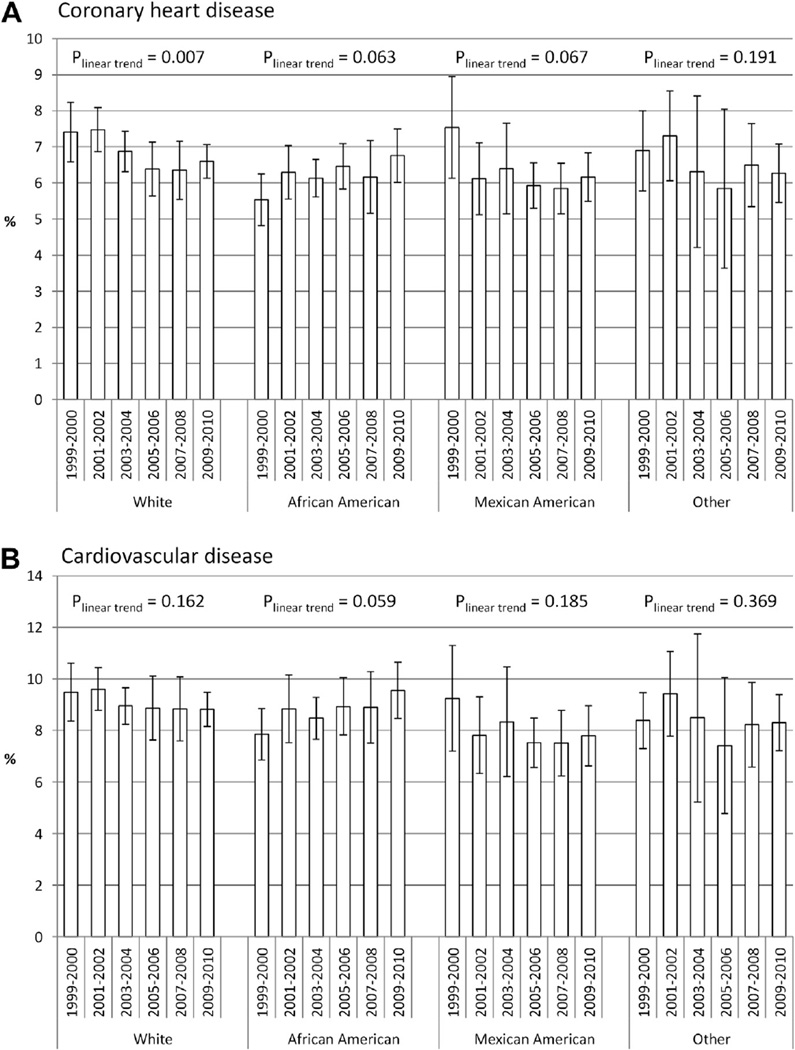
Mean predicted 10-year risk for CHD was 7.2% during 1999 to 2000 and 6.5% during 2009 to 2010 (p for linear trend = 0.005), and for CVD it was 9.2% during 1999 to 2000 and 8.7% during 2009 to 2010 (p for linear trend = 0.152). Mean predicted risk for CHD and CVD declined significantly among participants ages 40 to 49 years, 50 to 59 years, 60 to 74 years, and among women. Mean predicted risk for CHD declined significantly among men and whites but nonsignificantly among Mexican Americans (p for linear trend = 0.067). Mean predicted risk increased nonsignificantly among African Americans for both CHD (p for linear trend = 0.063) and CVD (p for linear trend = 0.059). Of the modifiable cardiovascular risk factors included in the risk equations, favorable trends were noted for mean systolic and diastolic blood pressure, mean concentrations of total cholesterol and high-density lipoprotein cholesterol, and smoking status. The prevalence of diabetes mellitus worsened.
Predicted 10-year risk for CHD improved modestly. Reversing the seemingly rising trend in risk among African-American adults should be a high priority.
本研究旨在检验美国成年人在 1999 至 2000 年和 2009 至 2010 年期间,冠心病(CHD)和心血管疾病(CVD)的 10 年预测风险的变化趋势。
检验 CHD 和 CVD 的预测风险变化趋势,可能有助于了解心血管健康的发展方向。
本研究使用了来自美国国家健康与营养调查(NHANES)6 个连续 2 年周期中 7751 名年龄在 30 至 74 岁的禁食参与者的数据。使用Framingham 心脏研究的数据得出的风险方程来计算 CHD 和 CVD 的 10 年预测风险。
1999 至 2000 年期间,CHD 的平均 10 年预测风险为 7.2%,2009 至 2010 年期间为 6.5%(线性趋势 p 值=0.005);1999 至 2000 年期间,CVD 的平均 10 年预测风险为 9.2%,2009 至 2010 年期间为 8.7%(线性趋势 p 值=0.152)。40 至 49 岁、50 至 59 岁、60 至 74 岁的参与者以及女性的 CHD 和 CVD 预测风险均显著下降。男性和白人的 CHD 预测风险显著下降,但墨西哥裔美国人的预测风险无显著变化(线性趋势 p 值=0.067)。非裔美国人的 CHD(线性趋势 p 值=0.063)和 CVD(线性趋势 p 值=0.059)预测风险均呈上升趋势,但无统计学意义。风险方程中包含的可改变心血管危险因素,其平均收缩压和舒张压、总胆固醇和高密度脂蛋白胆固醇的平均浓度以及吸烟状况均呈有利趋势。糖尿病的患病率则恶化了。
CHD 的 10 年预测风险略有改善。扭转非裔美国人风险上升的趋势应是重中之重。