Department of Clinical Neurosciences, Norwegian University of Science and Technology, Trondheim, N-7489, Norway.
J Headache Pain. 2013 Feb 14;14(1):12. doi: 10.1186/1129-2377-14-12.
Our aim was to compare subjective and objective sleep quality and arousal in migraine and to evaluate the relationship between sleep quality and pain thresholds (PT) in controls, interictal, preictal and postictal migraine.
Polysomnography and PT (to pressure, heat and cold) measurements were done in 34 healthy controls and 50 migraineurs. Subjective sleep quality was assessed by sleep diaries, Epworth sleepiness scale, Karolinska sleep questionnaire and Pittsburgh sleep quality index. Migraineurs who had their sleep registration more than 48 h from an attack were classified as interictal while those who were less than 48 h from an attack were classified as either preictal or postictal.
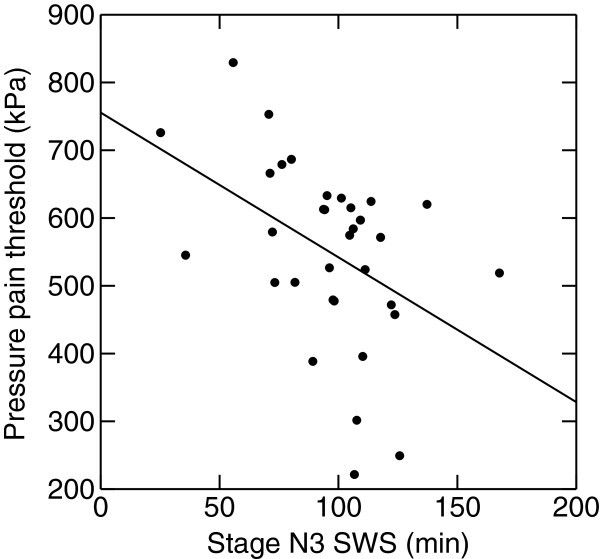
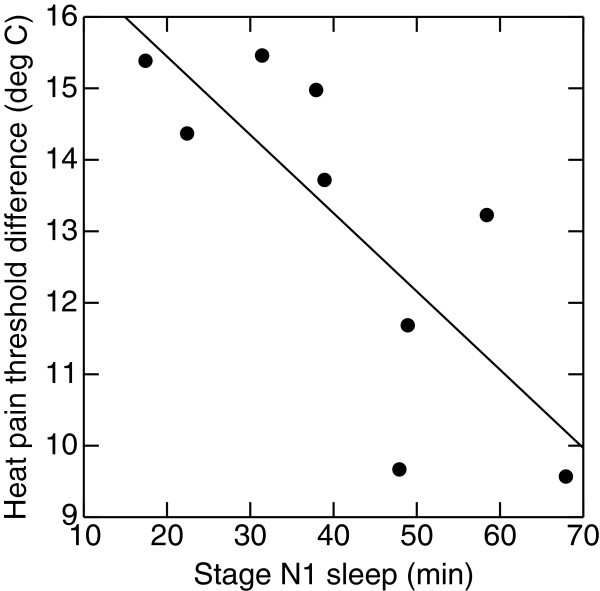
Migraineurs reported more insomnia and other sleep-related symptoms than controls, but the objective sleep differences were smaller and we found no differences in daytime sleepiness. Interictal migraineurs had more awakenings (p=0.048), a strong tendency for more slow-wave sleep (p=0.050), lower thermal pain thresholds (TPT) (heat pain thresholds p=0.043 and cold pain thresholds p=0.031) than controls. Migraineurs in the preictal phase had shorter latency to sleep onset than controls (p=0.003). Slow-wave sleep correlated negatively with pressure PT and slow bursts correlated negatively with TPT.
Lower PT in interictal migraineurs seems related to increased sleep pressure. We hypothesize that migraineurs on the average suffer from a relative sleep deprivation and need more sleep than healthy controls. Lack of adequate rest might be an attack-precipitating- and hyperalgesia-inducing factor.
我们的目的是比较偏头痛患者的主观和客观睡眠质量和觉醒,并评估睡眠质量与对照组、发作间期、发作前和发作后偏头痛患者疼痛阈值(PT)之间的关系。
对 34 名健康对照者和 50 名偏头痛患者进行多导睡眠图和 PT(压力、热和冷)测量。通过睡眠日记、Epworth 嗜睡量表、卡罗林斯卡睡眠问卷和匹兹堡睡眠质量指数评估主观睡眠质量。睡眠登记时间距发作超过 48 小时的偏头痛患者被归类为发作间期,而距发作不足 48 小时的患者被归类为发作前或发作后。
偏头痛患者比对照组报告更多的失眠和其他与睡眠相关的症状,但客观睡眠差异较小,且我们发现白天嗜睡没有差异。发作间期偏头痛患者的觉醒次数更多(p=0.048),慢波睡眠有较强的趋势(p=0.050),热痛阈值(heat pain thresholds,PT)较低(热痛阈值 p=0.043,冷痛阈值 p=0.031)。发作前相的偏头痛患者比对照组入睡潜伏期更短(p=0.003)。慢波睡眠与压力 PT 呈负相关,慢波爆发与 TPT 呈负相关。
发作间期偏头痛患者的 PT 较低似乎与睡眠压力增加有关。我们假设偏头痛患者平均存在相对的睡眠剥夺,需要比健康对照组更多的睡眠。缺乏足够的休息可能是诱发发作和引起痛觉过敏的因素。