Groener Jan B, Lehnhoff Daniel, Piel David, Nawroth Peter P, Schanz Jurik, Rudofsky Gottfried
Department Medicine, Endocrinology and Clinical Chemistry, University of Heidelberg, Heidelberg, Germany.
Am J Case Rep. 2013;14:48-51. doi: 10.12659/AJCR.883788. Epub 2013 Feb 20.
Hypothyroidism can usually be treated effectively by oral levothyroxine supplementation. There are, however, some rare circumstances, when oral levothyroxine application is not sufficient, for example malabsorption, interactions with food or other medications, or various gastrointestinal diseases.
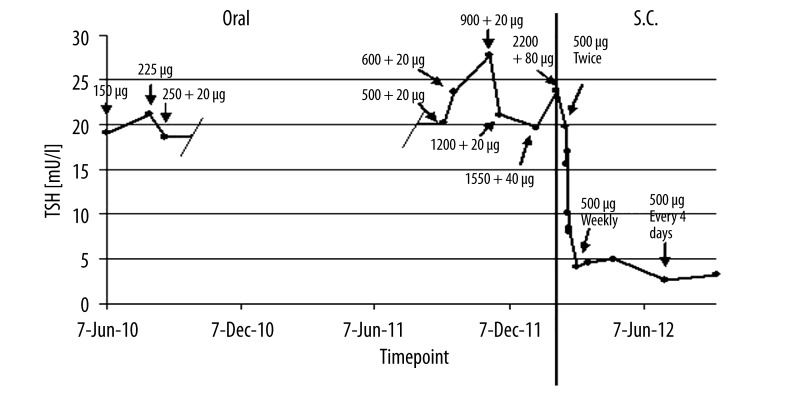
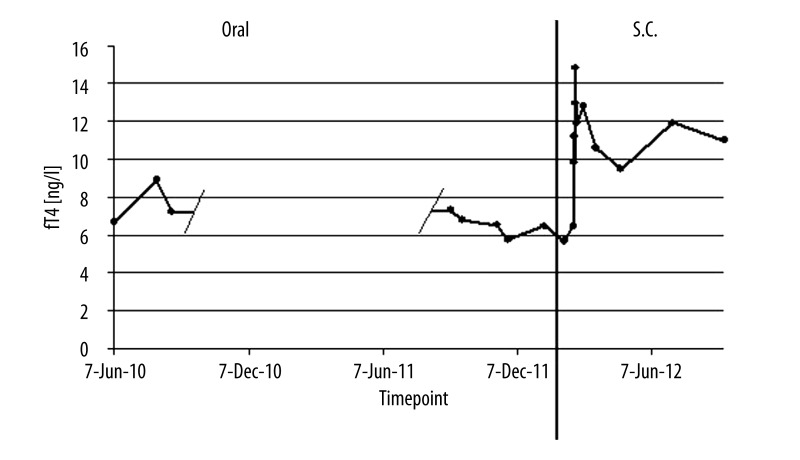
We present a 42 year old woman with refractory and severe symptomatic hypothyroidism after subtotal thyroidectomy in spite of high dose oral levothyroxine supplementation. By stepwise increasing oral levothyroxine dosage up to 2200 micrograms plus 80 micrograms of thyronine, no sufficient substitution could be achieved. After suspicion of enteral malabsorption due to a pathological D-Xylose-test, subcutaneous levothyroxine supplementation was started. Finally, a sustained euthyroid state could be achieved.
For selected patients who do not respond to oral treatment subcutaneous application of levothyroxine can be a suitable and effective therapy.
甲状腺功能减退通常可通过口服补充左甲状腺素有效治疗。然而,在一些罕见情况下,口服左甲状腺素并不足够,例如吸收不良、与食物或其他药物相互作用,或各种胃肠道疾病。
我们报告一名42岁女性,在甲状腺次全切除术后,尽管口服高剂量左甲状腺素,仍患有难治性严重症状性甲状腺功能减退。逐步将口服左甲状腺素剂量增加至2200微克加80微克三碘甲状腺原氨酸,仍无法实现充分替代。在因病理D-木糖试验怀疑肠道吸收不良后,开始皮下补充左甲状腺素。最终,实现了持续的甲状腺功能正常状态。
对于口服治疗无反应的特定患者,皮下应用左甲状腺素可能是一种合适且有效的治疗方法。