Department of Epidemiology, University of North Carolina, Chapel Hill, NC, USA.
J Acquir Immune Defic Syndr. 2013 Aug 1;63(4):506-13. doi: 10.1097/QAI.0b013e318293df9e.
Hormonal contraception (HC) use by HIV-infected women has been identified by the World Health Organization as an important strategy for reducing vertical HIV transmission. Little is known about the factors associated with HC discontinuation among HIV-infected women.
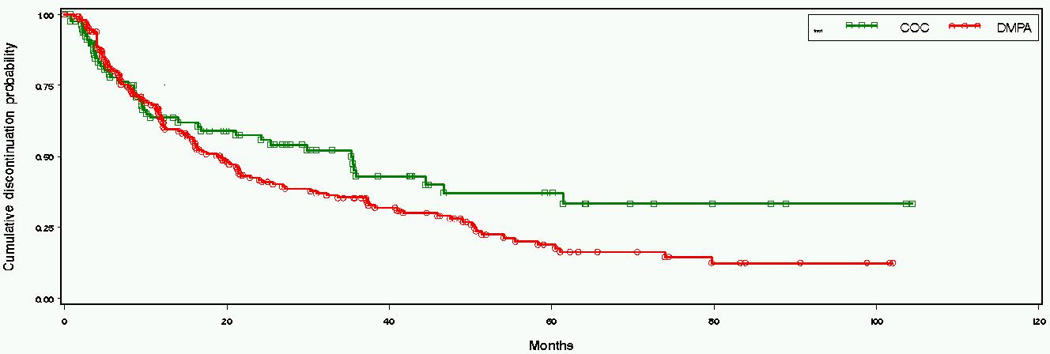
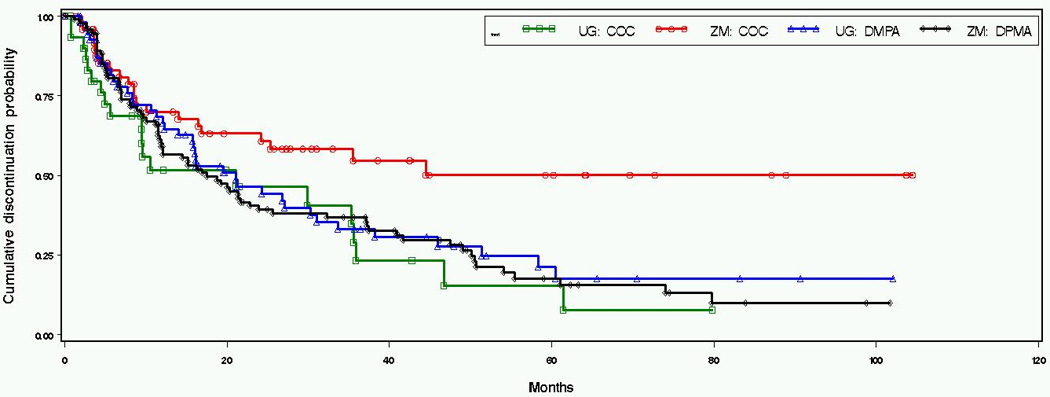
We analyzed data from a prospective study of HC use among 231 HIV-infected users with oral contraceptive (OC) or injectable depot medroxyprogesterone acetate (DMPA) in Uganda and Zimbabwe. We used Kaplan-Meier survival curves to estimate the median duration of OC and DMPA use and use of any highly effective contraceptive method. Cox proportional hazards models were used to investigate factors associated with HC discontinuation.
Median duration was 36 months [95% confidence interval (CI): 14 to 61] for OC use and 19 months (95% CI: 14 to 24) for DMPA use. Median duration of any highly effective method was 36 months (95% CI: 26 to N/A) for OC users and 22 months (95% CI: 14 to 38) for DMPA users. In multivariable analyses, living in Zimbabwe [hazard ratio (HR): 0.39; 95% CI: 0.18 to 0.83], no partner (HR: 7.18; 95% CI: 3.05 to 16.88), and cervical infection (HR: 1.99; 95% CI: 0.90 to 4.41) were associated with OC discontinuation. No partner (HR: 2.00; 95% CI: 1.12 to 3.58), nausea (HR: 1.84; 95% CI: 1.02 to 3.34), and excessive night sweats (HR: 1.80; 95% CI: 0.95 to 3.40) were associated with DMPA discontinuation.
Long-term use of HC methods is acceptable to HIV-infected women. Women discontinue for a variety of reasons, primarily unrelated to HIV. Alternative methods and ongoing contraceptive counseling is essential to reduce unplanned pregnancies and vertical HIV transmission.
世界卫生组织已将艾滋病毒感染者使用激素避孕(HC)确定为降低垂直艾滋病毒传播的重要策略。目前,人们对艾滋病毒感染者停止使用 HC 的相关因素知之甚少。
我们分析了在乌干达和津巴布韦开展的一项前瞻性研究中,231 名使用口服避孕药(OC)或注射型长效醋酸甲羟孕酮(DMPA)的 HIV 感染者使用 HC 的数据。我们使用 Kaplan-Meier 生存曲线来估计 OC 和 DMPA 的使用中位持续时间以及任何高效避孕方法的使用中位持续时间。我们采用 Cox 比例风险模型来研究与 HC 停药相关的因素。
OC 的使用中位持续时间为 36 个月(95%CI:14 至 61),DMPA 的使用中位持续时间为 19 个月(95%CI:14 至 24)。OC 用户使用任何高效方法的中位持续时间为 36 个月(95%CI:26 至 N/A),DMPA 用户为 22 个月(95%CI:14 至 38)。在多变量分析中,居住在津巴布韦(HR:0.39;95%CI:0.18 至 0.83)、无伴侣(HR:7.18;95%CI:3.05 至 16.88)和宫颈感染(HR:1.99;95%CI:0.90 至 4.41)与 OC 停药相关。无伴侣(HR:2.00;95%CI:1.12 至 3.58)、恶心(HR:1.84;95%CI:1.02 至 3.34)和夜间盗汗过多(HR:1.80;95%CI:0.95 至 3.40)与 DMPA 停药相关。
HIV 感染者长期使用 HC 方法是可以接受的。女性停药的原因多种多样,主要与 HIV 无关。提供替代方法和持续的避孕咨询对于减少意外怀孕和垂直传播 HIV 至关重要。