
基于人群的 [(18)F]FMPEP-d2 内源性函数模型建立,一种大麻素 CB1 受体反向激动剂放射性配体:在临床研究中的验证。
Population-based input function modeling for [(18)F]FMPEP-d 2, an inverse agonist radioligand for cannabinoid CB1 receptors: validation in clinical studies.
机构信息
Molecular Imaging Branch, National Institute of Mental Health, National Institutes of Health, Bethesda, MD, USA.
出版信息
PLoS One. 2013;8(4):e60231. doi: 10.1371/journal.pone.0060231. Epub 2013 Apr 5.
BACKGROUND
Population-based input function (PBIF) may be a valid alternative to full blood sampling for quantitative PET imaging. PBIF is typically validated by comparing its quantification results with those obtained via arterial sampling. However, for PBIF to be employed in actual clinical research studies, its ability to faithfully capture the whole spectrum of results must be assessed. The present study validated a PBIF for [(18)F]FMPEP-d 2, a cannabinoid CB1 receptor radioligand, in healthy volunteers, and also attempted to utilize PBIF to replicate three previously published clinical studies in which the input function was acquired with arterial sampling.
METHODS
The PBIF was first created and validated with data from 42 healthy volunteers. This PBIF was used to assess the retest variability of [(18)F]FMPEP-d 2, and then to quantify CB1 receptors in alcoholic patients (n = 18) and chronic daily cannabis smokers (n = 29). Both groups were scanned at baseline and after 2-4 weeks of monitored drug abstinence.
RESULTS
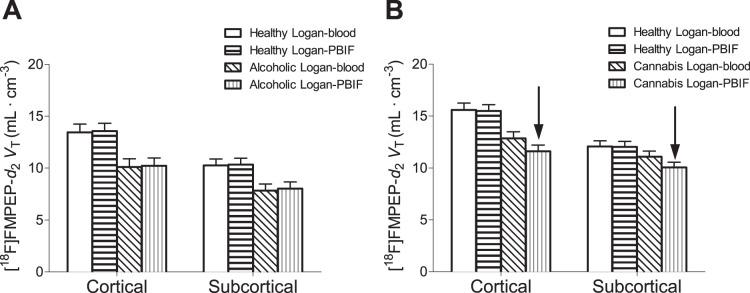
PBIF yielded accurate results in the 42 healthy subjects (average Logan-distribution volume (V T) was 13.3±3.8 mL/cm(3) for full sampling and 13.2±3.8 mL/cm(3) for PBIF; R(2) = 0.8765, p<0.0001) and test-retest results were comparable to those obtained with full sampling (variability: 16%; intraclass correlation coefficient: 0.89). PBIF accurately replicated the alcoholism study, showing a widespread ∼20% reduction of CB1 receptors in alcoholic subjects, without significant change after abstinence. However, a small PBIF-V T bias of -9% was unexpectedly observed in cannabis smokers. This bias led to substantial errors, including a V T decrease in regions that had shown no downregulation in the full input function. Simulated data showed that the original findings could only have been replicated with a PBIF bias between -6% and +4%.
CONCLUSIONS
Despite being initially well validated in healthy subjects, PBIF may misrepresent clinical protocol results and be a source of variability between different studies and institutions.
背景
基于人群的输入函数(PBIF)可能是定量 PET 成像的全血采样的有效替代方法。PBIF 的定量结果通常通过与动脉采样获得的结果进行比较来验证。然而,为了在实际的临床研究中使用 PBIF,必须评估其准确捕获整个结果谱的能力。本研究通过 42 名健康志愿者验证了一种用于[(18)F]FMPEP-d2 的 PBIF,[(18)F]FMPEP-d2 是一种大麻素 CB1 受体放射性配体,同时还尝试利用 PBIF 复制以前使用动脉采样获得输入函数的三项临床研究。
方法
首先使用 42 名健康志愿者的数据创建和验证 PBIF。使用该 PBIF 评估[(18)F]FMPEP-d2 的重测可变性,然后用于量化酒精患者(n=18)和慢性每日吸食大麻者(n=29)的 CB1 受体。两组均在基线和 2-4 周的药物戒断监测后进行扫描。
结果
PBIF 在 42 名健康受试者中产生了准确的结果(全采样的平均 Logan 分布容积(V T)为 13.3±3.8 mL/cm3,PBIF 为 13.2±3.8 mL/cm3;R2=0.8765,p<0.0001),且测试-重测结果与全采样结果相当(变异性:16%;组内相关系数:0.89)。PBIF 准确复制了酒精中毒研究结果,显示酒精中毒患者的 CB1 受体广泛减少了约 20%,但戒断后没有明显变化。然而,在大麻吸食者中意外观察到 PBIF-V T 的小的-9%偏差。这种偏差导致了很大的误差,包括在全输入函数显示无下调的区域中 V T 的减少。模拟数据表明,只有在 PBIF 偏差在-6%和+4%之间时,原始发现才能被复制。
结论
尽管在健康受试者中最初得到了很好的验证,但 PBIF 可能会歪曲临床方案的结果,并且是不同研究和机构之间变异性的来源。


 Zotero 插件