Naghibi Sistani Mohammad Mehdi, Yazdani Reza, Virtanen Jorma, Pakdaman Afsaneh, Murtomaa Heikki
Department of Community Oral Health, School of Dentistry, Tehran University of Medical Sciences, P.O. Box 1439955991, Tehran, Iran ; Department of Oral Public Health, Institute of Dentistry, University of Helsinki, P.O. Box 41, 00014 Helsinki, Finland.
ISRN Dent. 2013;2013:249591. doi: 10.1155/2013/249591. Epub 2013 Mar 13.
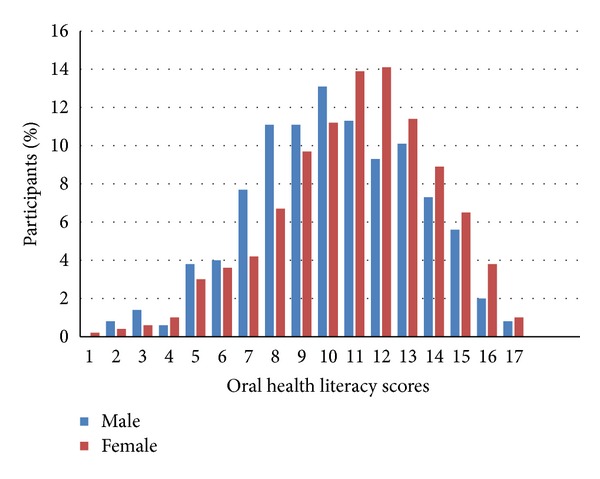
Objective. To evaluate oral health literacy, independent of other oral health determinants, as a risk indicator for self-reported oral health. Methods. A cross-sectional population-based survey conducted in Tehran, Iran. Multiple logistic regression analysis served to estimate the predictive effect of oral health literacy on self-reported oral health status (good versus poor) controlling for socioeconomic and demographic factors and tooth-brushing behavior. Results. In all, among 1031 participants (mean age 36.3 (SD 12.9); 51% female), women reported brushing their teeth more frequently (P < 0.001) and scored higher for oral health literacy (mean 10.9 versus 10.2, P < 0.001). In the adjusted model, high age (OR = 1.01, 95% CI 1.003-1.034), low education (OR = 1.88, 95% CI 1.23-2.87), small living area in square meters per person (OR = 1.85, 95% CI 1.003-3.423), poor tooth brushing behavior (OR = 3.35, 95% CI 2.02-5.57), and low oral health literacy scores (OR = 1.58, 95% CI 1.02-2.45) were significant risk indicators for poor self-reported oral health. Conclusions. Low oral health literacy level, independent of education and other socioeconomic determinants, was a predictor for poor self-reported oral health and should be considered a vital determinant of oral health in countries with developing health care systems.
目的。评估口腔健康素养作为自我报告的口腔健康风险指标的情况,该指标独立于其他口腔健康决定因素。方法。在伊朗德黑兰进行了一项基于人群的横断面调查。多元逻辑回归分析用于估计口腔健康素养对自我报告的口腔健康状况(良好与不佳)的预测作用,同时控制社会经济和人口因素以及刷牙行为。结果。总共1031名参与者(平均年龄36.3岁(标准差12.9);51%为女性)中,女性报告刷牙更频繁(P < 0.001)且口腔健康素养得分更高(平均10.9分对10.2分,P < 0.001)。在调整后的模型中,高龄(比值比[OR]=1.01,95%置信区间[CI]1.003 - 1.034)、低教育水平(OR = 1.88,95% CI 1.23 - 2.87)、人均居住面积小(OR = 1.85,95% CI 1.003 - 3.423)、刷牙行为不佳(OR = 3.35,95% CI 2.02 - 5.57)以及口腔健康素养得分低(OR = 1.58,95% CI 1.02 - 2.45)是自我报告口腔健康不佳的显著风险指标。结论。口腔健康素养水平低,独立于教育和其他社会经济决定因素,是自我报告口腔健康不佳的一个预测因素,在医疗保健系统发展中的国家应被视为口腔健康的一个重要决定因素。