Fuse-Nagase Yasuko, Nishikawa Toru
Addict Sci Clin Pract. 2013 Apr 11;8(1):9. doi: 10.1186/1940-0640-8-9.
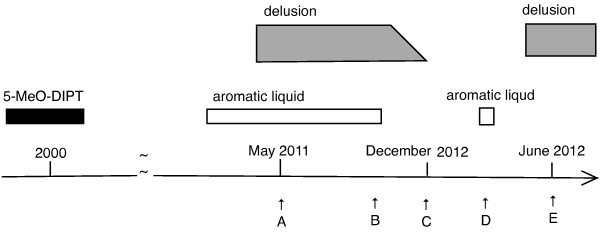
A 30-year-old Japanese man with no previous psychiatric history presented to our facility with delusions, which had been ongoing for 2 months. Upon further interview, he confided that he had a past history of recurrent 5-methoxy-N,N-diisopropyltryptamine (5-MeO-DIPT or "Foxy") abuse, as well as a recent history of recurrent ingestion of a legal aromatic liquid used as a recreational drug. After this episode, his condition improved and he did not follow up at subsequent appointments. However, 6 months later, he suffered a relapse of prolonged delusions after again ingesting a recreational aromatic liquid. An evaluation of the chronological sequence of the patient's condition revealed that ingestion of these aromatic liquids, which can be purchased easily on the Internet, likely triggered the patient's delusional episodes. We speculate that the patient's recurrent abuse of 5-MeO-DIPT caused sensitization (or reverse tolerance), thus prolonging his delusions. Sensitization is the amplification of a response following repeated administrations of a stimulus. 5-MeO-DIPT is a popular drug of abuse, and it is highly probable that a large number of past 5-MeO-DIPT users are currently sensitized. This is an important latent factor underlying subsequent episode of drug-induced psychosis. Psychiatrists should consider the possibility of 5-MeO-DIPT sensitization when evaluating patients with acute psychoses.
一名30岁、既往无精神病史的日本男性因妄想症状前来我院就诊,该症状已持续2个月。进一步询问后,他透露自己有反复滥用5-甲氧基-N,N-二异丙基色胺(5-MeO-DIPT,即“狐仙”)的既往史,以及近期反复摄入一种用作消遣性药物的合法芳香液体的病史。此次发作后,他的病情有所改善,但后续预约时并未前来复诊。然而,6个月后,他在再次摄入一种消遣性芳香液体后,出现了长时间妄想的复发。对该患者病情时间顺序的评估显示,摄入这些可在互联网上轻松购得的芳香液体,可能引发了患者的妄想发作。我们推测,患者反复滥用5-MeO-DIPT导致了致敏(或反向耐受),从而延长了他的妄想时间。致敏是指在反复给予刺激后反应的增强。5-MeO-DIPT是一种常见的滥用药物,很可能大量既往使用过5-MeO-DIPT的人目前处于致敏状态。这是药物性精神病后续发作的一个重要潜在因素。精神科医生在评估急性精神病患者时应考虑5-MeO-DIPT致敏的可能性。