Couto-Alves Alexessander, Wright Victoria J, Perumal Karnan, Binder Alexander, Carrol Enitan D, Emonts Marieke, de Groot Ronald, Hazelzet Jan, Kuijpers Taco, Nadel Simon, Zenz Werner, Ramnarayan Padmanabhan, Levin Michael, Coin Lachlan, Inwald David P
Crit Care. 2013 Apr 11;17(2):R68. doi: 10.1186/cc12609.
The aim of this study was to derive a novel prognostic score for mortality in paediatric meningococcal sepsis (MS) based on readily available laboratory markers.
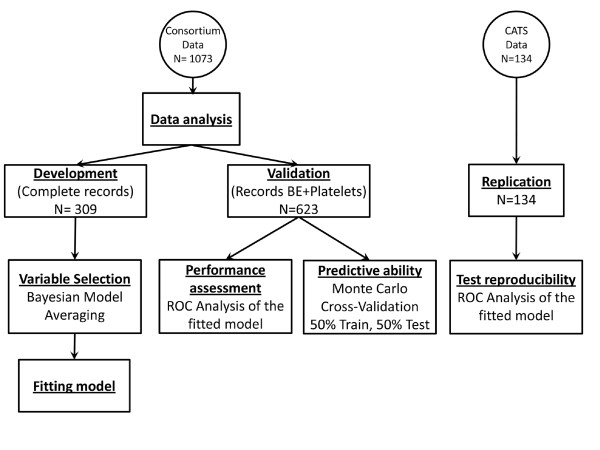
A multicentre retrospective cohort study for the consortium set and a single centre retrospective study for replication set. The consortium set were 1,073 children (age 1 week to 17.9 years) referred over a 15-year period (1996 to 2011), who had an admission diagnosis of MS, referred to paediatric intensive care units (PICUs) in six different European centres. The consortium set was split into a development set and validation set to derive the score. The replication set were 134 children with MS (age 2 weeks to 16 years) referred over a 4-year period (2007 to 2011) to PICUs via the Children's Acute Transport Service (CATS), London.
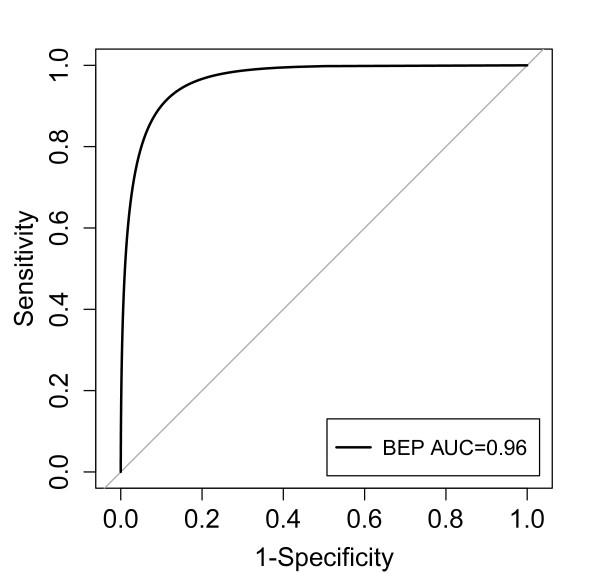
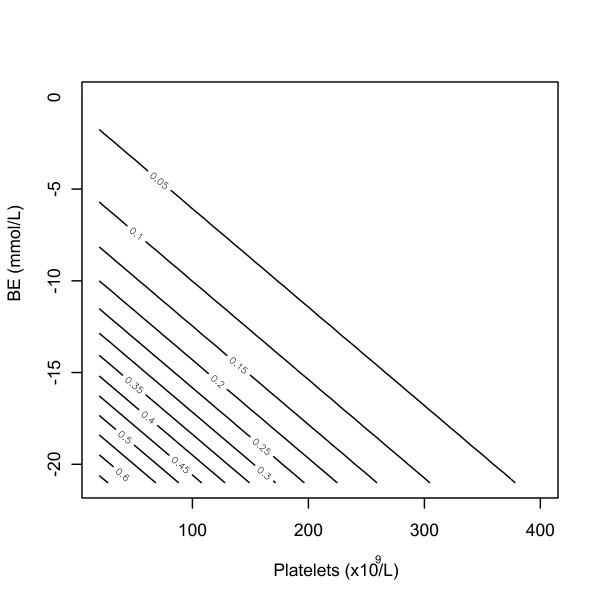
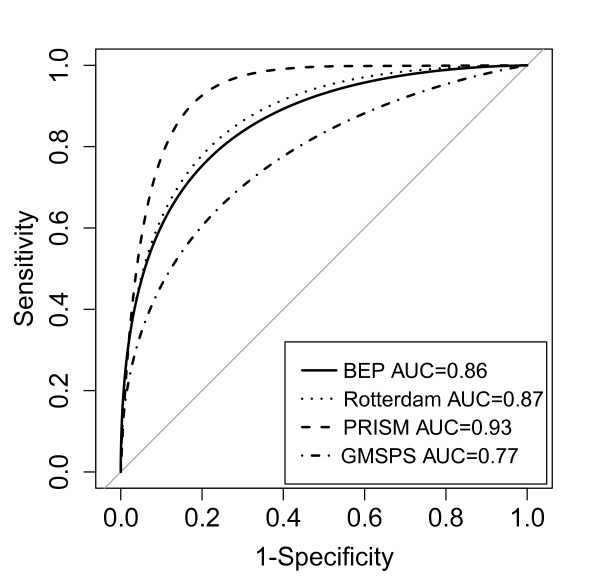
A total of 85/1,073 (7.9%) children in the consortium set died. A total of 16/134 (11.9%) children in the replication set died. Children dying in the consortium set had significantly lower base excess, C-reactive protein (CRP), platelet and white cell count, more deranged coagulation and higher lactate than survivors. Paediatric risk of mortality (PRISM) score, Glasgow meningococcal septicaemia prognosis score (GMSPS) and Rotterdam score were also higher. Using the consortium set, a new scoring system using base excess and platelet count at presentation, termed the BEP score, was mathematically developed and validated. BEP predicted mortality with high sensitivity and specificity scores (area under the curve (AUC) in the validation set=0.86 and in the replication set=0.96). In the validation set, BEP score performance (AUC=0.86, confidence interval (CI): 0.80 to 0.91) was better than GMSPS (AUC=0.77, CI: 0.68, 0.85), similar to Rotterdam (AUC=0.87, CI: 0.81 to 0.93) and not as good as PRISM (AUC=0.93, CI: 0.85 to 0.97).
The BEP score, relying on only two variables that are quickly and objectively measurable and readily available at presentation, is highly sensitive and specific in predicting death from MS in childhood.
本研究旨在基于易于获得的实验室指标得出一种用于小儿脑膜炎球菌败血症(MS)死亡率的新型预后评分。
一项针对联合数据集的多中心回顾性队列研究以及一项针对复制数据集的单中心回顾性研究。联合数据集为15年期间(1996年至2011年)转诊至6个不同欧洲中心的儿科重症监护病房(PICU)的1073名儿童(年龄1周至17.9岁),这些儿童入院诊断为MS。联合数据集被分为一个开发集和一个验证集以得出该评分。复制数据集为4年期间(2007年至2011年)通过伦敦儿童急性转运服务(CATS)转诊至PICU的134名MS儿童(年龄2周至16岁)。
联合数据集中共有85/1073名(7.9%)儿童死亡。复制数据集中共有16/134名(11.9%)儿童死亡。联合数据集中死亡的儿童碱剩余、C反应蛋白(CRP)、血小板和白细胞计数显著更低,凝血紊乱更严重,乳酸水平更高。小儿死亡风险(PRISM)评分、格拉斯哥脑膜炎球菌败血症预后评分(GMSPS)和鹿特丹评分也更高。利用联合数据集,通过数学方法开发并验证了一种新的评分系统,该系统使用入院时的碱剩余和血小板计数,称为BEP评分。BEP对死亡率的预测具有高灵敏度和特异性评分(验证集中曲线下面积(AUC)=0.86,复制集中AUC=0.96)。在验证集中,BEP评分表现(AUC=0.86,置信区间(CI):0.80至0.91)优于GMSPS(AUC=0.77,CI:0.68,0.85),与鹿特丹评分相似(AUC=0.87,CI:0.81至0.93),不如PRISM评分(AUC=0.93,CI:0.85至0.97)。
BEP评分仅依赖于两个可快速、客观测量且在入院时易于获得的变量,在预测儿童MS死亡方面具有高度的敏感性和特异性。