University of Houston, Department of Psychology, 126 Heyne Bldg, Houston, TX 77204-5022, USA.
Addict Behav. 2013 Jul;38(7):2261-6. doi: 10.1016/j.addbeh.2013.02.011. Epub 2013 Mar 5.
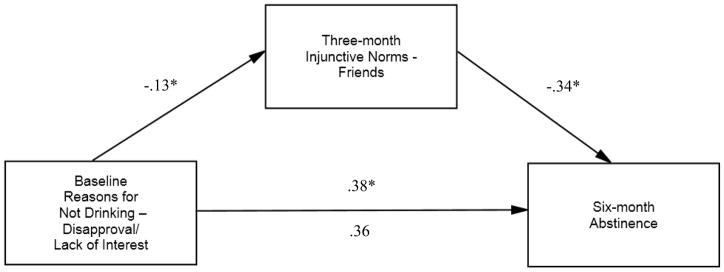
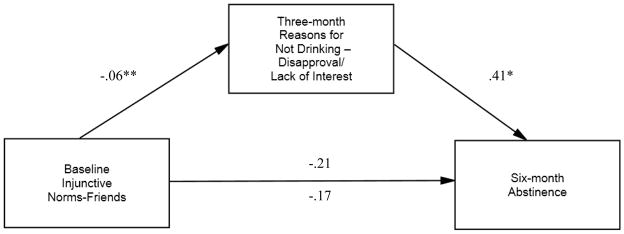
Few studies have examined the association between reasons for not drinking and social norms among abstinent college students. Research suggests that drinking motives are associated with perceived injunctive norms and drinking. Therefore, it seems likely that reasons for not drinking may also be associated with perceived injunctive norms and abstinence. The aim of this study was to examine the relationship between reasons for not drinking and perceived injunctive norms on alcohol abstinence. Participants were 423 light-drinking and abstinent college students from a public northwestern university who completed online surveys at baseline, 3-, and 6-month follow-up. We examined abstinence as a function of all subscales of the Reasons for Not Drinking scale using logistic regression, as well as conducted two mediational analyses indicating: (1) perceived injunctive norms as a mediator of the relationship between reasons for not drinking and abstinence, and (2) reasons for not drinking as a mediator of the relationship between perceived injunctive norms and abstinence. The Disapproval/Lack of Interest subscale was the only subscale of the Reasons for Not Drinking scale that was significantly associated with 6-month abstinence. Further, Disapproval/Lack of Interest both directly predicted abstinence and indirectly predicted abstinence via perceived injunctive norms. Perceived injunctive norms indirectly predicted abstinence via Disapproval/Lack of Interest, but did not directly predict abstinence. Results suggest that self-defining personal values are an important component of keeping abstaining college students abstinent. These results are discussed with regard to implications for interventions designed specifically for maintaining abstinence throughout college.
很少有研究探讨过不饮酒的原因与大学生中不饮酒的社会规范之间的关系。研究表明,饮酒动机与感知的禁令规范和饮酒有关。因此,不饮酒的原因可能也与感知的禁令规范和戒酒有关。本研究旨在探讨不饮酒的原因与对酒精戒酒的感知禁令规范之间的关系。参与者是来自一所公立西北大学的 423 名轻度饮酒和戒酒的大学生,他们在基线、3 个月和 6 个月的随访时完成了在线调查。我们使用逻辑回归检验了不饮酒的所有子量表与不饮酒之间的关系,同时进行了两项中介分析,表明:(1)感知禁令规范作为不饮酒的原因与戒酒之间关系的中介,(2)不饮酒的原因作为感知禁令规范与戒酒之间关系的中介。不饮酒的原因量表的不赞成/缺乏兴趣子量表是与 6 个月戒酒显著相关的唯一子量表。此外,不赞成/缺乏兴趣既直接预测戒酒,也通过感知禁令规范间接预测戒酒。感知禁令规范通过不赞成/缺乏兴趣间接预测戒酒,但不直接预测戒酒。结果表明,自我定义的个人价值观是保持大学生戒酒的一个重要组成部分。这些结果与专门为整个大学期间保持戒酒而设计的干预措施的意义有关。