Division of Genetic Medicine, Vanderbilt University School of Medicine, Nashville, TN 37232, USA.
Dis Model Mech. 2013 Jul;6(4):1001-11. doi: 10.1242/dmm.012203. Epub 2013 Apr 4.
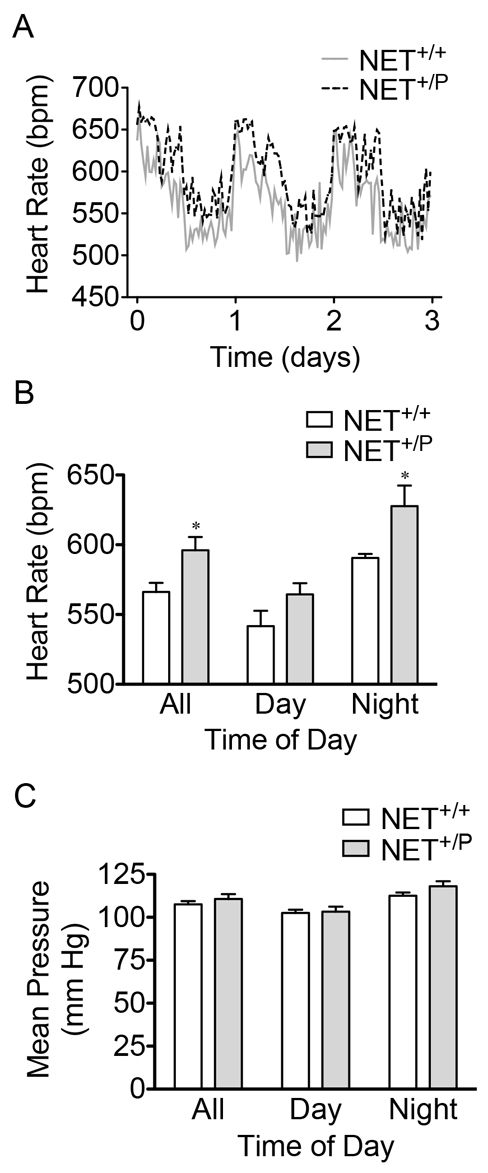
Postural orthostatic tachycardia syndrome (POTS) is a common autonomic disorder of largely unknown etiology that presents with sustained tachycardia on standing, syncope and elevated norepinephrine spillover. Some individuals with POTS experience anxiety, depression and cognitive dysfunction. Previously, we identified a mutation, A457P, in the norepinephrine (NE; also known as noradrenaline) transporter (NET; encoded by SLC6A2) in POTS patients. NET is expressed at presynaptic sites in NE neurons and plays a crucial role in regulating NE signaling and homeostasis through NE reuptake into noradrenergic nerve terminals. Our in vitro studies demonstrate that A457P reduces both NET surface trafficking and NE transport and exerts a dominant-negative impact on wild-type NET proteins. Here we report the generation and characterization of NET A457P mice, demonstrating the ability of A457P to drive the POTS phenotype and behaviors that are consistent with reported comorbidities. Mice carrying one A457P allele (NET(+/P)) exhibited reduced brain and sympathetic NE transport levels compared with wild-type (NET(+/+)) mice, whereas transport activity in mice carrying two A457P alleles (NET(P/P)) was nearly abolished. NET(+/P) and NET(P/P) mice exhibited elevations in plasma and urine NE levels, reduced 3,4-dihydroxyphenylglycol (DHPG), and reduced DHPG:NE ratios, consistent with a decrease in sympathetic nerve terminal NE reuptake. Radiotelemetry in unanesthetized mice revealed tachycardia in NET(+/P) mice without a change in blood pressure or baroreceptor sensitivity, consistent with studies of human NET A457P carriers. NET(+/P) mice also demonstrated behavioral changes consistent with CNS NET dysfunction. Our findings support that NET dysfunction is sufficient to produce a POTS phenotype and introduces the first genetic model suitable for more detailed mechanistic studies of the disorder and its comorbidities.
体位性心动过速综合征(POTS)是一种常见的自主神经功能紊乱,其病因尚不清楚,主要表现为站立时持续性心动过速、晕厥和去甲肾上腺素溢出增加。一些 POTS 患者会出现焦虑、抑郁和认知功能障碍。先前,我们在 POTS 患者中发现了去甲肾上腺素(NE;也称为去甲肾上腺素)转运体(NET;由 SLC6A2 编码)中的 A457P 突变。NET 在 NE 神经元的突触前部位表达,通过将 NE 摄取到去甲肾上腺素能神经末梢来调节 NE 信号传递和内稳态,从而发挥关键作用。我们的体外研究表明,A457P 降低了 NET 的表面转运和 NE 转运,并对野生型 NET 蛋白产生显性负效应。在这里,我们报告了 NET A457P 小鼠的产生和特征,证明了 A457P 能够驱动 POTS 表型和与报道的合并症一致的行为。携带一个 A457P 等位基因(NET(+/P))的小鼠与野生型(NET(+/+))小鼠相比,其大脑和交感神经 NE 转运水平降低,而携带两个 A457P 等位基因(NET(P/P))的小鼠的转运活性几乎被消除。NET(+/P)和 NET(P/P) 小鼠的血浆和尿液 NE 水平升高,3,4-二羟基苯乙二醇(DHPG)降低,DHPG:NE 比值降低,提示交感神经末梢 NE 再摄取减少。未麻醉小鼠的无线电遥测显示 NET(+/P) 小鼠的心动过速,而血压或压力感受器敏感性没有变化,这与人类 NET A457P 携带者的研究一致。NET(+/P) 小鼠还表现出与中枢神经系统 NET 功能障碍一致的行为变化。我们的研究结果表明 NET 功能障碍足以产生 POTS 表型,并引入了第一个适合更详细研究该疾病及其合并症的遗传模型。