Section of Translational Radiation Oncology, Radiation Oncology Branch, National Institutes of Health, Bethesda 20892, MD, USA.
Int J Oncol. 2013 Jun;42(6):2028-36. doi: 10.3892/ijo.2013.1890. Epub 2013 Apr 10.
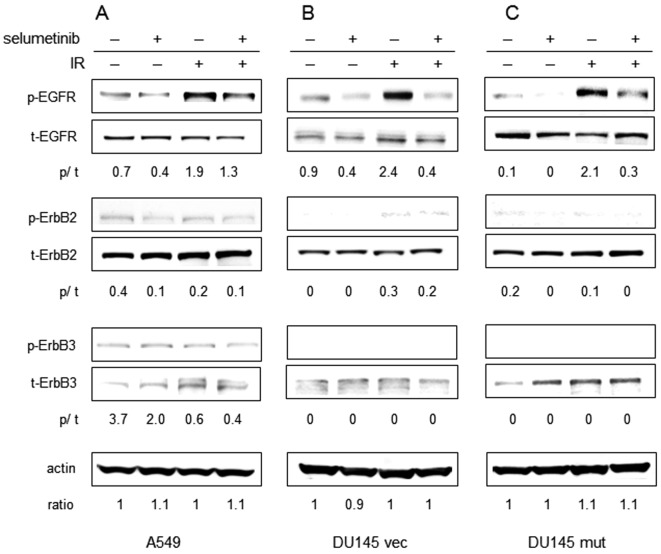
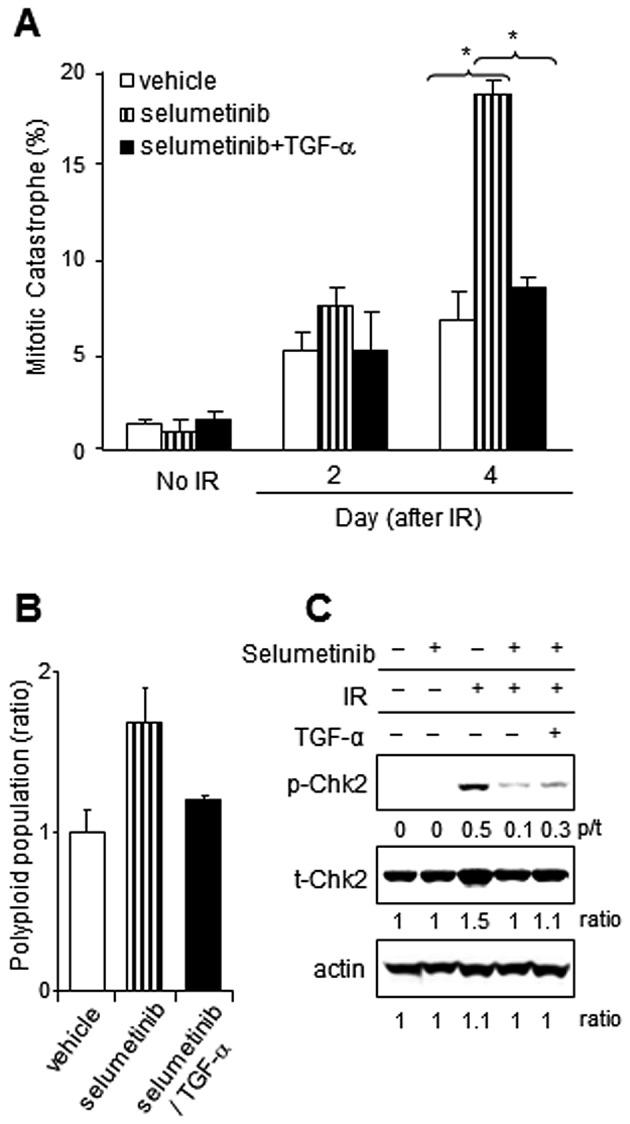
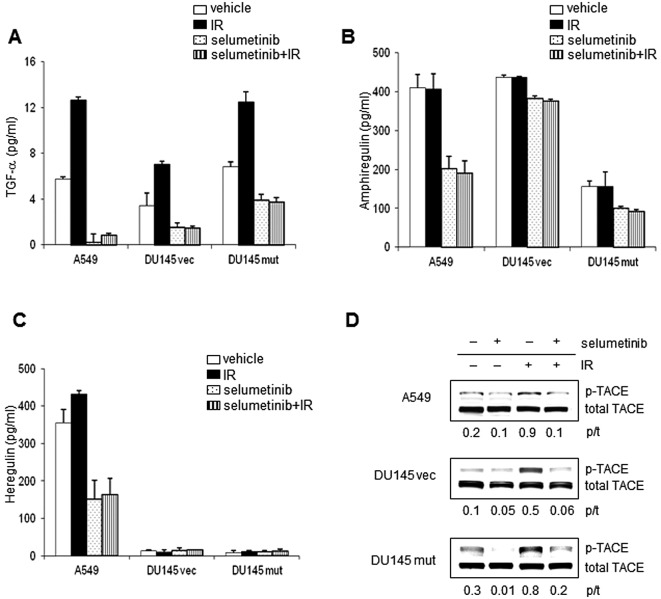
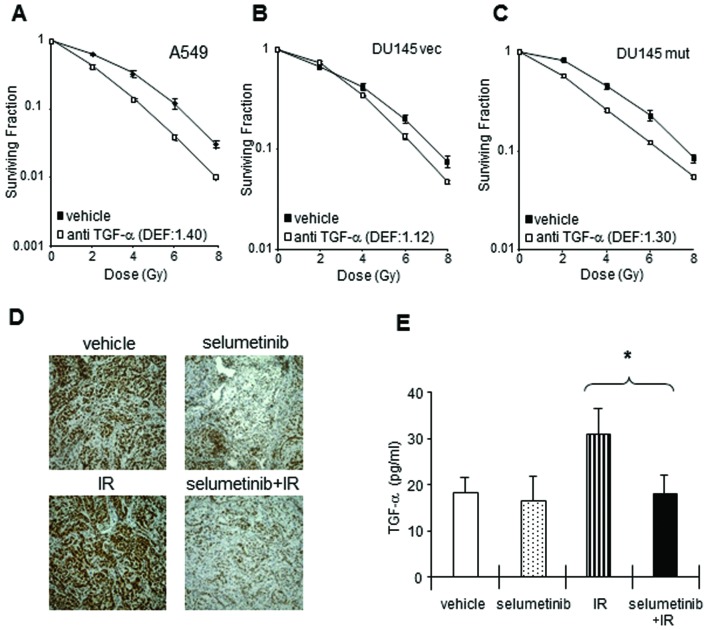
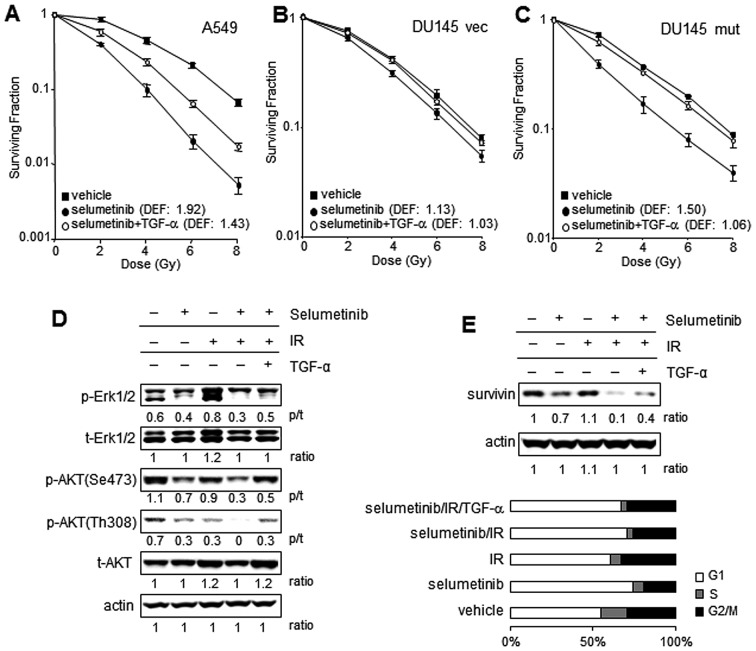
The inhibition of the Ras/mitogen-activated protein kinase (Ras/MAPK) pathway through the suppression of mutated Ras or MAPK/extracellular signal-regulated kinase 1/2 (MEK1/2) has been shown to sensitize tumor cells to ionizing radiation (IR). The molecular mechanisms of this sensitization however, are not yet fully understood. In this study, we investigated the role of transforming growth factor-α (TGF-α) in the radiosensitizing effects of selumetinib, a selective inhibitor of MEK1/2. The expression of epidermal growth factor receptor (EGFR) ligands was assessed by ELISA in both Ras wild-type and Ras mutant cells that were exposed to radiation with or without selumetinib. The effects of selumetinib on the TGF-α/EGFR signaling cascade in response to radiation were examined by western blot analysis, clonogenic assay and by determing the yield of mitotic catastrophe. The treatment of cells with selumetinib reduced the basal and IR-induced secretion of TGF-α in both Ras wild-type and Ras mutant cell lines in vitro and in vivo. The reduction of TGF-α secretion was accompanied with a reduction in phosphorylated tumor necrosis factor-α converting enzyme (TACE) in the cells treated with selumetinib with or without IR. The treatment of cells with selumetinib with or without IR inhibited the phosphorylation of EGFR and checkpoint kinase 2 (Chk2), and reduced the expression of survivin. Supplementation with exogenous TGF-α partially rescued the selumetinib-treated cells from IR-induced cell death, restored EGFR and Chk2 phosphorylation and increased survivin expression. These data suggest that the inhibition of MEK1/2 with selumetinib may provide a mechanism to sensitize tumor cells to IR in a fashion that prevents the activation of the TGF-α autocrine loop following IR.
通过抑制突变型 Ras 或丝裂原活化蛋白激酶/细胞外信号调节激酶 1/2(MEK1/2)来抑制 Ras/丝裂原活化蛋白激酶(Ras/MAPK)通路已被证明可使肿瘤细胞对电离辐射(IR)敏感。然而,这种增敏作用的分子机制尚不完全清楚。在这项研究中,我们研究了转化生长因子-α(TGF-α)在 MEK1/2 选择性抑制剂 selumetinib 的放射增敏作用中的作用。通过 ELISA 评估暴露于辐射或不暴露于辐射的 Ras 野生型和 Ras 突变细胞中表皮生长因子受体(EGFR)配体的表达。通过 Western blot 分析、集落形成测定和有丝分裂灾难产率测定来检查 selumetinib 对辐射反应中 TGF-α/EGFR 信号级联的影响。细胞用 selumetinib 处理可减少体外和体内 Ras 野生型和 Ras 突变细胞系中基础和 IR 诱导的 TGF-α分泌。用 selumetinib 处理的细胞中 TGF-α分泌减少伴随着 TNF-α转化酶(TACE)的磷酸化减少,无论是否存在 IR。用或不用 IR 用 selumetinib 处理细胞可抑制 EGFR 和检查点激酶 2(Chk2)的磷酸化,并降低 survivin 的表达。用外源性 TGF-α补充可部分挽救 selumetinib 处理的细胞免受 IR 诱导的细胞死亡,恢复 EGFR 和 Chk2 磷酸化并增加 survivin 表达。这些数据表明,用 selumetinib 抑制 MEK1/2 可能提供一种机制,以防止 IR 后 TGF-α自分泌环的激活,从而使肿瘤细胞对 IR 敏感。