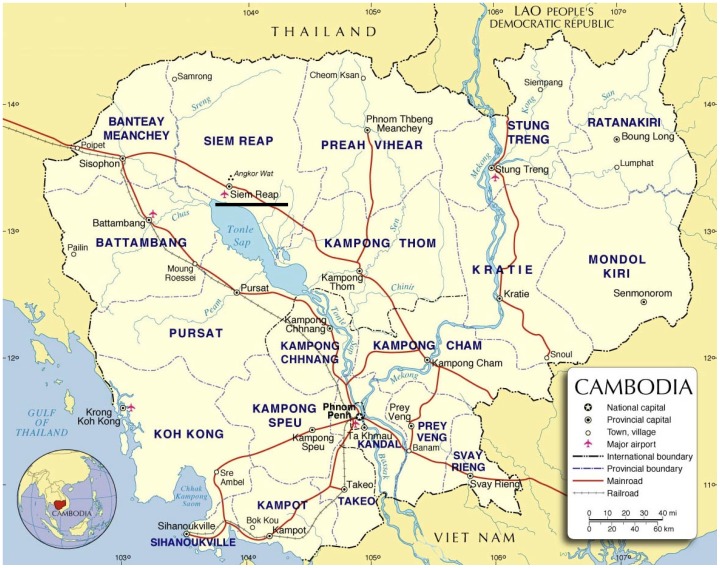
Angkor Hospital for Children, Siem Reap, Kingdom of Cambodia.
PLoS One. 2013 Apr 9;8(4):e60634. doi: 10.1371/journal.pone.0060634. Print 2013.
Febrile illnesses are pre-eminent contributors to morbidity and mortality among children in South-East Asia but the causes are poorly understood. We determined the causes of fever in children hospitalised in Siem Reap province, Cambodia.
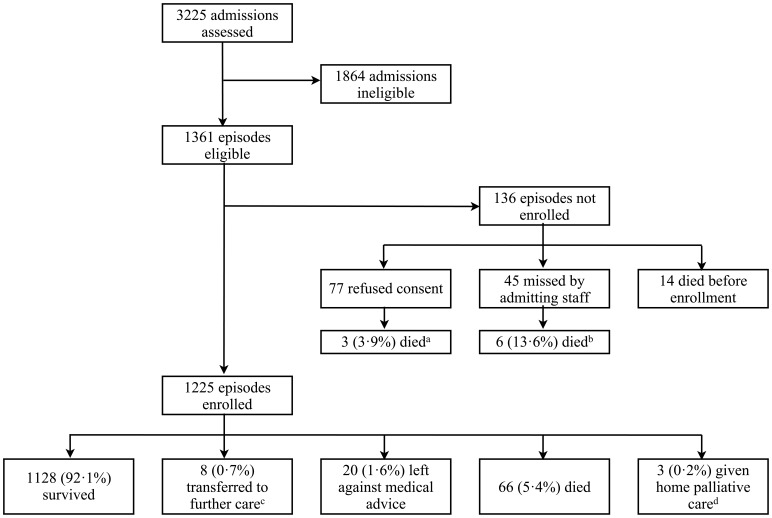
A one-year prospective study of febrile children admitted to Angkor Hospital for Children, Siem Reap. Demographic, clinical, laboratory and outcome data were comprehensively analysed. Between October 12(th) 2009 and October 12(th) 2010 there were 1225 episodes of febrile illness in 1180 children. Median (IQR) age was 2.0 (0.8-6.4) years, with 850 (69%) episodes in children <5 years. Common microbiological diagnoses were dengue virus (16.2%), scrub typhus (7.8%), and Japanese encephalitis virus (5.8%). 76 (6.3%) episodes had culture-proven bloodstream infection, including Salmonella enterica serovar Typhi (22 isolates, 1.8%), Streptococcus pneumoniae (13, 1.1%), Escherichia coli (8, 0.7%), Haemophilus influenzae (7, 0.6%), Staphylococcus aureus (6, 0.5%) and Burkholderia pseudomallei (6, 0.5%). There were 69 deaths (5.6%), including those due to clinically diagnosed pneumonia (19), dengue virus (5), and melioidosis (4). 10 of 69 (14.5%) deaths were associated with culture-proven bloodstream infection in logistic regression analyses (odds ratio for mortality 3.4, 95% CI 1.6-6.9). Antimicrobial resistance was prevalent, particularly in S. enterica Typhi, (where 90% of isolates were resistant to ciprofloxacin, and 86% were multi-drug resistant). Comorbid undernutrition was present in 44% of episodes and a major risk factor for acute mortality (OR 2.1, 95% CI 1.1-4.2), as were HIV infection and cardiac disease.
We identified a microbiological cause of fever in almost 50% of episodes in this large study of community-acquired febrile illness in hospitalized children in Cambodia. The range of pathogens, antimicrobial susceptibility, and co-morbidities associated with mortality described will be of use in the development of rational guidelines for infectious disease treatment and control in Cambodia and South-East Asia.
发热性疾病是东南亚儿童发病率和死亡率的主要原因,但病因尚不清楚。我们确定了柬埔寨暹粒省住院儿童发热的原因。
这是一项为期一年的前瞻性研究,研究对象为因发热而入住暹粒省吴哥医院的儿童。对人口统计学、临床、实验室和结局数据进行了全面分析。2009 年 10 月 12 日至 2010 年 10 月 12 日,1180 名儿童中有 1225 例发热。中位(IQR)年龄为 2.0(0.8-6.4)岁,850 例(69%)患儿年龄<5 岁。常见的微生物学诊断包括登革热病毒(16.2%)、恙虫病(7.8%)和日本脑炎病毒(5.8%)。76 例(6.3%)发热患儿有血培养阳性的血流感染,包括伤寒沙门氏菌血清型 Typhi(22 株,1.8%)、肺炎链球菌(13 株,1.1%)、大肠杆菌(8 株,0.7%)、流感嗜血杆菌(7 株,0.6%)、金黄色葡萄球菌(6 株,0.5%)和类鼻疽伯克霍尔德菌(6 株,0.5%)。共有 69 例死亡(5.6%),包括临床诊断为肺炎(19 例)、登革热病毒(5 例)和类鼻疽(4 例)所致死亡。在逻辑回归分析中,有 10 例(14.5%)死亡与血培养阳性的血流感染有关(死亡率的比值比为 3.4,95%CI 1.6-6.9)。抗生素耐药性普遍存在,尤其是伤寒沙门氏菌血清型 Typhi(90%的分离株对环丙沙星耐药,86%为多药耐药)。44%的病例合并营养不良,是急性死亡率的主要危险因素(OR 2.1,95%CI 1.1-4.2),HIV 感染和心脏病也是死亡的危险因素。
在对柬埔寨住院儿童社区获得性发热进行的这项大型研究中,我们发现近 50%的发热病例有明确的微生物病因。所描述的病原体范围、抗生素耐药性以及与死亡率相关的合并症,将有助于制定柬埔寨和东南亚传染病治疗和控制的合理指南。