
一种基于鸡翅和简易器械的高效微血管吻合训练模型。
An efficient microvascular anastomosis training model based on chicken wings and simple instruments.
作者信息
Kim Byeong Jin, Kim Sung-Tae, Jeong Young-Gyun, Lee Won-Hee, Lee Kun-Soo, Paeng Sung-Hwa
机构信息
Department of Neurosurgery, Busan Paik Hospital, School of Medicine, Inje University, Busan, Korea.
出版信息
J Cerebrovasc Endovasc Neurosurg. 2013 Mar;15(1):20-5. doi: 10.7461/jcen.2013.15.1.20. Epub 2013 Mar 31.
OBJECTIVE
The aim of this study is to introduce a microvascular training model based on use of materials that can be easily obtained from the daily surroundings.
METHODS
Simple microinstruments and a medical school laboratory microscope were used for anastomosis training. Chicken blood vessels were used as a material for this study. A long segment of blood vessel from the proximal brachial artery to the distal radial artery was used for training. End-to-side anastomosis was practiced first, and the training continued with end-to-end anastomosis of the appropriate segments.
RESULTS
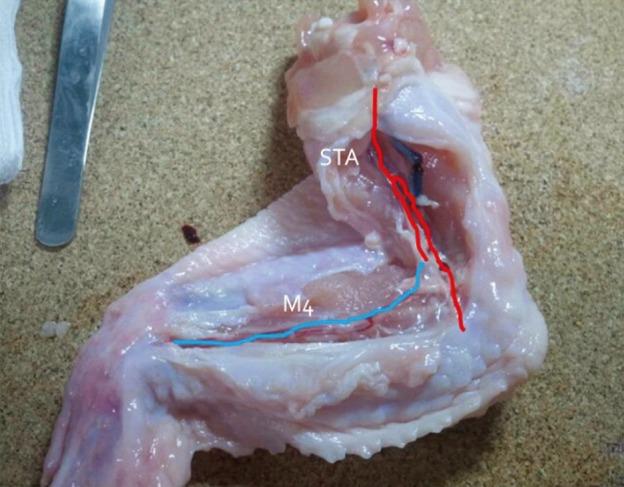
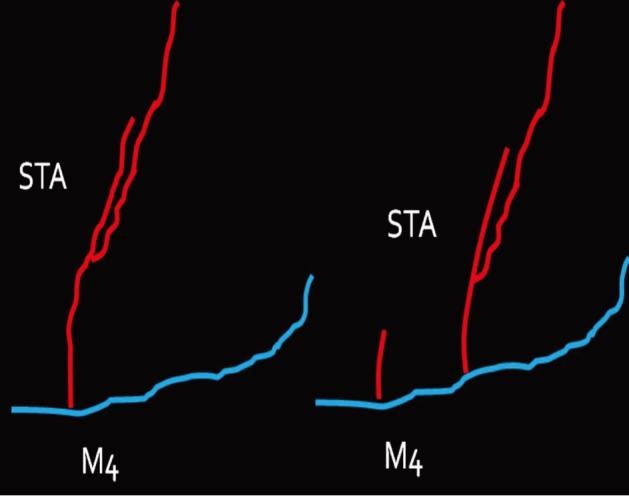
The instruments used for setting up this model were simple and easy to use; therefore, the time required for preparation of the materials and dissection of the chicken wings was only approximately five to ten minutes. The characteristics of 20 chicken wings were analyzed. The length of the brachial artery to the radial artery was 8 - 10 cm. The average diameter of the brachial artery was 1.3 mm ± 0.2 mm and that of the radial artery was 1.0 mm ± 0.2 mm. Taking advantage of these characteristics, the proximal brachial artery was grafted to the radial artery for practice of end-to-side anastomosis.
CONCLUSIONS
This study suggests an effective and feasible method for microvascular anastomosis training using chicken wing arteries and simple microinstruments. This model may simulate the conditions of a superficial temporal artery to middle cerebral artery anastomosis surgery.
目的
本研究旨在引入一种基于使用可从日常环境中轻松获取的材料的微血管训练模型。
方法
使用简单的显微器械和医学院实验室显微镜进行吻合训练。本研究使用鸡血管作为材料。取自近端肱动脉至远端桡动脉的一段长血管用于训练。首先进行端侧吻合练习,然后继续对适当节段进行端端吻合训练。
结果
用于建立该模型的器械简单易用;因此,准备材料和解剖鸡翅所需的时间仅约五到十分钟。分析了20个鸡翅的特征。肱动脉至桡动脉的长度为8 - 10厘米。肱动脉的平均直径为1.3毫米±0.2毫米,桡动脉的平均直径为1.0毫米±0.2毫米。利用这些特征,将近端肱动脉移植到桡动脉上进行端侧吻合练习。
结论
本研究提出了一种使用鸡翅动脉和简单显微器械进行微血管吻合训练的有效且可行的方法。该模型可模拟颞浅动脉至大脑中动脉吻合手术的情况。



 Zotero 插件