State Key Laboratory of Systematic and Evolutionary Botany, Institute of Botany, Chinese Academy of Sciences, Beijing, China.
Genome Biol Evol. 2013;5(5):989-97. doi: 10.1093/gbe/evt063.
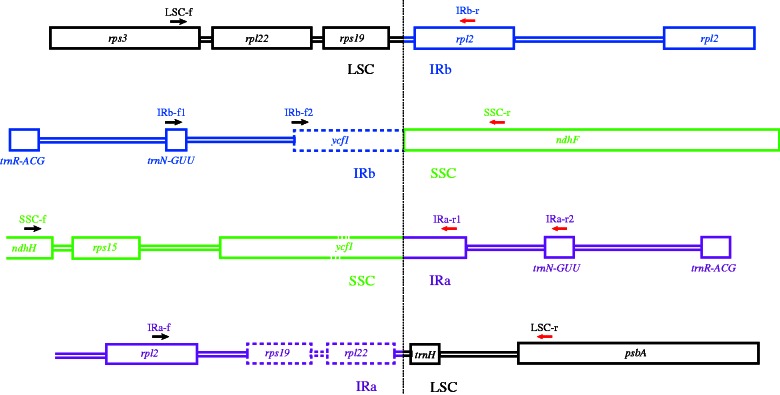
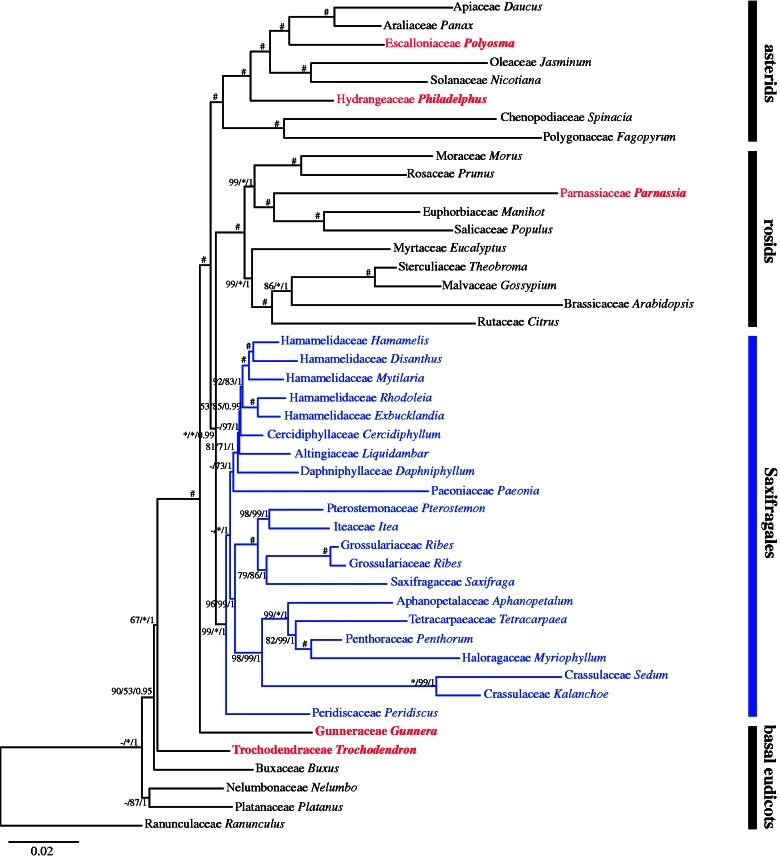
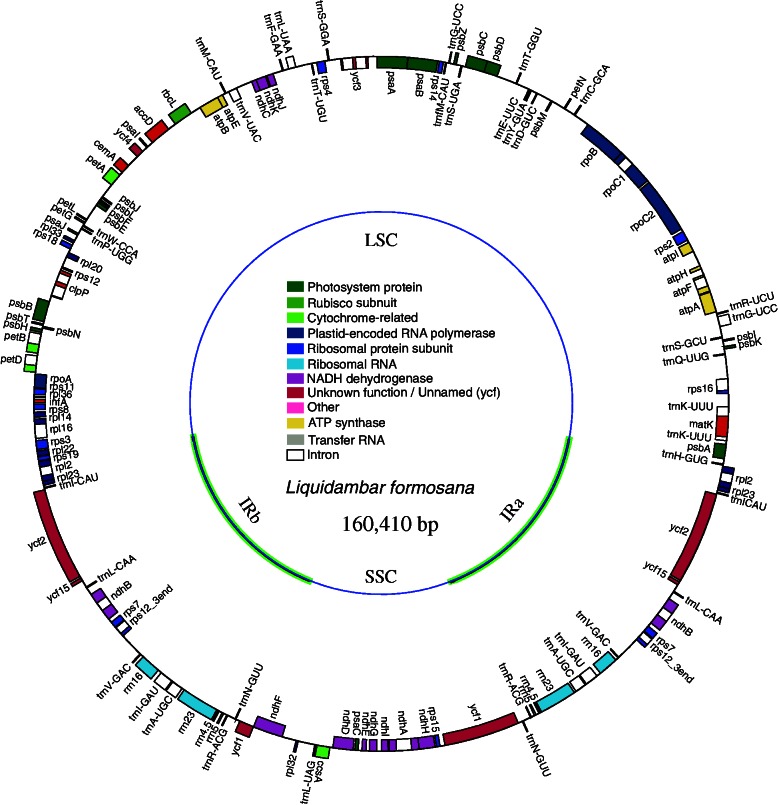
Plastid genomes are an invaluable resource for plant biological studies. However, the number of completely sequenced plant plastid genomes is still small compared with the vast number of species. To provide an alternative generalized approach, we designed a set of 138 pairs of universal primers for amplifying (termed "short-range PCR") and sequencing the entire genomes of the angiosperm plastid genomes. The universality of the primers was tested by using species from the basal to asterid angiosperms. The polymerase chain reaction (PCR) success rate was higher than 96%. We sequenced the complete chloroplast genome of Liquidambar formosana as an example using this method and compared it to the genomes independently determined by long-range PCR (from 6.3 kb to 13.3 kb) and next-generation sequencing methods. The three genomes showed that they were completely identical. To test the phylogenetic efficiency of this method, we amplified and sequenced 18 chloroplast regions of 19 Saxifragales and Saxifragales-related taxa, as a case study, to reconstruct the phylogeny of all families of the order. Phylograms based on a combination of our data, together with those from GenBank, clearly indicate three family groups and three single families within the order. This set of universal primers is expected to accelerate the accumulation of angiosperm plastid genomes and to make faster mass data collection of plastid genomes for molecular systematics.
质体基因组是植物生物学研究的宝贵资源。然而,与大量的物种相比,完全测序的植物质体基因组数量仍然很少。为了提供一种替代的通用方法,我们设计了一套 138 对通用引物,用于扩增(称为“短程 PCR”)和测序被子植物质体基因组的整个基因组。通过使用从基部分子到菊科被子植物的物种来测试引物的通用性。聚合酶链反应(PCR)的成功率高于 96%。我们使用这种方法测序了枫香的完整叶绿体基因组作为一个例子,并将其与通过长程 PCR(从 6.3 kb 到 13.3 kb)和下一代测序方法独立确定的基因组进行了比较。这三个基因组完全一致。为了测试这种方法的系统发育效率,我们扩增和测序了 19 种虎耳草目和虎耳草目相关类群的 18 个叶绿体区域,作为一个案例研究,以重建该目的所有科的系统发育。基于我们的数据与来自 GenBank 的数据相结合的系统发育树清楚地表明了该目中的三个科群和三个单科。这组通用引物有望加速被子植物质体基因组的积累,并为分子系统发育更快地收集质体基因组的大量数据。