Department of Functional Brain Research, National Institute of Neuroscience, National Center of Neurology and Psychiatry Tokyo, Japan.
Front Syst Neurosci. 2013 Apr 11;7:6. doi: 10.3389/fnsys.2013.00006. eCollection 2013.
Transcranial direct-current stimulation (tDCS) is a non-invasive procedure that achieves polarity-dependent modulation of neuronal membrane potentials. It has recently been used as a functional intervention technique for the treatment of psychiatric and neurological diseases; however, its neuronal mechanisms have not been fully investigated in vivo.
OBJECTIVE/HYPOTHESIS: To investigate whether the application of cathodal or anodal tDCS affects extracellular dopamine and serotonin levels in the rat striatum.
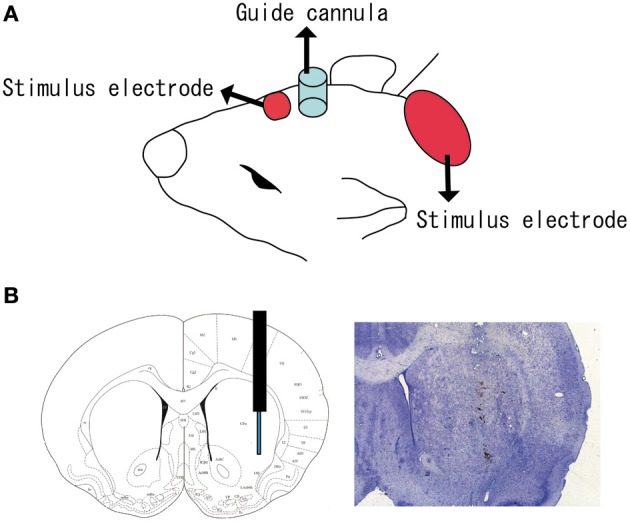
Stimulation and in vivo microdialysis were carried out under urethane anesthesia, and microdialysis probes were slowly inserted into the striatum. After the collection of baseline fractions in the rat striatum, cathodal or anodal tDCS was applied continuously for 10 min with a current intensity of 800 μA from an electrode placed on the skin of the scalp. Dialysis samples were collected every 10 min until at least 400 min after the onset of stimulation.
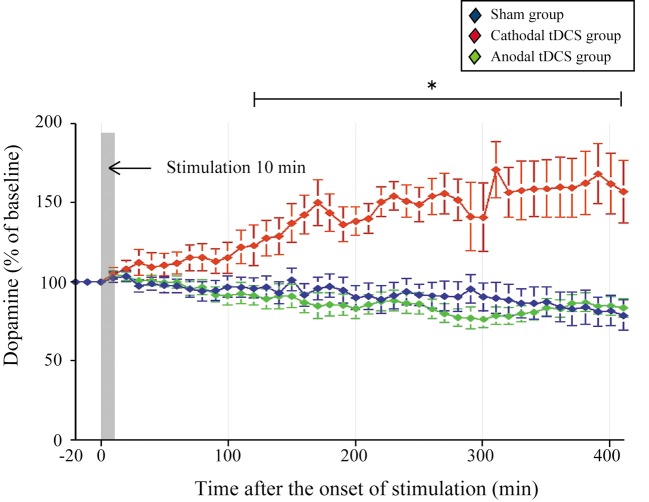
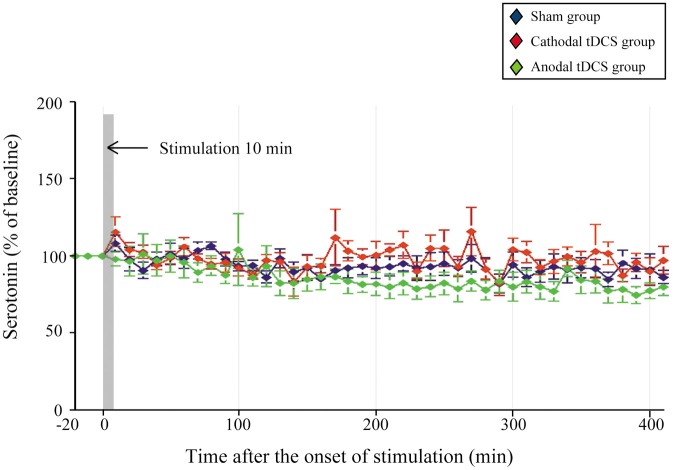
Following the application of cathodal, but not anodal, tDCS for 10 min, extracellular dopamine levels increased for more than 400 min in the striatum. There were no significant changes in extracellular serotonin levels.
These findings suggest that tDCS has a direct and/or indirect effect on the dopaminergic system in the rat basal ganglia.
经颅直流电刺激(tDCS)是一种非侵入性程序,可实现神经元膜电位的极性依赖性调制。它最近已被用作治疗精神和神经疾病的功能性干预技术;然而,其在体内的神经元机制尚未得到充分研究。
目的/假设:研究阴极或阳极 tDCS 是否会影响大鼠纹状体中的细胞外多巴胺和 5-羟色胺水平。
在 氨基甲酸乙酯麻醉下进行刺激和体内微透析,并且缓慢地将微透析探针插入纹状体中。在大鼠纹状体中收集基线分数后,将电流强度为 800μA 的电极放置在头皮上,连续进行阴极或阳极 tDCS 10 分钟。收集透析样本,每 10 分钟收集一次,直到刺激开始后至少 400 分钟。
在进行 10 分钟的阴极 tDCS 后,但不是阳极 tDCS 后,纹状体中的细胞外多巴胺水平增加了 400 多分钟。细胞外 5-羟色胺水平没有明显变化。
这些发现表明 tDCS 对大鼠基底神经节中的多巴胺能系统具有直接和/或间接作用。