Division of Molecular Oncology, The Netherlands Cancer Institute Amsterdam, Netherlands.
Front Oncol. 2013 Apr 15;3:88. doi: 10.3389/fonc.2013.00088. eCollection 2013.
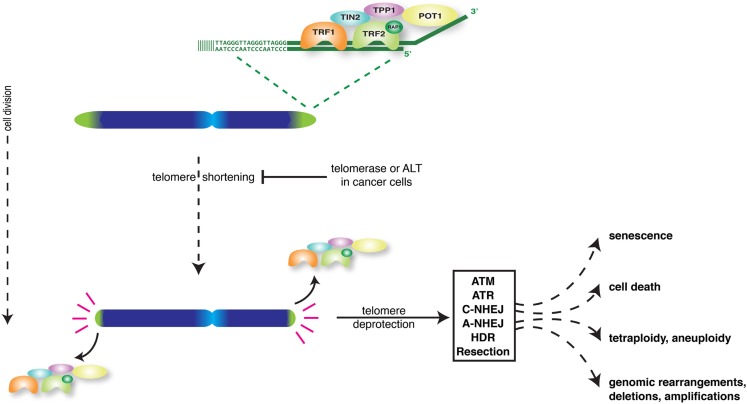
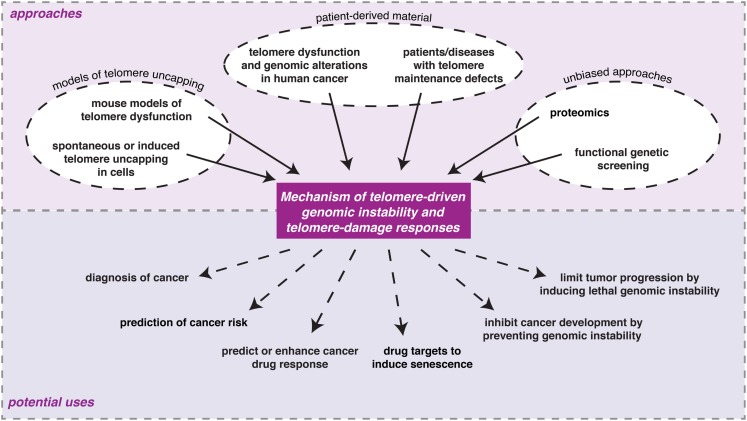
Telomeres are repetitive sequences at the natural ends of linear eukaryotic chromosomes that protect these from recognition as chromosome breaks. Their ability to do so critically depends on the binding of sufficient quantities of functional shelterin, a six-unit protein complex with specific and crucial roles in telomere maintenance and function. Insufficient telomere length, leading to insufficient concentration of shelterin at chromosome ends, or otherwise crippled shelterin function, causes telomere deprotection. While contributing to aging-related pathologies, loss of telomere protection can act as a barrier to tumorigenesis, as dysfunctional telomeres activate DNA-damage-like checkpoint responses that halt cell proliferation or trigger cell death. In addition, dysfunctional telomeres affect cancer development and progression by being a source of genomic instability. Reviewed here are the different approaches that are being undertaken to investigate the mammalian cellular response to telomere dysfunction and its consequences for cancer. Furthermore, it is discussed how current and future knowledge about the mechanisms underlying telomere damage responses might be applied for diagnostic purposes or therapeutic intervention.
端粒是线性真核染色体自然末端的重复序列,可保护这些染色体不被识别为染色体断裂。它们具有这种能力的关键取决于足够数量的功能性 shelterin 的结合,这是一个由六个亚基组成的蛋白质复合物,在端粒维持和功能方面具有特定和关键的作用。端粒长度不足,导致染色体末端的 shelterin 浓度不足,或者 shelterin 功能受损,会导致端粒去保护。虽然端粒保护的丧失会导致与衰老相关的病理,但也会阻碍肿瘤的发生,因为功能失调的端粒会激活类似于 DNA 损伤的检查点反应,从而阻止细胞增殖或引发细胞死亡。此外,功能失调的端粒通过成为基因组不稳定性的来源,影响癌症的发展和进展。本文综述了目前正在采用的不同方法来研究哺乳动物细胞对端粒功能障碍的反应及其对癌症的影响。此外,还讨论了当前和未来关于端粒损伤反应机制的知识如何应用于诊断目的或治疗干预。