Ono Hiroe, Chihara Dai, Chiwaki Fumiko, Yanagihara Kazuyoshi, Sasaki Hiroki, Sakamoto Hiromi, Tanaka Hideo, Yoshida Teruhiko, Saeki Norihisa, Matsuo Keitaro
Division of Genetics, National Cancer Center Research Institute, 5-1-1 Tsukiji, Chuo-ku, Tokyo, Japan.
J Carcinog. 2013 Mar 16;12:4. doi: 10.4103/1477-3163.109030. Print 2013.
Prostate stem cell antigen (PSCA), an organ-dependent tumor suppressor, is down regulated in gallbladder cancer (GBC). It is anticipated that the missense allele C of the single nucleotide polymorphism (SNP) rs2294008 (T/C) in the translation initiation codon of the gene affects the gene's biological function and has some influence on GBC susceptibility. We examined the biological effect of the C allele on the function of the gene and the relation between the C allele and GBC susceptibility.
Functional analysis of the SNP was conducted by introducing PSCA cDNA harboring the allele to a GBC cell line TGBC- 1TKB and performing colony formation assays in vitro and tumor formation assays in mice. The effect on transcriptional regulation was assessed by reporter assays. The association study was conducted on 44 Japanese GBC cases and 173 controls.
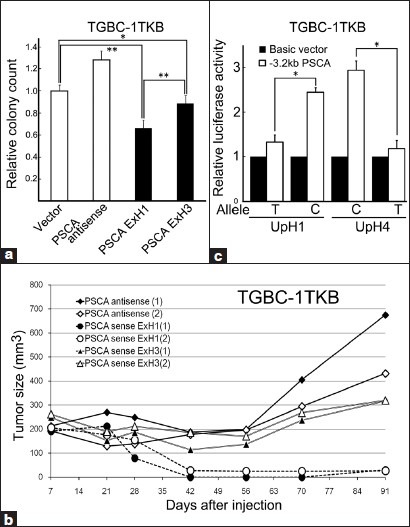
The PSCA cDNA harboring the C allele showed lower cell growth inhibition activity (20% reduction) than that with the T allele. Concordantly, when injected into subcutaneous tissues of mice, the GBC cell line stably expressing the cDNA with the C allele formed tumors of almost the same size as that of the control cells, but the cell line expressing the cDNA with the T allele showed slower growth. The upstream DNA fragment harboring the C allele had more transcriptional activity than that with the T allele. The C allele showed positive correlation to GBC but no statistical significant odds ratio (OR = 1.77, 95% confidence interval 0.85-3.70, P value = 0.127 in dominant model).
The missense allele was shown to have a biological effect, attenuating antitumor activities of PSCA, and consequently it may be a potential risk for GBC development. An association study in a larger sample size may reveal a significant association between the allele and GBC.
前列腺干细胞抗原(PSCA)是一种器官依赖性肿瘤抑制因子,在胆囊癌(GBC)中表达下调。预计该基因翻译起始密码子处单核苷酸多态性(SNP)rs2294008(T/C)的错义等位基因C会影响该基因的生物学功能,并对GBC易感性产生一定影响。我们研究了C等位基因对该基因功能的生物学效应以及C等位基因与GBC易感性之间的关系。
通过将携带该等位基因的PSCA cDNA导入GBC细胞系TGBC-1TKB,并进行体外集落形成试验和小鼠体内肿瘤形成试验,对该SNP进行功能分析。通过报告基因试验评估对转录调控的影响。对44例日本GBC病例和173例对照进行关联研究。
携带C等位基因的PSCA cDNA显示出比携带T等位基因的PSCA cDNA更低的细胞生长抑制活性(降低20%)。同样,当注射到小鼠皮下组织时,稳定表达携带C等位基因cDNA的GBC细胞系形成的肿瘤大小与对照细胞几乎相同,但表达携带T等位基因cDNA的细胞系生长较慢。携带C等位基因的上游DNA片段比携带T等位基因的片段具有更高的转录活性。C等位基因与GBC呈正相关,但在显性模型中无统计学显著优势比(OR = 1.77,95%置信区间0.85 - 3.70,P值 = 0.127)。
该错义等位基因显示出生物学效应,减弱了PSCA的抗肿瘤活性,因此它可能是GBC发生的潜在风险因素。更大样本量的关联研究可能会揭示该等位基因与GBC之间的显著关联。