Song Se Jin, Lauber Christian, Costello Elizabeth K, Lozupone Catherine A, Humphrey Gregory, Berg-Lyons Donna, Caporaso J Gregory, Knights Dan, Clemente Jose C, Nakielny Sara, Gordon Jeffrey I, Fierer Noah, Knight Rob
Department of Ecology and Evolutionary Biology , University of Colorado, Boulder , Boulder , United States.
Elife. 2013 Apr 16;2:e00458. doi: 10.7554/eLife.00458.
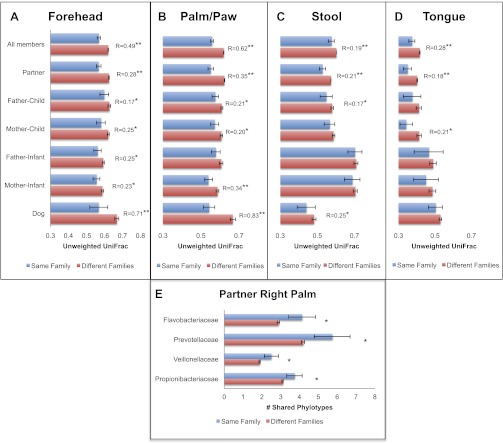
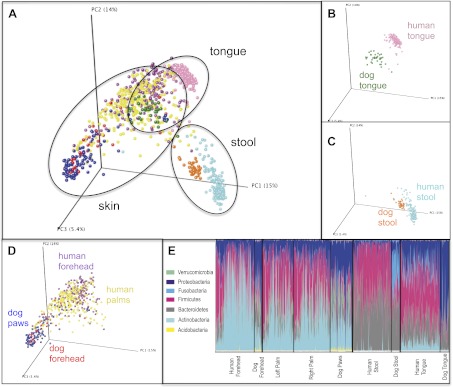
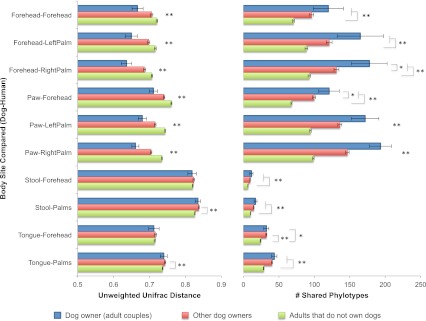
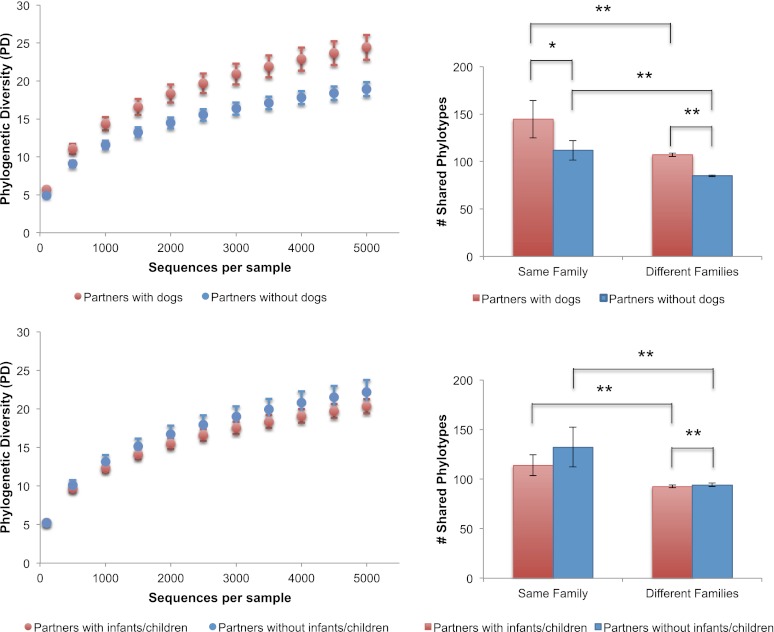
Human-associated microbial communities vary across individuals: possible contributing factors include (genetic) relatedness, diet, and age. However, our surroundings, including individuals with whom we interact, also likely shape our microbial communities. To quantify this microbial exchange, we surveyed fecal, oral, and skin microbiota from 60 families (spousal units with children, dogs, both, or neither). Household members, particularly couples, shared more of their microbiota than individuals from different households, with stronger effects of co-habitation on skin than oral or fecal microbiota. Dog ownership significantly increased the shared skin microbiota in cohabiting adults, and dog-owning adults shared more 'skin' microbiota with their own dogs than with other dogs. Although the degree to which these shared microbes have a true niche on the human body, vs transient detection after direct contact, is unknown, these results suggest that direct and frequent contact with our cohabitants may significantly shape the composition of our microbial communities. DOI:http://dx.doi.org/10.7554/eLife.00458.001.
可能的影响因素包括(基因)亲缘关系、饮食和年龄。然而,我们的周围环境,包括与我们互动的人,也可能塑造我们的微生物群落。为了量化这种微生物交换,我们对60个家庭(有孩子、狗、两者都有或两者都没有的配偶单元)的粪便、口腔和皮肤微生物群进行了调查。家庭成员,尤其是夫妻,比来自不同家庭的个体共享更多的微生物群,同居对皮肤微生物群的影响比对口腔或粪便微生物群的影响更大。养狗显著增加了同居成年人共享的皮肤微生物群,养狗的成年人与其自己的狗共享的“皮肤”微生物群比与其他狗共享的更多。虽然这些共享微生物在人体上真正定殖的程度,与直接接触后短暂检测到的程度相比尚不清楚,但这些结果表明,与同居者的直接和频繁接触可能会显著塑造我们微生物群落的组成。DOI:http://dx.doi.org/10.7554/eLife.00458.001