Skoufos Stylianos, Stavropoulou Elisavet, Tsigalou Christina, Voidarou Chrysoula Chrysa
Master Program in "Food, Nutrition and Microbiome", Department of Medicine, Democritus University of Thrace, 68100 Alexandroupolis, Greece.
Clinic of Obstetrics and Reproduction, Faculty of Veterinary Science, University of Thessaly, 43100 Karditsa, Greece.
Microorganisms. 2025 Jul 3;13(7):1564. doi: 10.3390/microorganisms13071564.
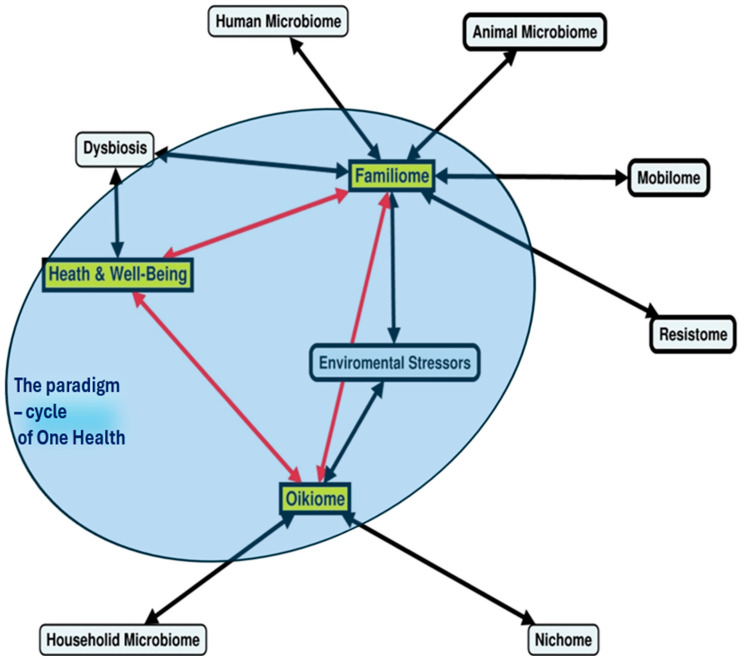
The One Health approach is rapidly gaining the attention of the scientific community worldwide and is expected to be a major model of scientific reasoning in the 21st century, concerning medical, veterinary and environmental issues. The basic concept of One Health, that humans, animals and their environments are parts of the same natural world affecting each other, is rooted in most ethnic as well as in many religious traditions. Despite this unity and for historical reasons, medical, veterinary and environmental sciences developed independently. The One Health concept tries to reunite these and many other relevant sciences, aiming at a deeper understanding of the interconnection between the natural world, humans and animal health. The dynamic interplay between a host's microbiome, the microbiomes of other hosts, and environmental microbial communities profoundly influences the host health, given the essential physiological functions the microbiome performs within the organism. The biodiversity of microbiomes is broad and complex. The different areas of the skin, the upper and lower respiratory systems, the ocular cavity, the oral cavity, the gastrointestinal tract and finally the urogenital system of pets and humans alike are niches where a multitude of microorganisms indigenous and transient-commensals and pathogens, thrive in a dynamic antagonistic balance of populations of different phyla, orders, genera and species. The description of these microbiomes attempted in this article is not meant to be exhaustive but rather demonstrative of their complexity. The study of microbiomes is a necessary step towards the One Health approach to pets and humans. Yet, despite the progress made on that subject, the scientific community faces challenges, such as the limitations of studies performed, the scarcity of studies concerning the microbiomes of cats, the multitude of environmental factors affecting the results and others. The two new terms proposed in this article, the "familiome" and the "oikiome", will aid in the One Health theoretical analysis as well as in its practical approach. The authors strongly believe that new technological breakthroughs, like Big Data Analytics and Artificial Intelligence (AI), will significantly help to overcome these hazards.
“同一健康”方法正迅速获得全球科学界的关注,并有望成为21世纪涉及医学、兽医和环境问题的科学推理主要模式。“同一健康”的基本概念,即人类、动物及其环境是相互影响的同一个自然世界的组成部分,植根于大多数民族以及许多宗教传统之中。尽管存在这种统一性,但由于历史原因,医学、兽医和环境科学是独立发展的。“同一健康”概念试图将这些以及许多其他相关科学重新结合起来,旨在更深入地理解自然世界、人类与动物健康之间的相互联系。鉴于微生物群在生物体内发挥的基本生理功能,宿主的微生物群、其他宿主的微生物群以及环境微生物群落之间的动态相互作用深刻影响着宿主健康。微生物群的生物多样性广泛而复杂。宠物和人类的皮肤不同区域、上呼吸道和下呼吸道系统、眼腔、口腔、胃肠道,以及最后泌尿生殖系统,都是大量本地和短暂共生及致病微生物的生态位,它们在不同门、目、属和种的种群动态拮抗平衡中繁衍生息。本文对这些微生物群的描述并非详尽无遗,而是旨在展示其复杂性。微生物群研究是宠物和人类“同一健康”方法的必要步骤。然而,尽管在该领域取得了进展,但科学界仍面临挑战,例如所开展研究的局限性、关于猫微生物群研究的稀缺性、影响结果的众多环境因素等。本文提出的两个新术语“家族微生物组”和“居家微生物组”,将有助于“同一健康”的理论分析及其实际应用。作者坚信,像大数据分析和人工智能(AI)这样的新技术突破将极大地有助于克服这些障碍。