Department of Chemistry, Midnapore College, Midnapore, West Bengal 721101, India.
Nanoscale Res Lett. 2013 Apr 19;8(1):181. doi: 10.1186/1556-276X-8-181.
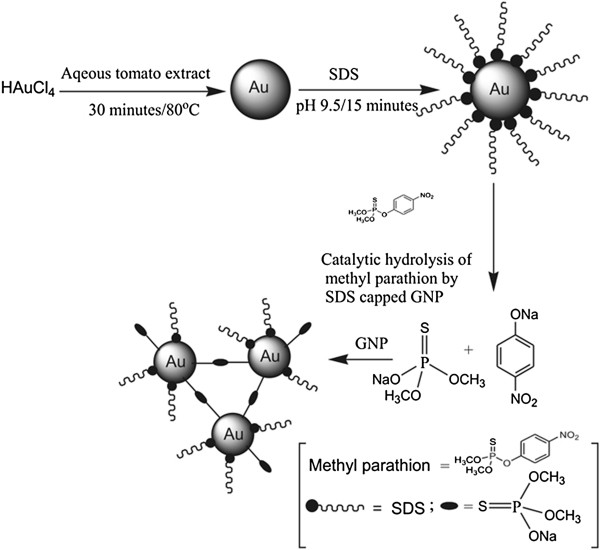
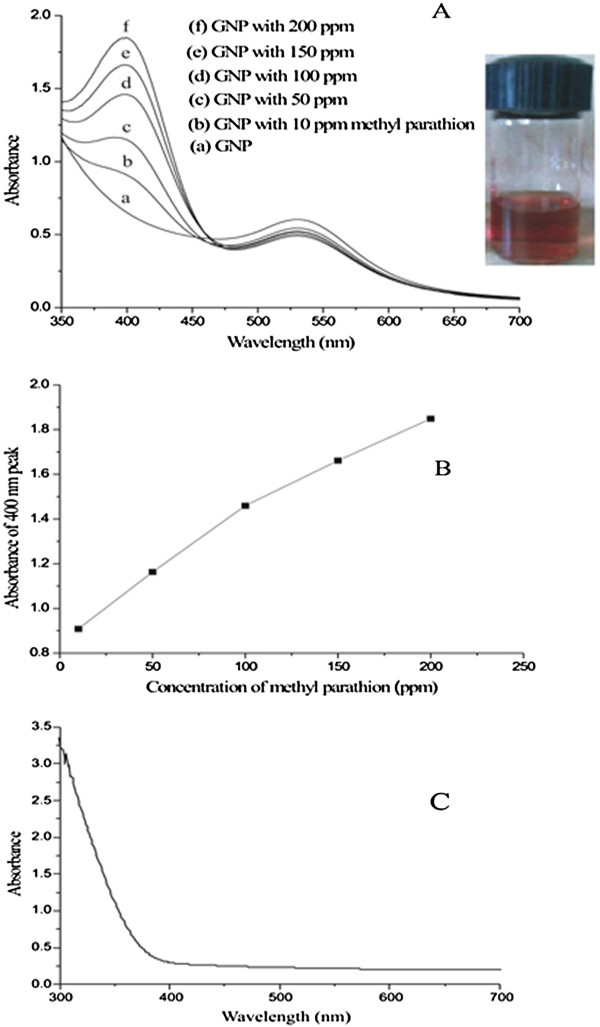
In this work, we report a green method for the synthesis of gold nanoparticles (GNP) using the aqueous extract of red tomato (Lycopersicon esculentum). We believe that citric acid and ascorbic acid present in tomato juice are responsible for the reduction of gold ions. This biosynthesized GNP in the presence of sodium dodecyl sulfate has been used as a colorimetric sensor to detect and estimate the pesticide, methyl parathion. The GNP in the presence of methyl parathion shows a new peak at 400 nm due to the formation of 4-nitrophenolate ion by catalytic hydrolysis of methyl parathion in alkaline medium. A calibration curve between the absorption coefficients of the 400-nm peak versus the concentration of the pesticide allows the quantitative estimation of the 4-nitrophenolate ion, thereby enabling indirect estimation of methyl parathion present in the system.
在这项工作中,我们报告了一种使用红色番茄(番茄)的水提物合成金纳米粒子(GNP)的绿色方法。我们认为番茄汁中存在的柠檬酸和抗坏血酸负责还原金离子。在十二烷基硫酸钠存在下,这种生物合成的 GNP 已被用作比色传感器来检测和估计杀虫剂甲基对硫磷。由于在碱性介质中甲基对硫磷的催化水解,在存在甲基对硫磷的 GNP 中在 400nm 处出现新的峰,由于形成 4-硝基苯酚盐离子。400nm 峰的吸收系数与杀虫剂浓度之间的校准曲线允许对 4-硝基苯酚盐离子进行定量估计,从而能够间接估计系统中存在的甲基对硫磷。