Spahn Donat R, Bouillon Bertil, Cerny Vladimir, Coats Timothy J, Duranteau Jacques, Fernández-Mondéjar Enrique, Filipescu Daniela, Hunt Beverley J, Komadina Radko, Nardi Giuseppe, Neugebauer Edmund, Ozier Yves, Riddez Louis, Schultz Arthur, Vincent Jean-Louis, Rossaint Rolf
Crit Care. 2013 Apr 19;17(2):R76. doi: 10.1186/cc12685.
Evidence-based recommendations are needed to guide the acute management of the bleeding trauma patient. When these recommendations are implemented patient outcomes may be improved.
The multidisciplinary Task Force for Advanced Bleeding Care in Trauma was formed in 2005 with the aim of developing a guideline for the management of bleeding following severe injury. This document represents an updated version of the guideline published by the group in 2007 and updated in 2010. Recommendations were formulated using a nominal group process, the Grading of Recommendations Assessment, Development and Evaluation (GRADE) hierarchy of evidence and based on a systematic review of published literature.
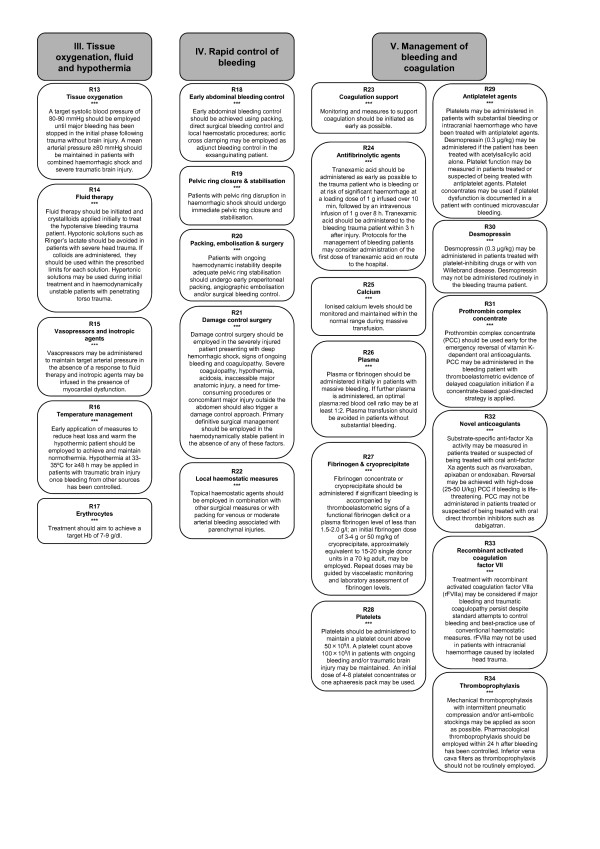
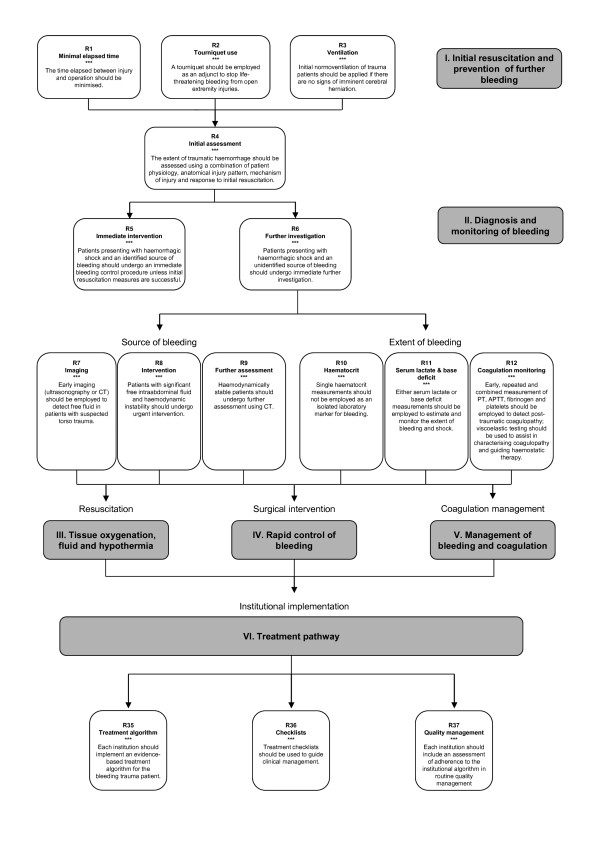
Key changes encompassed in this version of the guideline include new recommendations on the appropriate use of vasopressors and inotropic agents, and reflect an awareness of the growing number of patients in the population at large treated with antiplatelet agents and/or oral anticoagulants. The current guideline also includes recommendations and a discussion of thromboprophylactic strategies for all patients following traumatic injury. The most significant addition is a new section that discusses the need for every institution to develop, implement and adhere to an evidence-based clinical protocol to manage traumatically injured patients. The remaining recommendations have been re-evaluated and graded based on literature published since the last edition of the guideline. Consideration was also given to changes in clinical practice that have taken place during this time period as a result of both new evidence and changes in the general availability of relevant agents and technologies.
A comprehensive, multidisciplinary approach to trauma care and mechanisms with which to ensure that established protocols are consistently implemented will ensure a uniform and high standard of care across Europe and beyond.
需要基于证据的建议来指导创伤出血患者的急性处理。实施这些建议可能会改善患者的预后。
创伤严重出血高级护理多学科特别工作组于2005年成立,旨在制定严重创伤后出血管理指南。本文档是该小组于2007年发布并于2010年更新的指南的更新版本。建议采用名义小组法制定,依据推荐分级的评估、发展和评价(GRADE)证据分级体系,并基于对已发表文献的系统综述。
本版指南涵盖的关键变化包括关于血管加压药和正性肌力药合理使用的新建议,反映了对总体人群中接受抗血小板药物和/或口服抗凝剂治疗的患者数量不断增加的认识。当前指南还包括对所有创伤患者血栓预防策略的建议及讨论。最显著的新增内容是一个新章节,讨论每个机构制定、实施和遵守基于证据的临床方案以管理创伤患者的必要性。其余建议根据自上一版指南发布以来的文献进行了重新评估和分级。还考虑了在此期间由于新证据以及相关药物和技术总体可得性的变化而发生的临床实践变化。
采用全面、多学科的方法进行创伤护理,并建立确保既定方案得到持续实施的机制,将确保在欧洲及其他地区实现统一且高标准的护理。