Joslin Diabetes Center, Boston, Massachusetts, USA.
Diabetes. 2013 Aug;62(8):2717-27. doi: 10.2337/db13-0062. Epub 2013 Apr 22.
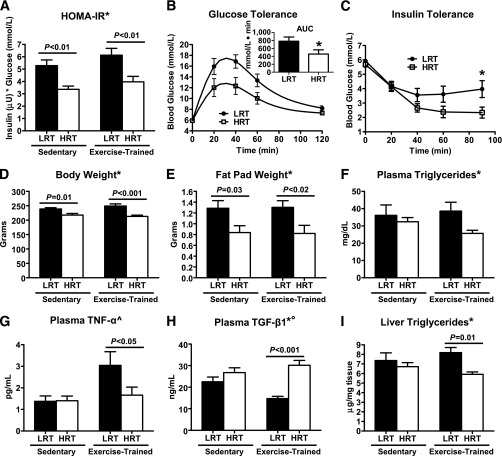
Low aerobic exercise capacity is a risk factor for diabetes and a strong predictor of mortality, yet some individuals are "exercise-resistant" and unable to improve exercise capacity through exercise training. To test the hypothesis that resistance to aerobic exercise training underlies metabolic disease risk, we used selective breeding for 15 generations to develop rat models of low and high aerobic response to training. Before exercise training, rats selected as low and high responders had similar exercise capacities. However, after 8 weeks of treadmill training, low responders failed to improve their exercise capacity, whereas high responders improved by 54%. Remarkably, low responders to aerobic training exhibited pronounced metabolic dysfunction characterized by insulin resistance and increased adiposity, demonstrating that the exercise-resistant phenotype segregates with disease risk. Low responders had impaired exercise-induced angiogenesis in muscle; however, mitochondrial capacity was intact and increased normally with exercise training, demonstrating that mitochondria are not limiting for aerobic adaptation or responsible for metabolic dysfunction in low responders. Low responders had increased stress/inflammatory signaling and altered transforming growth factor-β signaling, characterized by hyperphosphorylation of a novel exercise-regulated phosphorylation site on SMAD2. Using this powerful biological model system, we have discovered key pathways for low exercise training response that may represent novel targets for the treatment of metabolic disease.
低有氧运动能力是糖尿病的一个风险因素,也是死亡率的一个强有力预测指标,但有些人是“运动抵抗”的,无法通过运动训练来提高运动能力。为了验证“对有氧运动训练的抵抗是代谢疾病风险的基础”这一假设,我们使用了 15 代选择性繁殖来开发对训练有低和高有氧反应的大鼠模型。在进行运动训练之前,选择的低和高反应者的运动能力相似。然而,经过 8 周的跑步机训练,低反应者未能提高其运动能力,而高反应者则提高了 54%。值得注意的是,低反应者的有氧训练表现出明显的代谢功能障碍,表现为胰岛素抵抗和肥胖增加,表明运动抵抗表型与疾病风险有关。低反应者的肌肉运动诱导血管生成受损;然而,线粒体能力完整,随着运动训练正常增加,表明线粒体对于有氧适应或低反应者的代谢功能障碍不是有限的。低反应者的应激/炎症信号增加,转化生长因子-β信号改变,特征是 SMAD2 上一个新的运动调节磷酸化位点的过度磷酸化。使用这种强大的生物模型系统,我们发现了低运动训练反应的关键途径,这些途径可能代表代谢疾病治疗的新靶点。