Department of Mechanical Engineering and Materials Science, University of Pittsburgh, 3700 O'Hara Street, Pittsburgh, Pennsylvania 15261, USA.
Nat Commun. 2013;4:1742. doi: 10.1038/ncomms2768.
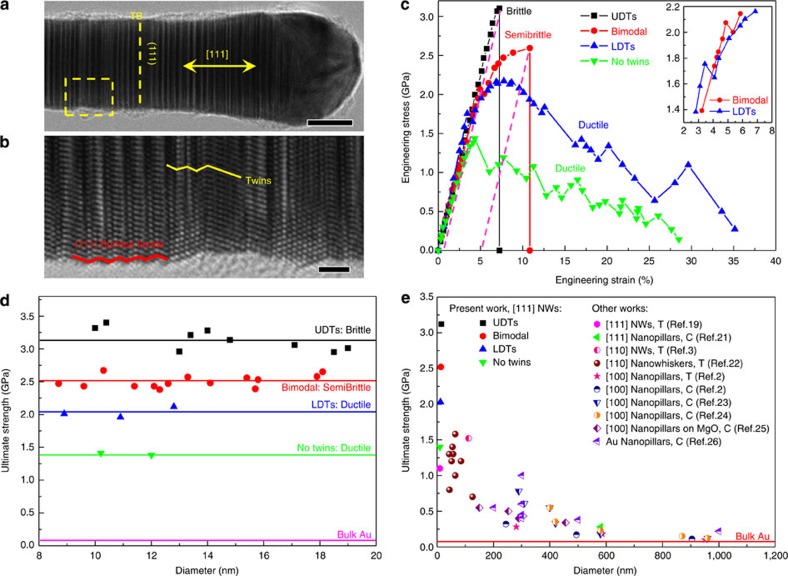
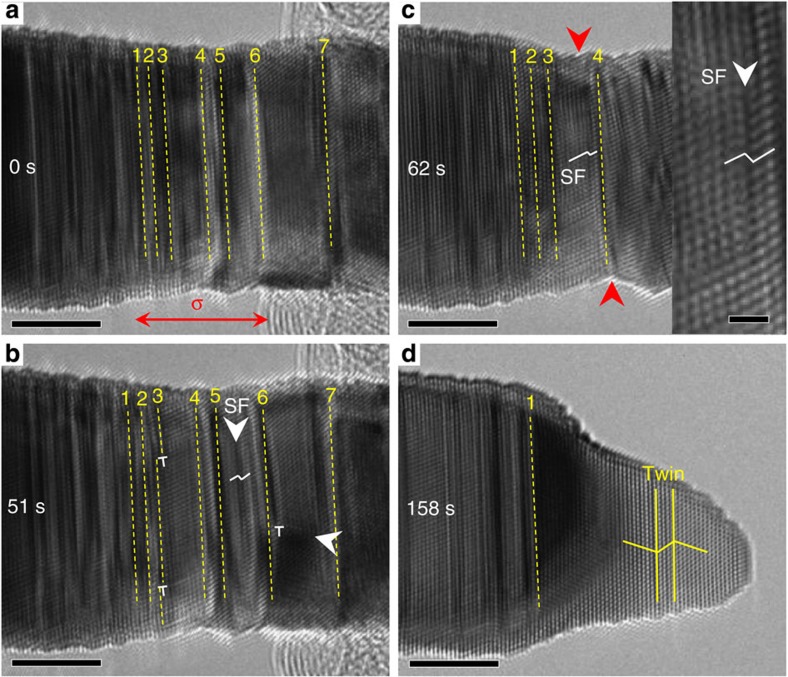
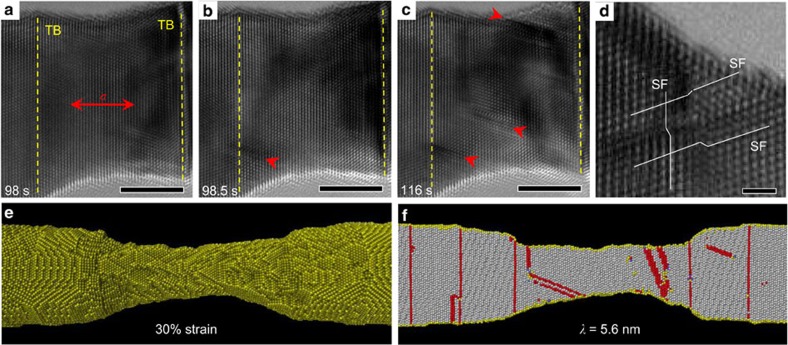
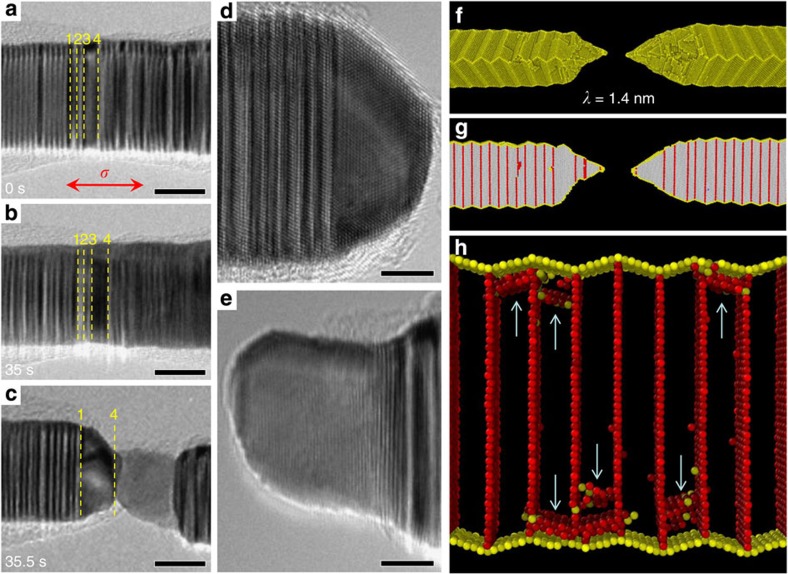
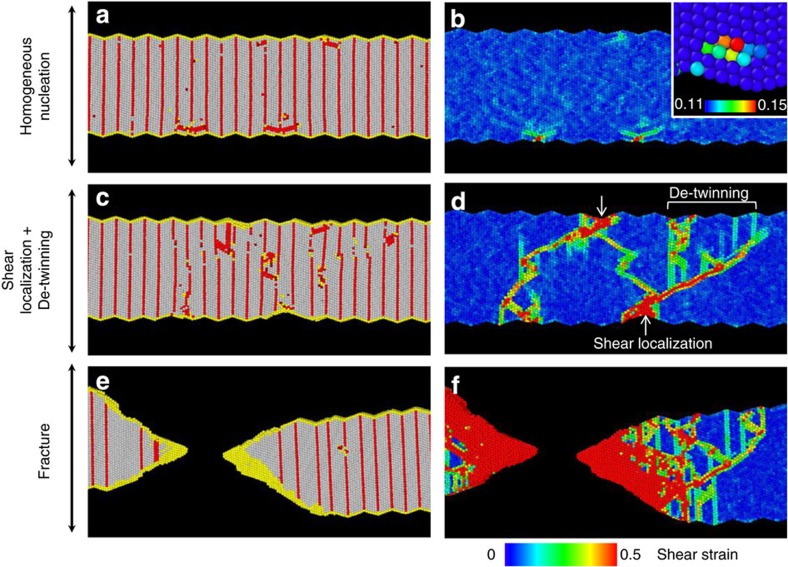
Although nanoscale twinning is an effective means to enhance yield strength and tensile ductility in metals, nanotwinned metals generally fail well below their theoretical strength limit due to heterogeneous dislocation nucleation from boundaries or surface imperfections. Here we show that Au nanowires containing angstrom-scaled twins (0.7 nm in thickness) exhibit tensile strengths up to 3.12 GPa, near the ideal limit, with a remarkable ductile-to-brittle transition with decreasing twin size. This is opposite to the behaviour of metallic nanowires with lower-density twins reported thus far. Ultrahigh-density twins (twin thickness<2.8 nm) are shown to give rise to homogeneous dislocation nucleation and plastic shear localization, contrasting with the heterogeneous slip mechanism observed in single-crystalline or low-density-twinned nanowires. The twin size dependent dislocation nucleation and deformation represent a new type of size effect distinct from the sample size effects described previously.
尽管纳米孪晶是提高金属屈服强度和拉伸延展性的有效手段,但由于从晶界或表面缺陷不均匀位错形核,纳米孪晶金属通常远低于其理论强度极限而失效。在这里,我们展示了含有埃米尺度孪晶(厚度为 0.7nm)的 Au 纳米线具有高达 3.12GPa 的拉伸强度,接近理想极限,并且随着孪晶尺寸的减小,延展性到脆性的转变非常显著。这与迄今为止报道的具有低密度孪晶的金属纳米线的行为相反。超高密度孪晶(孪晶厚度<2.8nm)导致均匀位错形核和塑性剪切局部化,与在单晶或低密度孪晶纳米线中观察到的不均匀滑移机制形成对比。孪晶尺寸相关的位错形核和变形代表了一种不同于以前描述的样品尺寸效应的新型尺寸效应。