Zhang Tong, Tong Yuanbiao, Pan Chenxinyu, Pei Jun, Wang Xiaomeng, Liu Tao, Yin Binglun, Wang Pan, Gao Yang, Tong Limin, Yang Wei
Center for X-mechanics, Department of Engineering Mechanics, Zhejiang University, Hangzhou, China.
State Key Laboratory of Extreme Photonics and Instrumentation, College of Optical Science and Engineering, Hangzhou, China.
Nat Commun. 2025 Jan 22;16(1):926. doi: 10.1038/s41467-025-56047-x.
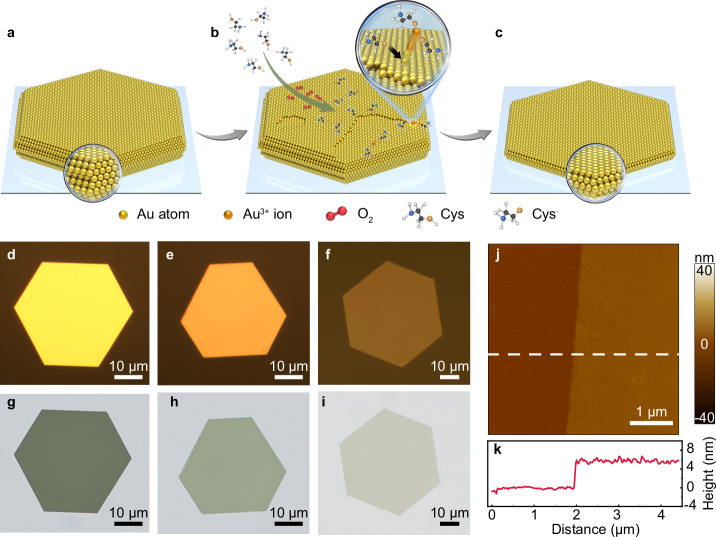
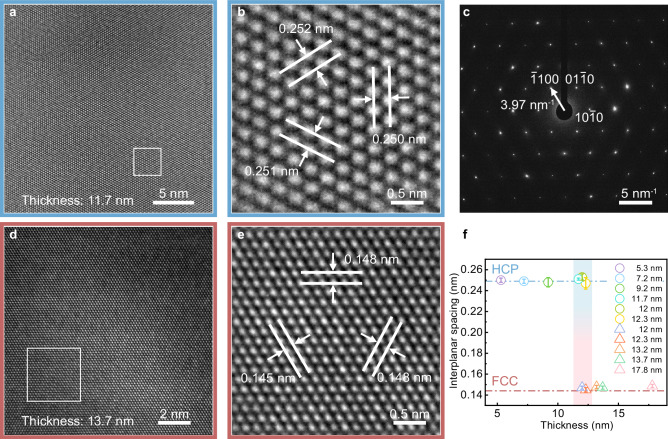
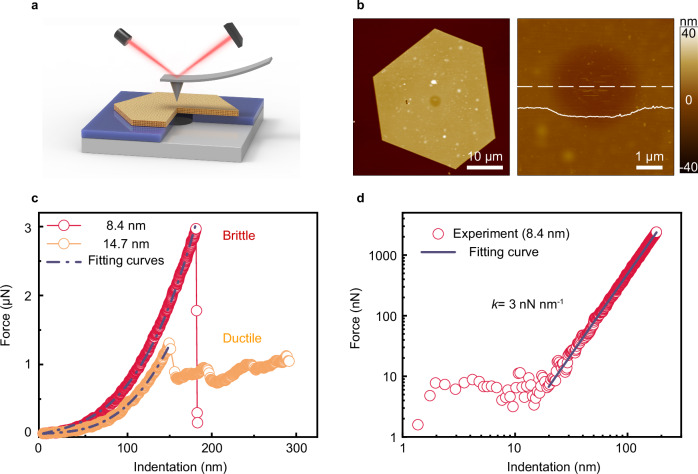
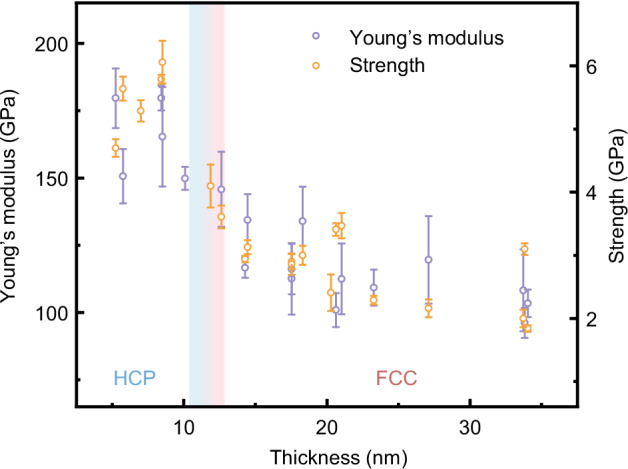
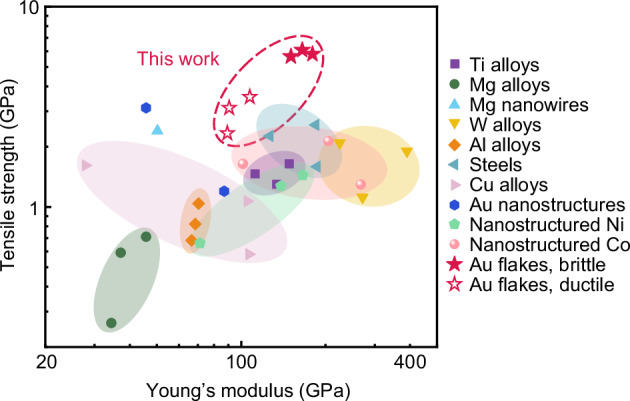
Materials usually fracture before reaching their ideal strength limits. Meanwhile, materials with high strength generally have poor ductility, and vice versa. For example, gold with the conventional face-centered cubic (FCC) phase is highly ductile while the yield strength (~10MPa) is significantly lower than its ideal theoretical limit. Here, through phase engineering, we show that defect-free single-crystalline gold nanoflakes with the hexagonal close-packed (HCP) phase can exhibit a strength of 6.0 GPa, which is beyond the ideal theoretical limit of the conventional FCC counterpart. The lattice structure is thickness-dependent and the FCC-HCP phase transformation happens in the range of 11-13 nm. Suspended-nanoindentations based on atomic force microscopy (AFM) show that the Young's modulus and tensile strength are also thickness-and phase- dependent. The maximum strength is reached in HCP nanoflakes thinner than 10 nm. First-principles and molecular dynamics (MD) calculations demonstrate that the mechanical properties arise from the unconventional HCP structure as well as the strong surface effect. Our study provides valuable insights into the fabrication of nanometals with extraordinary mechanical properties through phase engineering.
材料通常在达到其理想强度极限之前就会断裂。同时,高强度的材料通常延展性较差,反之亦然。例如,具有传统面心立方(FCC)相的金具有很高的延展性,但其屈服强度(约10MPa)明显低于其理想理论极限。在此,通过相工程,我们表明具有六方密排(HCP)相的无缺陷单晶金纳米片可表现出6.0 GPa的强度,这超过了传统FCC对应物的理想理论极限。晶格结构取决于厚度,FCC-HCP相变发生在11-13 nm范围内。基于原子力显微镜(AFM)的悬浮纳米压痕表明,杨氏模量和拉伸强度也与厚度和相有关。在厚度小于10 nm的HCP纳米片中达到最大强度。第一性原理和分子动力学(MD)计算表明,力学性能源于非常规的HCP结构以及强大的表面效应。我们的研究为通过相工程制造具有非凡力学性能的纳米金属提供了有价值的见解。