Department of Physiology, Institute of Neuroscience and Physiology, The Sahlgrenska Academy at the University of Gothenburg, Gothenburg, Sweden.
PLoS One. 2013 Apr 16;8(4):e61965. doi: 10.1371/journal.pone.0061965. Print 2013.
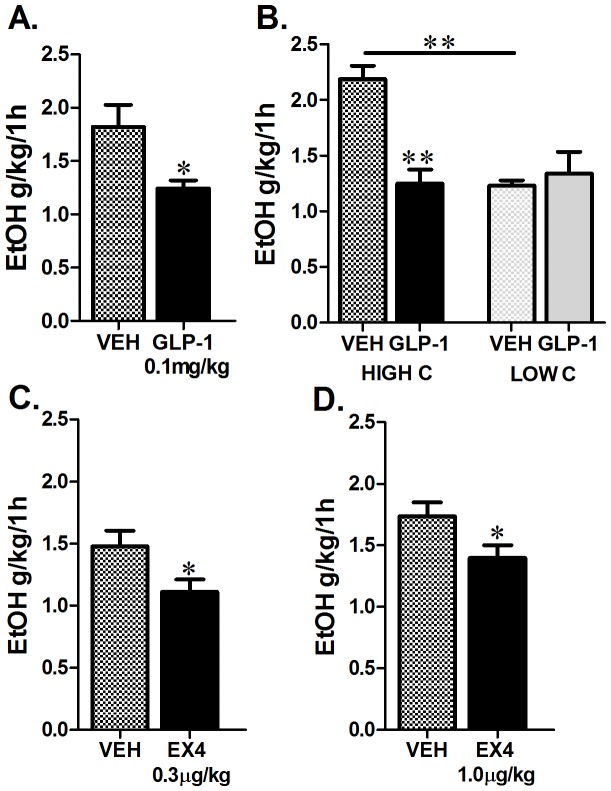
Glucagon-like-peptide-1 (GLP-1) is a gut- and neuro-peptide with an important role in the regulation of food intake and glucose metabolism. Interestingly, GLP-1 receptors (GLP-1R) are expressed in key mesolimbic reward areas (including the ventral tegmental area, VTA), innervated by hindbrain GLP-1 neurons. Recently GLP-1 has emerged as a potential regulator of food reward behavior, an effect driven by the mesolimbic GLP-1Rs. Its role in other reward behaviors remains largely unexplored. Since a considerable overlap has been suggested for circuitry controlling reward behavior derived from food and alcohol we hypothesized that GLP-1 and GLP-1Rs could regulate alcohol intake and alcohol reward. We sought to determine whether GLP-1 or its clinically safe stable analogue, Exendin-4, reduce alcohol intake and reward. To determine the potential role of the endogenous GLP-1 in alcohol intake we evaluated whether GLP-1R antagonist, Exendin 9-39, can increase alcohol intake. Furthermore, we set out to evaluate whether VTA GLP-1R activation is sufficient to reduce alcohol intake. Male Wistar rats injected peripherally with GLP-1 or Exendin-4 reduced their alcohol intake in an intermittent access two bottle free choice drinking model. Importantly, a contribution of endogenously released GLP-1 is highlighted by our observation that blockade of GLP-1 receptors alone resulted in an increased alcohol intake. Furthermore, GLP-1 injection reduced alcohol reward in the alcohol conditioned place preference test in mice. To evaluate the neuroanatomical substrate linking GLP-1 with alcohol intake/reward, we selectively microinjected GLP-1 or Exendin 4 into the VTA. This direct stimulation of the VTA GLP-1 receptors potently reduced alcohol intake. Our findings implicate GLP-1R signaling as a novel modulator of alcohol intake and reward. We show for the first time that VTA GLP-1R stimulation leads to reduced alcohol intake. Considering that GLP-1 analogues are already approved for clinical use, this places the GLP system as an exciting new potential therapeutic target for alcohol use disorders.
胰高血糖素样肽-1(GLP-1)是一种肠道和神经肽,在调节食物摄入和葡萄糖代谢方面发挥着重要作用。有趣的是,GLP-1 受体(GLP-1R)在关键的中脑边缘奖赏区域(包括腹侧被盖区,VTA)中表达,由后脑 GLP-1 神经元支配。最近,GLP-1 已成为食物奖赏行为的潜在调节剂,这种作用是由中脑边缘 GLP-1R 驱动的。其在其他奖赏行为中的作用在很大程度上仍未得到探索。由于控制食物和酒精奖赏行为的回路有相当大的重叠,我们假设 GLP-1 和 GLP-1R 可以调节酒精摄入和酒精奖赏。我们试图确定 GLP-1 或其临床安全的稳定类似物 Exendin-4 是否可以减少酒精摄入和奖赏。为了确定内源性 GLP-1 在酒精摄入中的潜在作用,我们评估了 GLP-1R 拮抗剂 Exendin 9-39 是否可以增加酒精摄入。此外,我们着手评估 VTA GLP-1R 的激活是否足以减少酒精摄入。雄性 Wistar 大鼠经外周注射 GLP-1 或 Exendin-4 后,可减少间歇性双瓶自由选择饮酒模型中的酒精摄入量。重要的是,我们观察到单独阻断 GLP-1 受体就会导致酒精摄入量增加,这突出了内源性 GLP-1 的作用。此外,GLP-1 注射可降低小鼠酒精条件性位置偏爱测试中的酒精奖赏。为了评估将 GLP-1 与酒精摄入/奖赏联系起来的神经解剖学基础,我们将 GLP-1 或 Exendin 4 选择性地微注射到 VTA 中。VTA GLP-1R 的这种直接刺激强烈减少了酒精摄入。我们的研究结果表明,GLP-1R 信号作为酒精摄入和奖赏的新型调节剂。我们首次表明,VTA GLP-1R 刺激可导致酒精摄入减少。考虑到 GLP-1 类似物已被批准用于临床使用,这使 GLP 系统成为治疗酒精使用障碍的一个令人兴奋的新潜在治疗靶点。