Shim Hunbo, Yang Ji-Hyuk, Park Pyo-Won, Jeong Dong Seop, Jun Tae-Gook
Department of Thoracic and Cardiovascular Surgery, Samsung Medical Center, Sungkyunkwan University School of Medicine, Korea.
Korean J Thorac Cardiovasc Surg. 2013 Apr;46(2):98-103. doi: 10.5090/kjtcs.2013.46.2.98. Epub 2013 Apr 9.
Atrial fibrillation (AF) is a common complication in elderly patients with atrial septal defect (ASD). The purpose of this study was to examine the efficacy of the maze procedure in these patients.
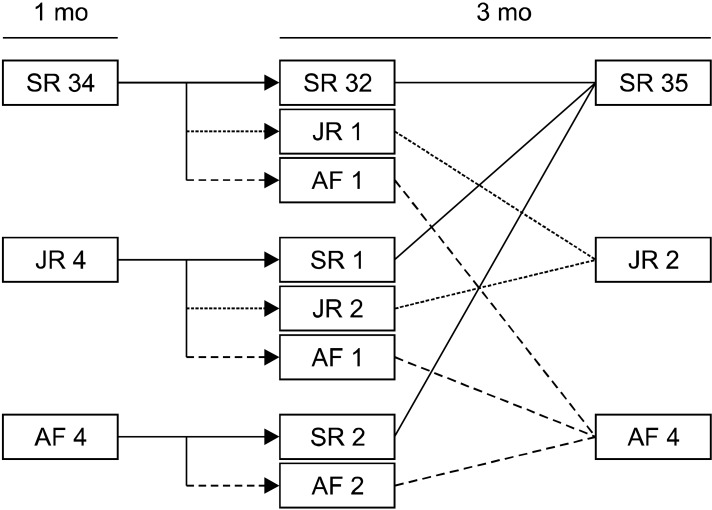
Between February 2000 and May 2011, 46 patients underwent the maze procedure as a concomitant operation with ASD closure. Three patients who underwent a right-sided maze were excluded, and one patient was lost to follow-up. The mean follow-up duration was 3.2±2.5 years. Electrocardiography was performed 1 month, 3 months, 6 months, and 1 year after surgery, and checked annually after that.
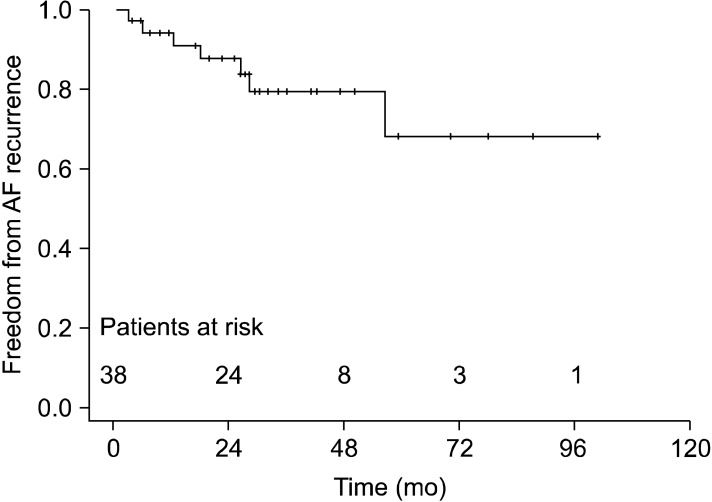
AF persisted in 4 patients after surgery. One year after surgery, among 38 patients, 55.3% remained in sinus rhythm without antiarrhythmic drugs. However, when including the patients who took antiarrhythmic drugs, 92.1% were in sinus rhythm. Freedom from AF recurrence at 3 months, 6 months, 1 year, 2 years, 3 years, and 5 years after surgery were 97.4±2.6, 94.4±3.8, 91.2±4.9, 87.8±5.8, 79.5±7.6, and 68.2±12.4, respectively. There was no early mortality after operation.
Concomitant treatment with the maze procedure and ASD closure is safe and effective for restoring the sinus rhythm.
心房颤动(AF)是老年房间隔缺损(ASD)患者的常见并发症。本研究的目的是检验迷宫手术在这些患者中的疗效。
2000年2月至2011年5月期间,46例患者在ASD封堵术的同时接受了迷宫手术。3例行右侧迷宫手术的患者被排除,1例失访。平均随访时间为3.2±2.5年。术后1个月、3个月、6个月和1年进行心电图检查,此后每年检查一次。
术后4例患者持续存在AF。术后1年,38例患者中,55.3%在未使用抗心律失常药物的情况下维持窦性心律。然而,若将使用抗心律失常药物的患者纳入,92.1%为窦性心律。术后3个月、6个月、1年、2年、3年和5年的AF复发率分别为97.4±2.6、94.4±3.8、91.2±4.9、87.8±5.8、79.5±7.6和68.2±12.4。术后无早期死亡病例。
迷宫手术与ASD封堵术联合治疗恢复窦性心律安全有效。