INSERM, UMR 738, Université Paris Diderot, Sorbonne Paris Cité, Paris F-75018, France.
BMC Med Res Methodol. 2013 Apr 25;13:60. doi: 10.1186/1471-2288-13-60.
Models of hepatitis C virus (HCV) kinetics are increasingly used to estimate and to compare in vivo drug's antiviral effectiveness of new potent anti-HCV agents. Viral kinetic parameters can be estimated using non-linear mixed effect models (NLMEM). Here we aimed to evaluate the performance of this approach to precisely estimate the parameters and to evaluate the type I errors and the power of the Wald test to compare the antiviral effectiveness between two treatment groups when data are sparse and/or a large proportion of viral load (VL) are below the limit of detection (BLD).
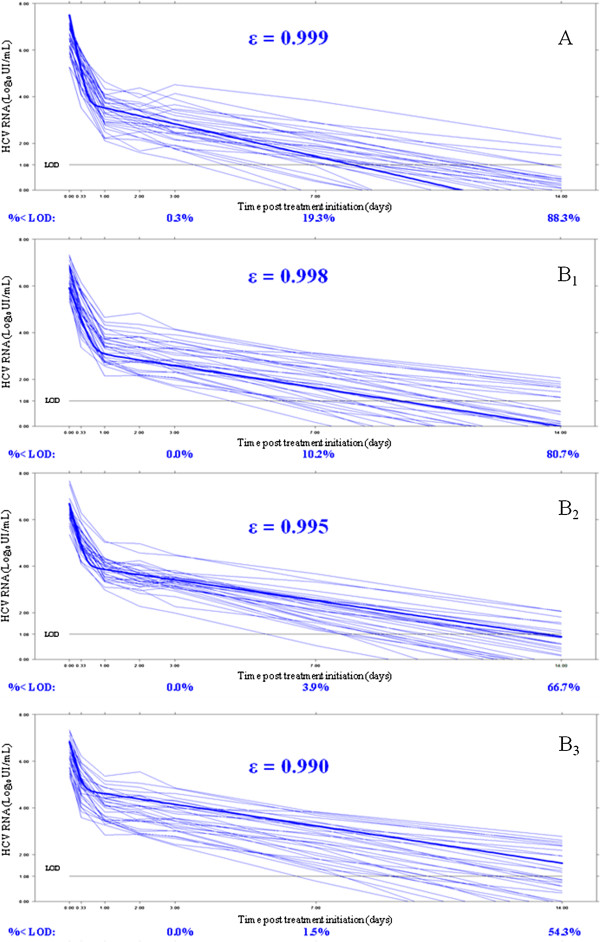
We performed a clinical trial simulation assuming two treatment groups with different levels of antiviral effectiveness. We evaluated the precision and the accuracy of parameter estimates obtained on 500 replication of this trial using the stochastic approximation expectation-approximation algorithm which appropriately handles BLD data. Next we evaluated the type I error and the power of the Wald test to assess a difference of antiviral effectiveness between the two groups. Standard error of the parameters and Wald test property were evaluated according to the number of patients, the number of samples per patient and the expected difference in antiviral effectiveness.
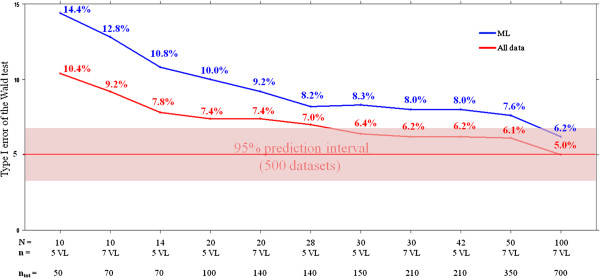
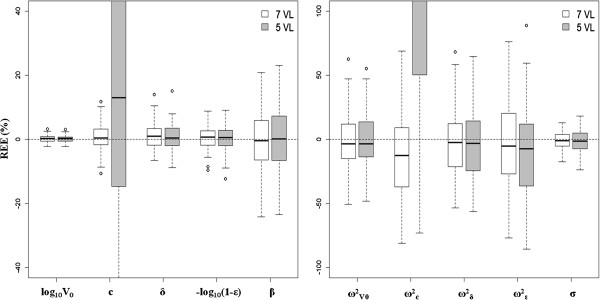
NLMEM provided precise and accurate estimates for both the fixed effects and the inter-individual variance parameters even with sparse data and large proportion of BLD data. However Wald test with small number of patients and lack of information due to BLD resulted in an inflation of the type I error as compared to the results obtained when no limit of detection of VL was considered. The corrected power of the test was very high and largely outperformed what can be obtained with empirical comparison of the mean VL decline using Wilcoxon test.
This simulation study shows the benefit of viral kinetic models analyzed with NLMEM over empirical approaches used in most clinical studies. When designing a viral kinetic study, our results indicate that the enrollment of a large number of patients is to be preferred to small population sample with frequent assessments of VL.
丙型肝炎病毒(HCV)动力学模型越来越多地用于估计和比较新的强效抗 HCV 药物的体内药物抗病毒效果。病毒动力学参数可以使用非线性混合效应模型(NLMEM)进行估计。在这里,我们旨在评估这种方法的性能,以准确估计参数,并评估 Wald 检验的Ⅰ类错误和功效,以比较两组治疗之间的抗病毒效果,当数据稀疏和/或大量病毒载量(VL)低于检测限(BLD)时。
我们进行了一项临床试验模拟,假设两组治疗具有不同水平的抗病毒效果。我们使用随机近似期望逼近算法对该试验的 500 次重复进行了参数估计的精度和准确性评估,该算法适当地处理 BLD 数据。接下来,我们评估了 Wald 检验的Ⅰ类错误和功效,以评估两组之间抗病毒效果的差异。根据患者数量、每个患者的样本数量以及预期的抗病毒效果差异,评估了参数的标准误差和 Wald 检验性质。
即使数据稀疏且 BLD 数据比例较大,NLMEM 也能为固定效应和个体间方差参数提供精确和准确的估计。然而,由于 BLD 导致患者数量较少且缺乏信息,Wald 检验导致Ⅰ类错误增加,与不考虑 VL 检测限时获得的结果相比。校正后的检验功效非常高,并且大大超过了使用 Wilcoxon 检验比较平均 VL 下降的经验方法所获得的功效。
这项模拟研究表明,使用 NLMEM 分析病毒动力学模型优于大多数临床研究中使用的经验方法。在设计病毒动力学研究时,我们的结果表明,与频繁评估 VL 的小人群样本相比,应优先招募大量患者。