• 文献检索
  • 文档翻译
  • 深度研究
  • 学术资讯
  • Suppr Zotero 插件Zotero 插件
  • 邀请有礼
  • 套餐&价格
  • 历史记录
应用&插件
Suppr Zotero 插件Zotero 插件浏览器插件Mac 客户端Windows 客户端微信小程序
定价
高级版会员购买积分包购买API积分包
服务
文献检索文档翻译深度研究API 文档MCP 服务
关于我们
关于 Suppr公司介绍联系我们用户协议隐私条款
关注我们

Suppr 超能文献

核心技术专利:CN118964589B侵权必究
粤ICP备2023148730 号-1Suppr @ 2026

文献检索

告别复杂PubMed语法,用中文像聊天一样搜索,搜遍4000万医学文献。AI智能推荐,让科研检索更轻松。

立即免费搜索

文件翻译

保留排版,准确专业,支持PDF/Word/PPT等文件格式,支持 12+语言互译。

免费翻译文档

深度研究

AI帮你快速写综述,25分钟生成高质量综述,智能提取关键信息,辅助科研写作。

立即免费体验

多发性硬化症患者的 TSPO 体内成像:[18F]FEDAA1106 脑 PET 研究。

In vivo TSPO imaging in patients with multiple sclerosis: a brain PET study with [18F]FEDAA1106.

机构信息

Center for Psychiatric Research, Department of Clinical Neuroscience, Karolinska Institutet, Stockholm SE-171 77, Sweden.

出版信息

EJNMMI Res. 2013 Apr 24;3(1):30. doi: 10.1186/2191-219X-3-30.

DOI:10.1186/2191-219X-3-30
PMID:23618062
原文链接:https://pmc.ncbi.nlm.nih.gov/articles/PMC3640965/
Abstract

BACKGROUND

The activation of microglia, in general, and the upregulation of the translocator protein (18 kDa) (TSPO) system, in particular, are key features of neuroinflammation, of which the in vivo visualization and quantitative assessment are still challenging due to the lack of appropriate molecular imaging biomarkers. Recent positron emission tomography (PET) studies using TSPO radioligands such as [11C]PK11195 and [11C]PBR28 have indicated the usefulness of these PET biomarkers in patients with neuroinflammatory diseases, including multiple sclerosis (MS). [18F]FEDAA1106 is a recently developed PET radioligand for the in vivo quantification of TSPO. In the present study, we aimed at investigating the diagnostic usefulness of [18F]FEDAA1106 in patients with MS.

METHODS

Nine patients (three on the interferon beta therapy and six without immunomodulatory therapy; seven females/two males; age 34.2 ± 9.1 years old) with relapsing-remitting MS in acute relapse and with gadolinium (Gd)-enhancing lesion(s) in the magnetic resonance imaging (MRI) scans and five healthy controls (four females/one male, age 38.0 ± 9.7 years old) were investigated in this study. Genetic information about the TSPO binding could not be obtained because knowledge about the importance of genetic background for TSPO binding was not available at the time the study was performed. Dynamic PET measurements were performed using an ECAT EXACT HR system (CTI/Siemens, Knoxville, TN, USA) for a total of 150 min, with a 30-min break after the injection of 153.4 ± 10.2 MBq of [18F]FEDAA1106. Metabolite-corrected arterial plasma samples were used to calculate the input function. PET data were analyzed in the following ways: (1) region-of-interest analysis for cortical and subcortical regions was performed using a two-tissue compartment kinetic model in order to estimate binding potentials (BPND) and distribution volume (VT), (2) the feasibility of the estimation of BPND and VT was investigated for MS lesions, and (3) VT parametric images by a Logan plot and standard uptake value (SUV) images were visually compared with the corresponding MRI, focusing on MRI-identified MS lesions.

RESULTS

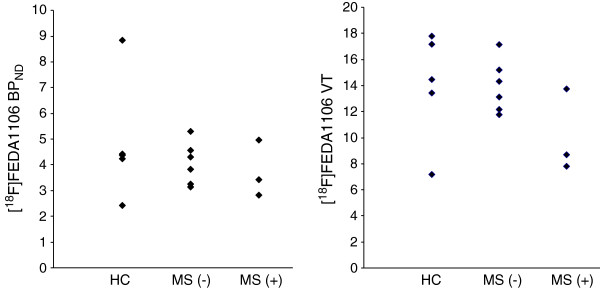
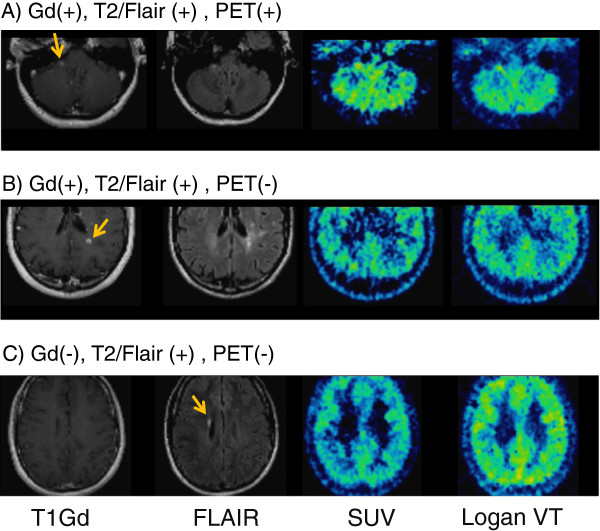
There were no significant differences in the BPND or VT values between patients with MS and healthy controls. Robust BPND and VT values could not be obtained for most MS lesions due to noisy time-activity curves. Visual inspection of VT and SUV images in all nine patients did not reveal high uptake of the radioligand inside and beyond MRI-identified active MS lesions with the exception of one Gd-enhanced MS lesion in the whole patient population.

CONCLUSIONS

In our study, [18F]FEDAA1106 as a PET radioligand could neither differentiate patients with MS from healthy controls nor detect active plaques in the brain of MS patients. Stratification with respect to genetics and binder status might help to uncover the differences between the groups, which could not be detected here.

TRIAL REGISTRATION

ClinicalTrials.gov, NCT01031199.

https://cdn.ncbi.nlm.nih.gov/pmc/blobs/b2e2/3640965/b59593aaa381/2191-219X-3-30-2.jpg
https://cdn.ncbi.nlm.nih.gov/pmc/blobs/b2e2/3640965/641320de72d0/2191-219X-3-30-1.jpg
https://cdn.ncbi.nlm.nih.gov/pmc/blobs/b2e2/3640965/b59593aaa381/2191-219X-3-30-2.jpg
https://cdn.ncbi.nlm.nih.gov/pmc/blobs/b2e2/3640965/641320de72d0/2191-219X-3-30-1.jpg
https://cdn.ncbi.nlm.nih.gov/pmc/blobs/b2e2/3640965/b59593aaa381/2191-219X-3-30-2.jpg
摘要

背景

小胶质细胞的激活,一般来说,以及转位蛋白(18 kDa)(TSPO)系统的上调,是神经炎症的关键特征,由于缺乏适当的分子影像学生物标志物,其体内可视化和定量评估仍然具有挑战性。最近使用 TSPO 放射性配体(如[11C]PK11195和[11C]PBR28)的正电子发射断层扫描(PET)研究表明,这些 PET 生物标志物在神经炎症性疾病患者中具有一定的应用价值,包括多发性硬化症(MS)。[18F]FEDAA1106 是一种最近开发的用于体内定量 TSPO 的 PET 放射性配体。在本研究中,我们旨在研究[18F]FEDAA1106 在 MS 患者中的诊断价值。

方法

本研究纳入了 9 名处于急性复发期的复发缓解型 MS 患者(3 名接受干扰素β治疗,6 名未接受免疫调节治疗;7 名女性/2 名男性;年龄 34.2±9.1 岁)和 5 名健康对照者(4 名女性/1 名男性;年龄 38.0±9.7 岁)。由于当时还没有关于 TSPO 结合遗传背景重要性的知识,因此无法获得有关 TSPO 结合的遗传信息。使用 ECAT EXACT HR 系统(CTI/Siemens,田纳西州诺克斯维尔)进行了 150 分钟的动态 PET 测量,在注射 153.4±10.2MBq [18F]FEDAA1106 后进行了 30 分钟的休息。使用代谢校正的动脉血浆样本计算输入函数。以以下方式分析 PET 数据:(1)使用双组织室动力学模型进行皮质和皮质下区域的感兴趣区分析,以估计结合潜能(BPND)和分布容积(VT);(2)研究 MS 病变中 BPND 和 VT 估计的可行性;(3)通过 Logan 图和标准摄取值(SUV)图像进行 VT 参数图像的视觉比较,并重点关注 MRI 确定的 MS 病变。

结果

MS 患者和健康对照者的 BPND 或 VT 值无显著差异。由于时间活性曲线噪声较大,大多数 MS 病变的 BPND 和 VT 值均无法获得。对所有 9 名患者的 VT 和 SUV 图像进行视觉检查,除了整个患者群体中的一个 Gd 增强 MS 病变外,并未发现放射性配体在 MRI 确定的活跃 MS 病变内和病变外的摄取增加。

结论

在我们的研究中,[18F]FEDAA1106 作为一种 PET 放射性配体,既不能区分 MS 患者与健康对照者,也不能检测 MS 患者大脑中的活动斑块。对遗传学和配体状态进行分层可能有助于揭示两组之间的差异,而这在本研究中无法检测到。

试验注册

ClinicalTrials.gov,NCT01031199。

相似文献

1
In vivo TSPO imaging in patients with multiple sclerosis: a brain PET study with [18F]FEDAA1106.多发性硬化症患者的 TSPO 体内成像:[18F]FEDAA1106 脑 PET 研究。
EJNMMI Res. 2013 Apr 24;3(1):30. doi: 10.1186/2191-219X-3-30.
2
In vivo imaging of the 18-kDa translocator protein (TSPO) with [18F]FEDAA1106 and PET does not show increased binding in Alzheimer's disease patients.采用 [18F]FEDAA1106 和正电子发射断层扫描(PET)对 18 kDa 转位蛋白(TSPO)进行体内成像显示,阿尔茨海默病患者的结合没有增加。
Eur J Nucl Med Mol Imaging. 2013 Jun;40(6):921-31. doi: 10.1007/s00259-013-2359-1. Epub 2013 Feb 22.
3
TSPO PET with [F]GE-180 sensitively detects focal neuroinflammation in patients with relapsing-remitting multiple sclerosis.TSPO PET 联合 [F]GE-180 可敏感检测复发性缓解型多发性硬化患者的局灶性神经炎症。
Eur J Nucl Med Mol Imaging. 2018 Jul;45(8):1423-1431. doi: 10.1007/s00259-018-3974-7. Epub 2018 Mar 9.
4
Confirmation of Specific Binding of the 18-kDa Translocator Protein (TSPO) Radioligand [F]GE-180: a Blocking Study Using XBD173 in Multiple Sclerosis Normal Appearing White and Grey Matter.18kDa 转位蛋白(TSPO)放射性配体[F]GE-180 的特异性结合确认:XBD173 在多发性硬化症正常表现白质和灰质中的阻断研究。
Mol Imaging Biol. 2019 Oct;21(5):935-944. doi: 10.1007/s11307-019-01323-8.
5
Quantitative assessment of translocator protein (TSPO) in the non-human primate brain and clinical translation of [F]LW223 as a TSPO-targeted PET radioligand.非人灵长类动物大脑中转运体蛋白(TSPO)的定量评估以及[F]LW223作为TSPO靶向正电子发射断层显像(PET)放射性配体的临床转化
Pharmacol Res. 2023 Mar;189:106681. doi: 10.1016/j.phrs.2023.106681. Epub 2023 Feb 4.
6
In vivo evaluation of a novel F-labeled PET radioligand for translocator protein 18 kDa (TSPO) in monkey brain.在体评价新型 F 标记的 18 kDa 膜转位蛋白(TSPO)正电子发射断层扫描(PET)放射性配体在猴脑中的应用。
Eur J Nucl Med Mol Imaging. 2023 Aug;50(10):2962-2970. doi: 10.1007/s00259-023-06270-9. Epub 2023 May 30.
7
Characterization of cortico-meningeal translocator protein expression in multiple sclerosis.多发性硬化症中皮质脑膜转位蛋白表达的特征。
Brain. 2024 Jul 5;147(7):2566-2578. doi: 10.1093/brain/awae030.
8
Recent developments on PET radiotracers for TSPO and their applications in neuroimaging.用于TSPO的正电子发射断层显像(PET)放射性示踪剂的最新进展及其在神经成像中的应用。
Acta Pharm Sin B. 2021 Feb;11(2):373-393. doi: 10.1016/j.apsb.2020.08.006. Epub 2020 Aug 25.
9
Flutriciclamide (18F-GE180) PET: First-in-Human PET Study of Novel Third-Generation In Vivo Marker of Human Translocator Protein.氟替卡胺(18F-GE180)正电子发射断层扫描(PET):新型第三代活体人转位蛋白标志物的首例人体正电子发射断层扫描(PET)研究。
J Nucl Med. 2016 Nov;57(11):1753-1759. doi: 10.2967/jnumed.115.169078. Epub 2016 Jun 3.
10
Brain translocator protein occupancy by ONO-2952 in healthy adults: A Phase 1 PET study using [ C]PBR28.健康成年人中ONO-2952对脑转运体蛋白的占有率:一项使用[C]PBR28的1期PET研究。
Synapse. 2017 Jul;71(7). doi: 10.1002/syn.21970. Epub 2017 Mar 11.

引用本文的文献

1
Molecular imaging for evaluation of synovitis associated with osteoarthritis: a narrative review.骨关节炎相关滑膜炎的分子影像学评估:叙事性综述。
Arthritis Res Ther. 2024 Jan 16;26(1):25. doi: 10.1186/s13075-023-03258-6.
2
Visualizing reactive astrocyte-neuron interaction in Alzheimer's disease using 11C-acetate and 18F-FDG.利用 11C-乙酸盐和 18F-FDG 可视化阿尔茨海默病中的反应性星形胶质细胞-神经元相互作用。
Brain. 2023 Jul 3;146(7):2957-2974. doi: 10.1093/brain/awad037.
3
F-Radiolabeled Translocator Protein (TSPO) PET Tracers: Recent Development of TSPO Radioligands and Their Application to PET Study.

本文引用的文献

1
A genetic polymorphism for translocator protein 18 kDa affects both in vitro and in vivo radioligand binding in human brain to this putative biomarker of neuroinflammation.一个 18 kDa 转位蛋白的遗传多态性影响了人脑中这种神经炎症生物标志物的体外和体内放射性配体结合。
J Cereb Blood Flow Metab. 2013 Jan;33(1):53-8. doi: 10.1038/jcbfm.2012.131. Epub 2012 Sep 12.
2
Translocator protein (18 kDa) polymorphism (rs6971) explains in-vivo brain binding affinity of the PET radioligand [(18)F]-FEPPA.转位蛋白(18 kDa)多态性(rs6971)可解释正电子发射断层扫描放射性配体 [(18)F]-FEPPA 的体内脑结合亲和力。
J Cereb Blood Flow Metab. 2012 Jun;32(6):968-72. doi: 10.1038/jcbfm.2012.46. Epub 2012 Apr 4.
3
F 放射性标记转运蛋白(TSPO)正电子发射断层显像(PET)示踪剂:TSPO 放射性配体的最新进展及其在 PET 研究中的应用
Pharmaceutics. 2022 Nov 21;14(11):2545. doi: 10.3390/pharmaceutics14112545.
4
Novel PET Imaging of Inflammatory Targets and Cells for the Diagnosis and Monitoring of Giant Cell Arteritis and Polymyalgia Rheumatica.用于巨细胞动脉炎和风湿性多肌痛诊断与监测的炎症靶点和细胞的新型PET成像
Front Med (Lausanne). 2022 Jun 6;9:902155. doi: 10.3389/fmed.2022.902155. eCollection 2022.
5
Radiopharmaceuticals for PET and SPECT Imaging: A Literature Review over the Last Decade.正电子发射断层扫描和单光子发射计算机断层扫描用放射性药物:过去十年的文献综述。
Int J Mol Sci. 2022 Apr 30;23(9):5023. doi: 10.3390/ijms23095023.
6
Have (R)-[C]PK11195 challengers fulfilled the promise? A scoping review of clinical TSPO PET studies.(R)-[C]PK11195 挑战物是否兑现了承诺?一项临床 TSPO PET 研究的范围综述。
Eur J Nucl Med Mol Imaging. 2021 Dec;49(1):201-220. doi: 10.1007/s00259-021-05425-w. Epub 2021 Aug 13.
7
The Use, Standardization, and Interpretation of Brain Imaging Data in Clinical Trials of Neurodegenerative Disorders.神经退行性疾病临床试验中脑影像学数据的使用、标准化和解读。
Neurotherapeutics. 2021 Apr;18(2):686-708. doi: 10.1007/s13311-021-01027-4. Epub 2021 Apr 12.
8
GMP-compliant fully automated radiosynthesis of [F]FEPPA for PET/MRI imaging of regional brain TSPO expression.用于区域脑TSPO表达PET/MRI成像的[F]FEPPA的符合GMP的全自动放射性合成。
EJNMMI Res. 2021 Mar 16;11(1):26. doi: 10.1186/s13550-021-00768-9.
9
Recent developments on PET radiotracers for TSPO and their applications in neuroimaging.用于TSPO的正电子发射断层显像(PET)放射性示踪剂的最新进展及其在神经成像中的应用。
Acta Pharm Sin B. 2021 Feb;11(2):373-393. doi: 10.1016/j.apsb.2020.08.006. Epub 2020 Aug 25.
10
Reversing binding sensitivity to A147T translocator protein.逆转对A147T易位蛋白的结合敏感性。
RSC Med Chem. 2020 Mar 12;11(4):511-517. doi: 10.1039/c9md00580c. eCollection 2020 Apr 1.
Identifying improved TSPO PET imaging probes through biomathematics: the impact of multiple TSPO binding sites in vivo.
通过生物数学方法鉴定改良的 TSPO PET 成像探针:体内多个 TSPO 结合位点的影响。
Neuroimage. 2012 Apr 2;60(2):902-10. doi: 10.1016/j.neuroimage.2011.12.078. Epub 2012 Jan 10.
4
An 18-kDa translocator protein (TSPO) polymorphism explains differences in binding affinity of the PET radioligand PBR28.一种 18kDa 移位蛋白(TSPO)多态性解释了 PET 放射性配体 PBR28 结合亲和力的差异。
J Cereb Blood Flow Metab. 2012 Jan;32(1):1-5. doi: 10.1038/jcbfm.2011.147. Epub 2011 Oct 19.
5
Biodistribution and radiation dosimetry of the 18 kDa translocator protein (TSPO) radioligand [18F]FEDAA1106: a human whole-body PET study.18 kDa 转位蛋白(TSPO)放射性配体[18F]FEDAA1106 的生物分布和辐射剂量学:一项人体全身 PET 研究。
Eur J Nucl Med Mol Imaging. 2011 Nov;38(11):2058-65. doi: 10.1007/s00259-011-1864-3. Epub 2011 Jul 6.
6
Mixed-affinity binding in humans with 18-kDa translocator protein ligands.人源 18kDa 转位蛋白配体的混合亲和力结合。
J Nucl Med. 2011 Jan;52(1):24-32. doi: 10.2967/jnumed.110.079459. Epub 2010 Dec 13.
7
Translocator protein PET imaging for glial activation in multiple sclerosis.胶质细胞激活的转位蛋白 PET 成像在多发性硬化中的应用。
J Neuroimmune Pharmacol. 2011 Sep;6(3):354-61. doi: 10.1007/s11481-010-9243-6. Epub 2010 Sep 25.
8
Expression of the translocator protein of 18 kDa by microglia, macrophages and astrocytes based on immunohistochemical localization in abnormal human brain.基于免疫组织化学定位在异常人脑组织中,小胶质细胞、巨噬细胞和星形胶质细胞对18 kDa转位蛋白的表达。
Neuropathol Appl Neurobiol. 2009 Jun;35(3):306-28. doi: 10.1111/j.1365-2990.2008.01006.x. Epub 2008 Dec 11.
9
Wavelet denoising for voxel-based compartmental analysis of peripheral benzodiazepine receptors with (18)F-FEDAA1106.基于体素的外周苯二氮䓬受体与(18)F-FEDAA1106 分区分析的小波去噪法
Eur J Nucl Med Mol Imaging. 2008 Feb;35(2):416-23. doi: 10.1007/s00259-007-0623-y. Epub 2007 Nov 20.
10
Radiation dosimetry and biodistribution in monkey and man of 11C-PBR28: a PET radioligand to image inflammation.11C-PBR28在猴和人体中的辐射剂量测定与生物分布:一种用于炎症成像的正电子发射断层显像放射性配体
J Nucl Med. 2007 Dec;48(12):2072-9. doi: 10.2967/jnumed.107.044842. Epub 2007 Nov 15.