Department of Oncology, the Affiliated Hospital of Medical College, Qingdao University, Qingdao, Shandong 266003, R.P. China.
World J Surg Oncol. 2013 Apr 23;11:93. doi: 10.1186/1477-7819-11-93.
S100A7 signaling plays a critical role in the pathogenesis and progression of human breast cancers but the precise role and mechanism of S100A7 for tumor invasion remains unclear. in the present study, we investigated whether S100A7 overexpression could be mechanistically associated with the up-regulation of NF-κB, VEGF and MMP-9, resulting in the promotion of breast cancer cell invasion and growth, and vice versa.
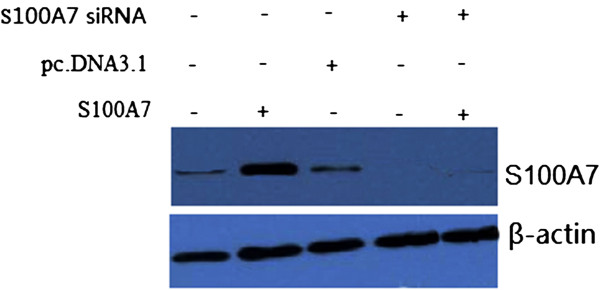
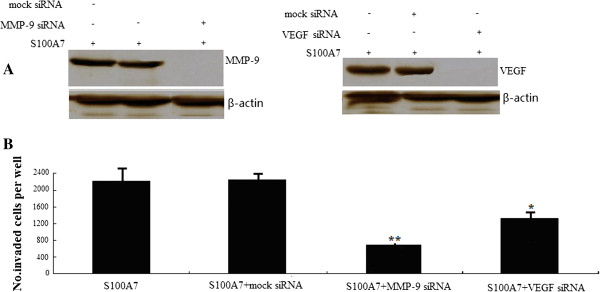
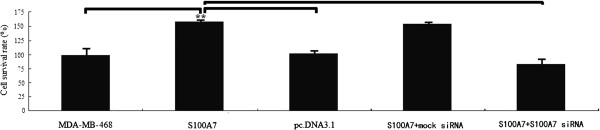
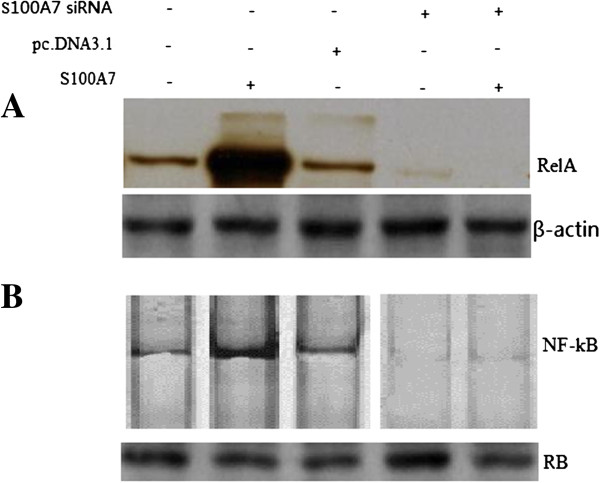
pcDNA3.1-S100A7 cDNA plasmid was constructed and transfected into the MDA-MB-468 cells. 4,5-dimethythiazol-2-yl)-2,5-diphenyl tetrazolium bromide (MTT) assay was used to detect cell proliferation, Matrigel was used to detect cell mobility and invasion in vitro.The MMP-9 and VEGF expression and levels was detected by western blot and ELISA assay. NF-κB DNA binding activity was detected by Electrophoretic mobility shift assay.
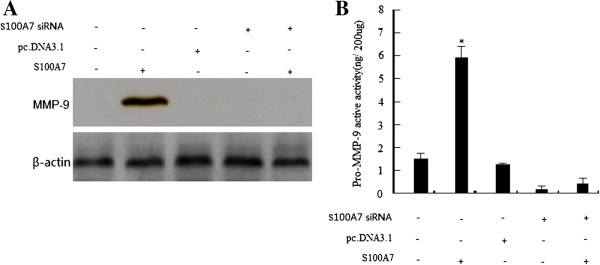
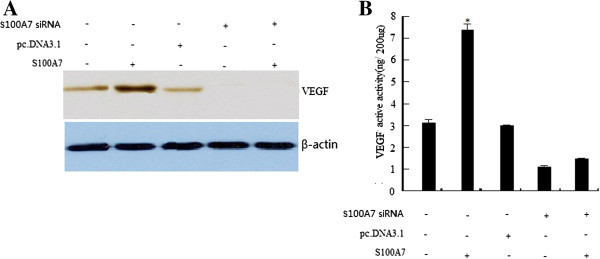
Up-regulation of S100A7 by stable S100A7 cDNA transfection increased cell invasion and proliferation, whereas downregulation of S100A7 by small interfering RNA in S100A7 cDNA-transfected MDA-MB-468 cells decreased cell invasion and proliferation. Consistent with these results, we found that the up-regulation of S100A7 increased NF-κB DNA-binding activity and MMP-9 and VEGF expression. Down-regulation of S100A7 in S100A7 cDNA -transfected decreased NF-κB DNA-binding activity and MMP-9 and VEGF expression.
Our data demonstrate that the S100A7 gene controls the proliferation and invasive potential of human MDA-MB-468 cells through regulation of NF-κB activity and its target genes, such as MMP-9 and VEGF expression. Down-regulation of S100A7 could be an effective approach for the down-regulation and inactivation of NF-κB and its target genes, such as MMP-9 and VEGF expression, resulting in the inhibition of invasion and growth.
S100A7 信号在人类乳腺癌的发病机制和进展中起着关键作用,但 S100A7 促进肿瘤侵袭的确切作用和机制尚不清楚。本研究旨在探讨 S100A7 过表达是否与 NF-κB、VEGF 和 MMP-9 的上调有关,从而促进乳腺癌细胞的侵袭和生长,反之亦然。
构建 pcDNA3.1-S100A7 cDNA 质粒并转染 MDA-MB-468 细胞。4,5-二甲基噻唑-2-基)-2,5-二苯基四唑溴盐(MTT)法检测细胞增殖,Matrigel 检测细胞体外迁移和侵袭。Western blot 和 ELISA 检测 MMP-9 和 VEGF 的表达和水平。电泳迁移率变动分析检测 NF-κB DNA 结合活性。
稳定转染 S100A7 cDNA 上调 S100A7 表达可增加细胞侵袭和增殖,而 S100A7 cDNA 转染 MDA-MB-468 细胞中 S100A7 的小干扰 RNA 下调则降低细胞侵袭和增殖。与这些结果一致,我们发现 S100A7 的上调增加了 NF-κB DNA 结合活性以及 MMP-9 和 VEGF 的表达。S100A7 cDNA 转染下调 S100A7 降低了 NF-κB DNA 结合活性以及 MMP-9 和 VEGF 的表达。
我们的数据表明,S100A7 基因通过调节 NF-κB 活性及其靶基因,如 MMP-9 和 VEGF 的表达,控制人 MDA-MB-468 细胞的增殖和侵袭潜能。下调 S100A7 可能是下调和失活 NF-κB 及其靶基因,如 MMP-9 和 VEGF 表达,从而抑制侵袭和生长的有效方法。