Department of Radiation Oncology, Massey Cancer Center, Virginia Commonwealth University, Richmond, Virginia 23112, USA.
Clin Cancer Res. 2013 Jun 15;19(12):3189-200. doi: 10.1158/1078-0432.CCR-12-3408. Epub 2013 Apr 25.
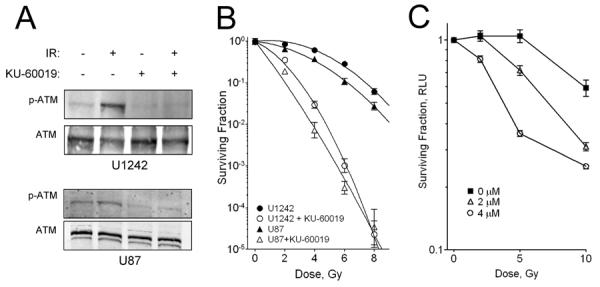
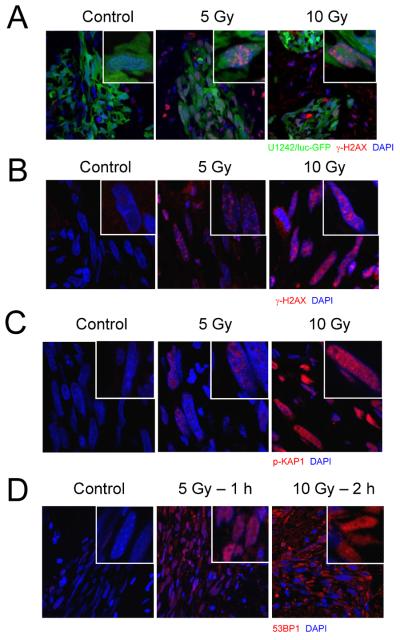
Glioblastoma multiforme (GBM) is the most lethal form of brain cancer with a median survival of only 12 to 15 months. Current standard treatment consists of surgery followed by chemoradiation. The poor survival of patients with GBM is due to aggressive tumor invasiveness, an inability to remove all tumor tissue, and an innate tumor chemo- and radioresistance. Ataxia-telangiectasia mutated (ATM) is an excellent target for radiosensitizing GBM because of its critical role in regulating the DNA damage response and p53, among other cellular processes. As a first step toward this goal, we recently showed that the novel ATM kinase inhibitor KU-60019 reduced migration, invasion, and growth, and potently radiosensitized human glioma cells in vitro.
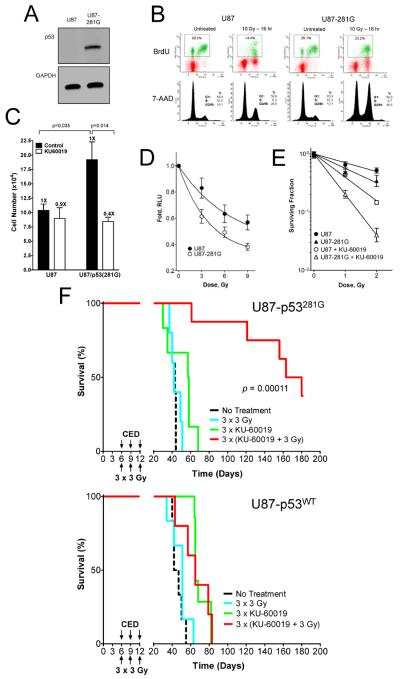
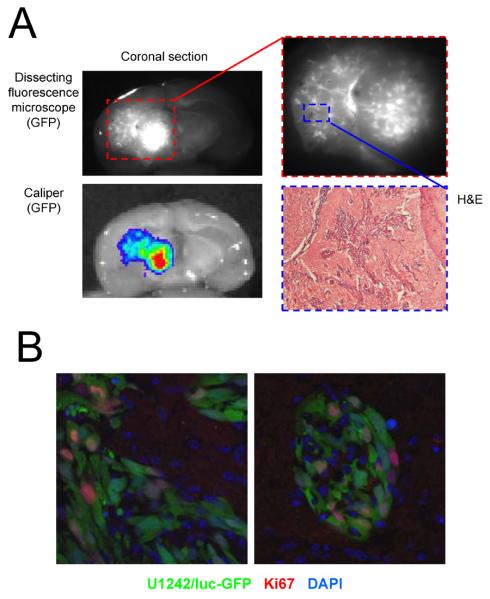
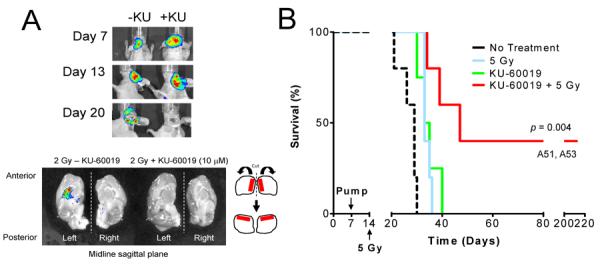
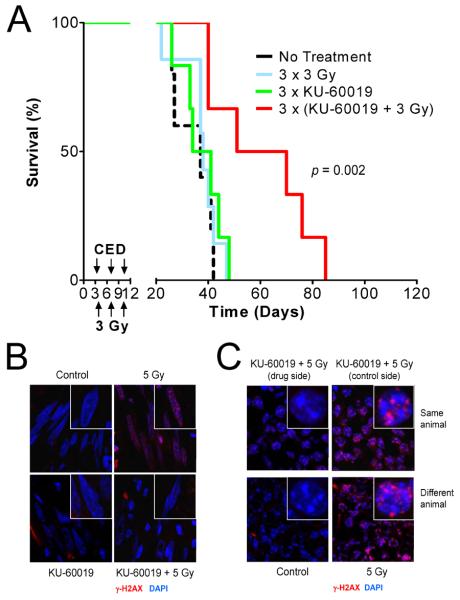
Using orthotopic xenograft models of GBM, we now show that KU-60019 is also an effective radiosensitizer in vivo. Human glioma cells expressing reporter genes for monitoring tumor growth and dispersal were grown intracranially, and KU-60019 was administered intratumorally by convection-enhanced delivery or osmotic pump.
Our results show that the combined effect of KU-60019 and radiation significantly increased survival of mice 2- to 3-fold over controls. Importantly, we show that glioma with mutant p53 is much more sensitive to KU-60019 radiosensitization than genetically matched wild-type glioma.
Taken together, our results suggest that an ATM kinase inhibitor may be an effective radiosensitizer and adjuvant therapy for patients with mutant p53 brain cancers.
多形性胶质母细胞瘤(GBM)是最致命的脑癌形式,中位生存期仅为 12 至 15 个月。目前的标准治疗包括手术加放化疗。GBM 患者的生存率低是由于肿瘤侵袭性强、无法切除所有肿瘤组织以及肿瘤对化疗和放疗的固有抗性。共济失调毛细血管扩张突变(ATM)是放射增敏 GBM 的理想靶点,因为它在调节 DNA 损伤反应和 p53 等细胞过程中起着关键作用。作为实现这一目标的第一步,我们最近表明,新型 ATM 激酶抑制剂 KU-60019 可减少迁移、侵袭和生长,并在体外显著增强人胶质细胞瘤细胞的放射敏感性。
我们现在使用 GBM 的原位异种移植模型表明,KU-60019 也是体内有效的放射增敏剂。表达监测肿瘤生长和扩散的报告基因的人胶质瘤细胞在颅内生长,KU-60019 通过对流增强递送或渗透泵颅内给药。
我们的结果表明,KU-60019 和辐射的联合作用使小鼠的存活率比对照组显著提高了 2 至 3 倍。重要的是,我们表明,携带突变 p53 的神经胶质瘤对 KU-60019 放射增敏的敏感性比基因匹配的野生型神经胶质瘤高得多。
综上所述,我们的结果表明,ATM 激酶抑制剂可能是突变型 p53 脑癌的有效放射增敏剂和辅助治疗药物。